‘Right now, we're in a desperate situation'
Emergency room patients at Whitehorse General Hospital,
By Jason Unrau on May 4, 2010
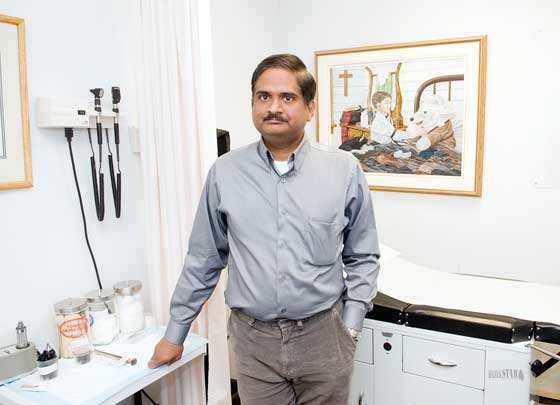
Emergency room patients at Whitehorse General Hospital, there to be treated for severe intoxication, are overwhelming doctors, burdening the system and, says Dr. Rao Tadepalli, endangering staff and other patients.
"Right now, we're in a desperate situation,” Tadepalli, the Yukon Medical Association (YMA) president, said today of what emergency room doctors face each day and the lack of a facility to handle the city's chronic substance abusers.
Tadepalli said there are 30 individuals who each year visit Whitehorse General's emergency room more than 200 times and use ambulances like taxis.
"Sometimes these individuals are coming in not once, but two and three times a day. This is quite a problem, and these individuals need help,” Tadepalli told the Star.
On average, one in four emergency room patients at Whitehorse General are severely intoxicated, Tadepalli added, which translates to between 15 and 20 such cases every day.
During the YMA president's emergency room shift Monday evening, six of his 20 patients were there for matters related to alcohol or drug abuse – unprecedented in his experience.
"And before I even (examined) anyone, I was going from one inebriated person to another.”
Following the December 2008 death of Raymond Silverfox in RCMP cells, after the 43-year-old Carmacks man vomited 26 times and was denied medical attention, new police policy requires an ambulance be called for detainees who throw up twice while in custody.
According to the RCMP, prior to Silverfox's death, the police called EMS or took a cells detainee to the hospital 174 times.
In 2009, that number skyrocketed to 417, and has surpassed 135 hospital visits or EMS calls for service fewer than five months into 2010.
This has added to the strain on hospital staff and patients, said Tadepalli.
"If somebody comes with a sore throat, a doctor can usually deal with that in less than 30 minutes,” said the YMA president. "Now if somebody comes in, throws up, has to be restrained ... that can take three or four hours to deal with.
"Some (inebriates) that come are very pleasant and polite, but others can get very aggressive, spitting, swearing ... causing a public nuisance,” Tadepalli described of what doctors are typically faced with in the emergency ward.
"If there are young children, adults, seniors in the public areas, we cannot function without the help the RCMP gives us by taking away people who are very abusive.”
While Tadepalli is grateful for the Sarah Steele (detox) Building, Salvation Army shelter and the RCMP, he said more must be done.
"We have a Band-aid solution at the moment. We just cannot send these people home ... even though it's not a medical facility, we are sending these people to the Salvation Army, detox or RCMP cells,” Tadepalli said. "But most of these individuals need some kind of monitoring. We cannot prevent all deaths, but at least we can make an impact.”
The YMA president today welcomed Health Minister Glenn Hart's pledge to form a task force of front-line agencies to address the problem.
"We're looking at having a committee struck with all the stakeholders involved right across the department, right across the government, including the Yukon Hospital Corporation, physicians and the general public to just ascertain what we need to do,” Hart said during Monday's question period in the legislature. "What types of facilities we need to look at, what types of facilities we already have and where we can utilize some of these.”
Hart was responding to NDP MLA Todd Hardy, who later asked if Hart would consider "wet shelters” – programs that allow alcohol on premises.
Hart would not immediately commit to such an idea, but acknowledged there is a gap in current services for the homeless drug/alcohol-addicted demographic.
Back at Tadepalli's office, the YMA president said a new approach is required, as things cannot continue as they are.
"These people need somewhere to go.”
Comments (5)
Up 0 Down 0
Kailey Irwin on May 4, 2010 at 10:41 pm
I think something that would really benefit Whitehorse would be a center similar to the Edgewood Centre in Nanaimo, BC. It's a treatment centre that operates on a lockdown system which has long term programs that last for about 3 months. After persons complete the 3 month detox under full supervision they move to a half way house on campus shared with others who have had similar troubles and stay there with slightly less supervision for a month. Once completed they move out on their own (note that we need more affordable housing first) and are required to attend 3 AA meetings a week and provide mentorship to those new to the centre to build a sense of community and understanding.
I think something like this would really benefit the Yukon and perhaps a budget to save up for something like this would be worth it. Not to mention it could also double for abuse victims, homeless who need job coaching, drunks, drug addicts, you name it. One large facility to accomodate it all. Plus they have the persons do community work as part of their rehabilitaion.
Up 0 Down 0
Nick Stoneburgh on May 4, 2010 at 11:46 am
With ALL the money and Self Government of the FN let them build, pay for and maintain a detox centre !
Up 0 Down 0
JC on May 4, 2010 at 9:00 am
Since most of these "troubled" people are FN, I think the government should tell the FN to set up their own 24/7 detox centre. If not, deduct the total cost from their government band allowances. These people pay nothing toward the system but use up most of it. Then they blame the white man when one of their people get hurt. Doesn't make much sense. And certainly not fair. By the way, I worked security at the Whitehorse hospital and know what Dr. Rao Tadepalli says is true. I too, had many tense moments dealing with these people. Personally, I would rather sleep with a Grizzly bear.
Up 0 Down 0
Donald McKenzie on May 4, 2010 at 7:44 am
It, sadly, does not truely surprise me, that the, "Dirty Dozen", I had mentioned while commenting on the inquest to Mr. Silverfox's death, is actually around 30 persons. Perhaps now is the time to begin discussions about ways to knock down the numbers.
One ways perhaps, is a rationing system, for alcohol. I understand in some nations, that is in effect. Perhaps tie it into a enhanced identification card. No ID. No booze. That may also have the added bonus of being able to ID, and ban troublemakers in bars.
Just a couple of thoughts.
Up 0 Down 0
Arn Anderson on May 4, 2010 at 7:23 am
So one of these clowns costs the taxpayers around $30,000 a year in hospital fees. Add that with Social Assistance, say $12,000 a year. Sum total of $42,000 in tax dollars down the drain. Now for the 'other' costs; detox center yearly budget, ambulance rides, RCMP man hours and trashed social housing homes. Wow, the yearly budget to keep these drunks alive almost comes out to $100,000 a year in tax dollars. This brings out the warm and fuzzy feeling outside from all of us, pfffftt.