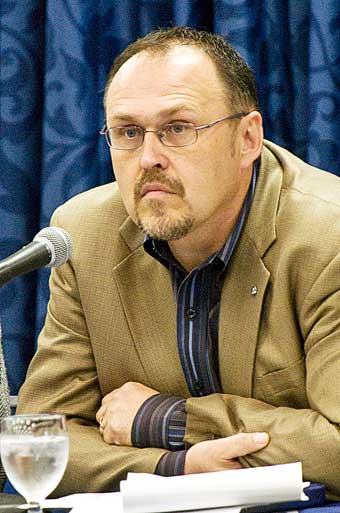
Photo by Whitehorse Star
Darrell Pasloski
Photo by Whitehorse Star
Darrell Pasloski
Despite two government reports and opposition MLAs calling for a new Pharmacy Agreement, local pharmacy owners say, not so fast.
Despite two government reports and opposition MLAs calling for a new Pharmacy Agreement, local pharmacy owners say, not so fast.
While the agreement expired 12 years ago, government and Yukon drug dispensers continue to adhere to the 1995 deal that set markup and dispensing fees - some of the highest in the country.
Outlined in September's Yukon Health Care Review, if the Yukon were to adopt British Columbia's model (the lowest in Canada), the territorial government could save $1.6 million annually on subsidies and consumers upwards of 30 per cent for all prescription drug purchases.
However, one pharmacy owner warned that if politicians think the government can save money by renegotiating the Pharmacy Agreement, they had better think again.
"For instance, the teachers, doctors, anybody dealing with the government, it's never a question of getting less, it's always a case of them getting more," Medicine Chest proprietor Jim Lindsay said in a recent interview.
"So you might say the pharmacists haven't had an increase in 11 years, and you might say that's unusual."
Lindsay said the cost of doing business has risen dramatically from 20 years ago when he bought the business, which remains the only independent pharmacy in the territory.
Pharmacists' salaries, for example, have increased upwards of 100 per cent, and Lindsay said perks like training opportunities he offers to attract and keep staff are an ongoing expense.
When asked if hashing out a new deal between pharmacy owners and the government might lower local drug prices, Lindsay dismissed the idea.
"I couldn't even answer a question like that," he told the Star.
"That's like going to Canadian Tire and asking them if they want less for their tires, or ask Wal-Mart if they want less for their merchandise. It's a loaded question."
Lindsay added that comparing drug prices in the Yukon to those in B.C. is unfair, and the territory's report writers should look at similar jurisdictions, such as the Northwest Territories.
There, pharmacies can add the same 30 per cent markup on prescription drugs, but are not charged the wholesalers markup (often as high as 14 per cent) that Yukon pharmacies are.
Darrell Pasloski, the owner of the Shoppers Drug Mart in the Qwanlin Mall, was involved in negotiating the 1995 agreement. He told the Star the Yukon's pharmacists have no control over wholesalers' markups.
"The numbers quoted in upcharges were misleading and incorrect," said Pasloski of media reports that Yukon pharmacists could mark up their drugs by as much as 44 per cent.
"The drug wholesalers, they are allowed to put a markup after buying from manufacturers ... that's how they make their money and what was being quoted was a combination of the fee structures."
As far as negotiating a new Pharmacy Agreement, Pasloski said if the government wants to sit down and talk, he would be willing to listen.
"I mean, that's not up for me to determine; the government has lots of priorities," he said.
Like Lindsay, Pasloski said wages are rising while the rates he and competitors can charge the government and consumers remain the same.
"In the last 13 years, pharmacists' wages have skyrocketed disproportionately more than other busineses and we've continued to absorb these higher and higher costs," he added.
The Whitehorse pharmacy owner and the territory's Conservative challenger in last October's federal election defended current drug costs in the territory. He said people need to realize the contribution pharmacists make towards lessening the cost of health care delivery.
"It's very easy to throw that out there, that we're paying too much for medication, but how much are we saving as a result of people taking their medicines?" he asked.
"Strong intervention by the pharmacists result in much more successful outcomes, and more pharmacist intervention plays a bigger role and results in lower burdens on our health care system."
In order to encourage thoughtful and responsible discussion, website comments will not be visible until a moderator approves them. Please add comments judiciously and refrain from maligning any individual or institution. Read about our user comment and privacy policies.
Your name and email address are required before your comment is posted. Otherwise, your comment will not be posted.
Be the first to comment