Photo by Vince Fedoroff
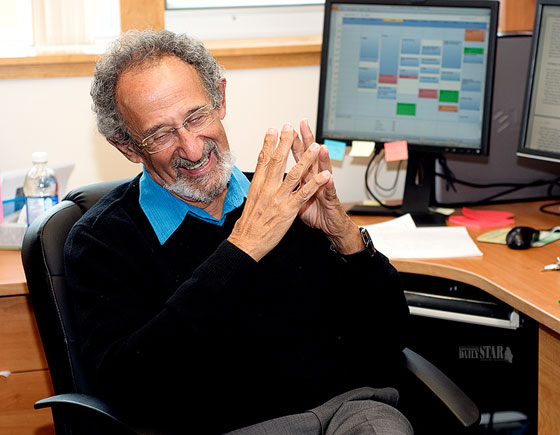
OUT OF RETIREMENT – John Wright, who retired from being the principal of Elijah Smith Elementary School at the end of the 2011/2012 school year, has taken over as the interim co-ordinator of YNTEP.
Photo by Vince Fedoroff
OUT OF RETIREMENT – John Wright, who retired from being the principal of Elijah Smith Elementary School at the end of the 2011/2012 school year, has taken over as the interim co-ordinator of YNTEP.
The Yukon Native Teacher Education Program (YNTEP) is back to full operation this year with 10 new first year students, and a new interim co-ordinator.
The Yukon Native Teacher Education Program (YNTEP) is back to full operation this year with 10 new first year students, and a new interim co-ordinator.
YNTEP did not accept any new first year students last year while a committee studied a review of the program and began the process of implementing its recommendations.
John Wright, the former longtime principal of Elijah Smith Elementary School, has taken over as the YNTEP co-ordinator for the year.
Wright retired at the end of the 2011/2012 school year, after 44 years in education. He's been involved with the four-year YNTEP program since the beginning.
"When I was vice-principal at Whitehorse Elementary in 1993, we hired one person from the first graduating class,” he told the Star in an interview last week.
"I'm an avid supporter of the program, and over the years at Elijah Smith, I was able, fortunate enough, to hire a great number of YNTEP graduates as teachers and specialists,” he said.
He didn't have to think too long before he accepted the offer to fill in as the interim co-ordinator for the next year.
"It's a home-grown, community-based teacher training program; that says everything right there,” Wright said, explaining his passion for the program.
"The whole point of the program way back in 1989, when it started, was to begin to develop teachers who had some kind of roots in Yukon teaching Yukon children.
"And that's exactly why I think it's such a powerful program,” Wright said.
While the program does accept non-First Nations students, a major focus is still First Nations' language, culture, and traditions.
"A large percentage of our students are of First Nations ancestry, so there alone is a major reason why we should be emphasizing a First Nations approach and content,” Wright noted.
"To me, that's the most important reason, but a secondary reason is we're all Yukoners.
"And I don't care who it is going through the school system, whether they're First Nations or not, they should be exposed to and have an understanding of and an appreciation of the Yukon, Yukon history, Yukon culture, Yukon First Nations, the whole picture. I think we're fairly unique in this country and our education system should reflect that uniqueness.”
YNTEP students graduate with a Bachelor of Education from the University of Regina and qualify for teaching certificates in both the Yukon and Saskatchewan.
Graduates are also eligible for certificates across Canada.
Over the next year, Wright will focus his energy on raising the program's profile.
He's meeting with principals, superintendents and school councils to share his views about the strengths of the program.
He's also begun talking to YNTEP graduates to find out about their experience in the work force.
"What I'm trying to get is a whole picture of YNTEP, what it was like at the beginning, what it's like now, what experiences the YNTEP teachers had or are having as they entered the school system,” he said.
Deb Bartlette, Yukon College's vice-president of Academic and Student Services, said the college is thrilled to have Wright as the interim co-ordinator.
"He just brings so much knowledge from having been a principal, having hired teachers, having worked with teachers, I think he can really bring a lot of benefit to our students,” she said.
"While he's just here for the year in the interim co-ordinator position, I'm kind of hoping that we might be able to entice him in the future to come back and work with our students in some way.”
Bartlette highlighted a number of key changes to the program this year, stemming from the implementation of recommendations made in the review.
An important difference is the transition from a skills-based first year curriculum, to one based on the philosophy of teaching. Students will focus more on specific skills in the later years of the program.
The college has also added some courses, including a senior class on the teaching of reading. As well, it's renewing its agreement with the University of Regina.
A new five-year agreement will be implemented, clarifying the college's governance role.
Bartlette noted that the college is also exploring the possibility of issuing its own degrees.
In the coming months, she'll also begin the search for a permanent co-ordinator.
The college is seeking someone of indigenous background with experience in indigenous teacher education at the doctorate level.
In order to encourage thoughtful and responsible discussion, website comments will not be visible until a moderator approves them. Please add comments judiciously and refrain from maligning any individual or institution. Read about our user comment and privacy policies.
Your name and email address are required before your comment is posted. Otherwise, your comment will not be posted.
Be the first to comment