Resources and indigenous well-being dominate discussion
A meeting of elected leaders from Arctic regions around the world descended on Whitehorse Tuesday to discuss the future of natural resources,
By Christopher Reynolds on September 10, 2014
A meeting of elected leaders from Arctic regions around the world descended on Whitehorse Tuesday to discuss the future of natural resources, community development and infrastructure expansion in the far North.
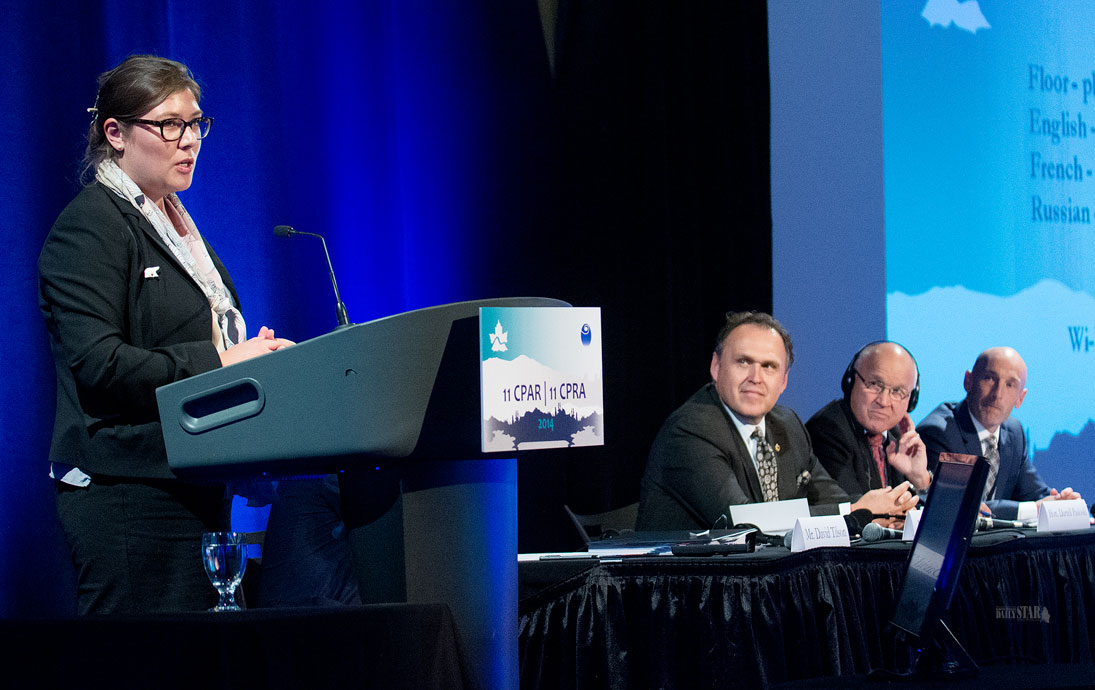
Danish member of parliament Sara Olsvig addressed roughly 70 delegates from eight member nations to set the tone for the 11th annual Conference of Parliamentarians of the Arctic Region.
Olsvig, the conference’s co-chair, stressed a balance between resource and infrastructure development on the one hand and social welfare and environmental protection on the other.
The gathering was overshadowed in part by yesterday morning’s announcement by the prime minister of the discovery of one of two ships lost in Sir John Franklin’s legendary and ultimately fatal expedition to seek a northwest passage.
Federal Environment Minister Leona Aglukkaq, scheduled to give the gathering’s keynote address, switched plans last minute to stay in Ottawa for the unveiling, leaving delegates one speaker down.
Olsvig, who lives in Greenland, said she envisioned “an arctic where development goes hand in hand with cultural integrity, protection of the environment and social welfare.”
She noted climate change has resulted in more extreme weather and melting sea ice, yielding natural resources and widening shipping lanes.
“This development makes the need for Arctic cooperation and good, sensible governance of the Arctic of vital importance.”
Olsvig also said that “well-being and a good life are not necessarily dependent on living in a larger ... settlement,” pointing out that students in smaller Greenland communities
receive on average better math grades than students from larger urban areas.
The Arctic Council, the intergovernmental forum behind the conference — and currently chaired by Canada — has established task forces to look at cooperation in areas like oil spill prevention.
Olsvig went on to assert the right of northern peoples to harvest and export responsibly their natural resources, including seal meat and fur — both banned as imports by the European Union.
“In my view, the issue of the seal product ban is not just a Canadian issue, or a Greenlandic issue,” she said. “It is an Arctic issue, which must be addressed and fought collectively.”
Yukon Senator Dan Lang took the point further: “We have to have economic development, we have to have jobs, because there’s no reason that a young person would stay otherwise.”
In a question-and-answer session, Lang asked Olsvig how governments and resource companies could begin to go “up against well-organized, well-financed (environmental)
organizations” that spend “hundreds of millions of dollars” on public relations campaigns.
He fretted their messages of green protectionism can “become a truth if they’re said enough times.”
Olsvig’s reply emphasized sustainable balance as well as her own “ambiguous relationship” to groups like Greenpeace, which put out both “good reports” and “quite one-sided” campaigns.
Mitch Bloom, a vice-president at the Canadian Northern Economic Development Agency (CanNor), spoke to infrastructure development and its dual role for local communities and broader economies and large companies.
“Infrastructure is the North’s lifeline,” he said.
The region — 40 per cent of Canada’s land mass — is remote and has minimal roads, Internet connectivity, energy generation and waste and water treatment, he reminded the delegates. Nunavut has no long-distance power transmission and no public road network to speak of.
As a result, “the cost of doing business in the North is exponentially higher than in other parts of the country,” he said.
Bloom pointed optimistically toward the 34 resource development projects currently working their way through the regulatory processes in the three territories.
Those projects represent more than 10,000 potential long-term jobs and a possible $25 billion capital investment in total, he estimated.
Rick Meyers, a vice-president at the Mining Association of Canada, also addressed infrastructure impediments to mining companies and residents North of 60.
Resource development is the North’s “primary economic advantage,” he said. “It helps communities become more self-sufficient.”
Meyers highlighted how hydro power in the Northwest Territories initially relied heavily on mining companies. Residents of Nunavut, where virtually all power is diesel-based, endure among the highest energy costs per capita in the country.
Most supplies to that territory arrive by sea lift, requiring construction of deep water ports.
Dennis Bevington, the Northwest Territories’ MP, cautioned that “mining development is not a panacea.”
He noted greater income disparity in regions with high development and cited a recent study on cost of living and income that shows “in a number of northern communities located within the mining region, the rate of poverty actually increased.”
Bevington also pointed out that while communities like Yellowknife and Dawson City may have launched on the backs of miners and mining companies, mining operations today tend to occur far from towns and cities.
“Most mines will be remote. When the mine goes, there really is nothing left. This is the new shape of mining,” he said.
“Diamond mines are not forever.”
Bevington observed that “authority and control (over lands and resources) is moving towards indigenous peoples,” citing more than two dozen court cases.
“It’s not good enough to be neutral toward future generations; we have to add to their chances for success. That’s
sustainability,” he concluded.
The conference of Parliamentarians of the Arctic Region continues today and tomorrow, and includes new U.S.
ambassador Bruce Heyman’s first visit to the Yukon.
Be the first to comment