Residents urged to ponder evacuation scenario
A wildfire burning in northern British Columbia could threaten communities along the Yukon/B.C. border,
By Jason Unrau on August 4, 2010
A wildfire burning in northern British Columbia could threaten communities along the Yukon/B.C. border, say officials, who this morning issued an evacuation notice to residents of Upper Liard and Junction 37.
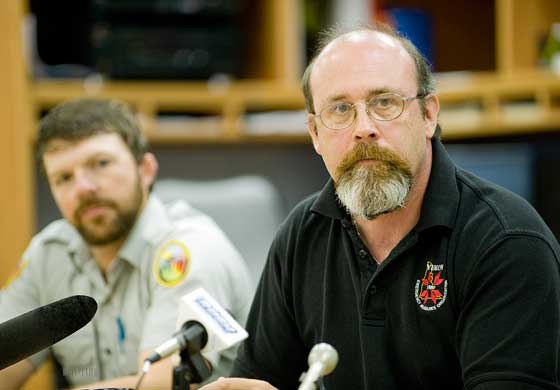
"It's a heads-up for people who live there ... if they had to leave, what would they grab?” Michael Templeton, director of the territory's Emergency Measures Organization (EMO), told a news briefing.
"Do they have pets or livestock (to consider)? Is there a full tank of gas in the car? So people should take a few extra moments to start thinking about that.”
The fire that has consumed 11,000 hectares of forest forced the closure of the Stewart-Cassiar Highway (37) ast Wednesday. It is approximately 25 kilometres from Upper Liard.
On Tuesday, authorities briefly opened the Stewart-Cassiar to allow a small convoy of stranded motorists through, but the highway remains closed today, and people are encouraged to take Highway 97 via Watson Lake.
While the hot weather is expected to break on Thursday with the arrival of a low pressure weather system, southerly winds could push the fire toward populated areas, said Yukon Wildland Fire Management officials.
And the change in atmospheric pressure increases the likelihood of lightning strikes – the number one cause of forest fires.
Ken Colbert, director of Yukon Wildland Fire Management, said there is no immediate threat to Upper Liard or Watson Lake, where the fire is between 30 km to 35 km away.
He said a "high level team” that includes the Yukon's fire marshall, EMO staff and firefighters is currently on the ground in Watson Lake assessing the situation.
"We brought our (wildland fire) crews home from B.C., and we're positioning them around the territory,” Colbert added.
Forty wildfires are currently burning around the territory but only two have been actioned – a small blaze in Whitehorse and one near the community of Ross River – and the prospect of new fires remains.
Fire crews and equipment are brought to bear on a wildfire only when person or property is threatened.
The fire danger rating is "high” in Carmacks, "extreme” for Haines Junction, Ross River, Watson Lake and Whitehorse, where the city has banned all open fires within municipal boundaries.
There are no fire bans for the remainder of the territory; however, the public is advised to exercise caution when burning as forecast conditions are hot and dry for much of the Yukon.
Watson Lake Mayor Richard Durocher said early this afternoon his community of about 1,600 people is prepared in the event citizens must evacuate, but to date, the town has not received any such direction.
"Obviously it's good to prepare regardless. We don't want people to panic, but we don't want them to be caught off-guard either,” Durocher told the Star.
Watson Lake has since offered assistance to Upper Liard and Junction 37 (both under evacuation notice), said Durocher.
The town would open its recreation complex for temporary housing in the event an order to evacuate was given to residents there.
In the absence of any health alerts from the Yukon government or the Watson Lake hospital, Durocher advised the elderly and those with respiratory issues to stay indoors.
"This is one of the worst smoke days we've had since this happened,” he said. "I don't have breathing problems, but I can sure feel it in my lungs.”
Comments (1)
Up 0 Down 0
Susan Maratos on Aug 14, 2010 at 7:25 am
A very informative and useful article.
Nice pic too. Good to see how our son George is looking in that far and away land.
Susan Maratos