Residents reluctant to embrace quarrying operation
Residents raised concerns about noise, dust and the loss of natural beauty at Wednesday night's public comment session on the proposed Steven's Quarry.
By Ainslie Cruickshank on November 23, 2012
Residents raised concerns about noise, dust and the loss of natural beauty at Wednesday night's public comment session on the proposed Steven's Quarry.
The concerns were consistent with those raised at the April 4 session earlier this year.
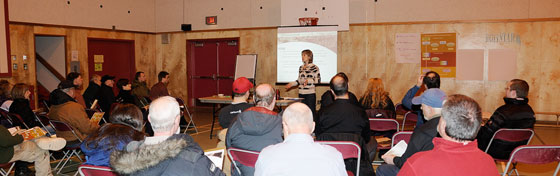
The meeting was hosted by the Yukon Environmental and Socio-economic Assessment Board and held at Hidden Valley Elementary School.
It began with a short presentation on the proposed project by Ben Campbell, a planner with the City of Whitehorse.
Campbell noted that gravel is essential for road and housing construction. And the city's need for gravel is growing steadily as existing sources are being depleted, he said.
Before the 30 or so residents in attendance broke into groups to discuss their key concerns, Campbell touched briefly on some planned mitigations.
Those included set backs and treed buffers, a coordination of crushing activities between lease holders and hours of operation that follow the city's maintenance bylaw, between 7 a.m. and 11 p.m.
The proposed access road from the Alaska Highway, which would be about two kilometres long, would be treated with BST to minimize dust and the city has developed a spill contingency plan, he said.
Concerns raised at the meeting fell into the three broad categories of noise, dust and natural beauty.
Under noise, concerns were discussed about crushing activities, and the potential health effects on residents and animals, both pets and wildlife. One group noted the area is termed "echo valley” for a reason.
Residents said they wanted certainty about quiet time and 5 p.m. was suggested as the evening work limit.
Suggested mitigations included leaving the government parcel undeveloped, and ensuring the equipment in use is modern and efficient. A specific limit on decibels was also suggested.
The possible health effects of dust were discussed and residents suggested frequent watering of the quarry to minimize dust.
There were also concerns about the effects on ecotourism and the loss of beauty in the area.
There were suggestions that the project could be undertaken in a progressive fashion, working smaller sections at a time and reclaiming those areas before undertaking work in subsequent portions.
Overall there seemed to be support for a broader "accumulative effects” study on the project.
Some residents suggested expanding existing quarries or finding an area where the social impact would not be as significant, noting that the environmental impacts are inescapable.
The proposed aggregate quarry (meaning no blasting) would be approximately 120 hectares and would contain five pits.
Four of those pits fall in line with land use designations in the Official Community Plan, but the fifth would require an amendment, Campbell said.
One of the pits would go to the Kwanlin Dun First Nation, fulfilling a commitment outlined in the First Nation's final agreement.
A second pit would be developed as a City of Whitehorse and Yukon government pit. And two parcels would be privately leased, with the potential of a third lease if the fifth pit is approved.
Under current estimates about 2.34 million cubic metres of sand and gravel would be extracted from the quarry, with about 100,000 cubic metres anticipated per year. It's expected extraction work would commence in 2013 and continue until 2025.
The Yukon government would collect a 10 cent per cubic metre royalty and a 15 cent per cubic metre rehabilitation fee that the company could repossess after reclamation, said Pat Ross, the city's acting planning manager, in an interview at the meeting.
Ross noted that the quality of material in the quarry is not what was hoped. There's a lot of sand, he said.
The city had hoped there would be at least six private leases, now only two are proposed.
About 60 test pits have been dug at Steven's Quarry since the 1970s and the project plan was first proposed in 1994. But Campbell noted it was abandoned at the time because of public concern and a proposed neighbourhood.
The comments made during Wednesday's meetings will be summarized and given to the City of Whitehorse. The city then has to provide an official response.
A petition is also circulating to prevent development of the proposed quarry.
The YESAB period for public comment closes on Nov. 30.
Be the first to comment