Photo by Stephanie Waddell
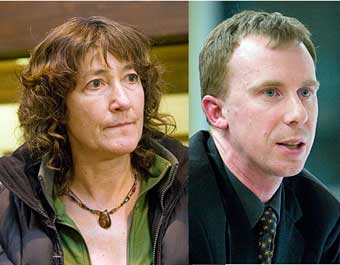
Karen Baltgailis and City Planner Mike Ellis
Photo by Stephanie Waddell
Karen Baltgailis and City Planner Mike Ellis
Whether you believe Whitehorse should have taller buildings, denser neighbourhoods, more green space or not,
Whether you believe Whitehorse should have taller buildings, denser neighbourhoods, more green space or not, the city's mayor and planning officials have been encouraging residents to have their say on the city's proposal to revise the Official Community Plan (OCP) by today's deadline.
The OCP acts as an overall long-term planning document for the future of the city that is reviewed every five years or so.
After a series of public meetings held last year, city planners have put forward a draft revision that includes 58 changes to the current plan.
While this afternoon marks the official deadline for commenting on the draft, city planner Mike Ellis hinted in an interview Tuesday that residents also have the long weekend to come up with their suggestions and input on the document. That's because he won't likely begin reviewing the input in detail until after the Easter weekend.
"There's a variety (of comments coming in),” he said. While he didn't have full tally, he usually arrives at work in the morning to find at least 15 e-mails about the OCP.
"McIntyre Creek is probably the biggest issue to date,” Ellis added.
Many, such as the Friends of McIntyre Creek and the Yukon Conservation Society, have spoken out against proposals that would impact the creek.
This week, in fact, the conservation society submitted a 17-page document detailing its position on the draft OCP. It included its own suggested greenspace map for the city.
Several of the suggestions that came forward were centred on McIntyre Creek.
"If ATCO develops its private property behind Raven's Ridge and across the highway right along the creek into residential, and Porter Creek D is developed, wildlife movement in this vital east-west corridor will be cut off,” reads the submission by Karen Baltgailis, the conservation society's executive director.
"In addition, the ATCO property across the highway from Raven's Ridge appears to be directly in the wetland – it is too ecologically sensitive to be developed.
"The land on the north side of Fish Lake Road where it intersects the highway is extremely steep, so does not provide for wildlife movement.
"At the very least, ATCO needs to be prevailed upon to leave generous buffers between housing developments and the creek. Porter Creek D would be extremely bad for wildlife movement and recreation, and should not be built.”
The submission notes discussions are taking place between the territorial government and Yukon College about the land between the school and Alaska Highway that's shown as future development.
"City planners have told us that Yukon College's plan is not to develop this whole area but to have a mix of development and greenspace,” reads the submission.
"This needs to be clarified in the OCP. It would make sense for the OCP to state that the goal of this area is to maintain viable habitat for research and instruction purposes, as well as for recreation, by maintaining wide protected areas along the creek and wetlands, and respecting the current trail system.”
The OCP should also state that the college's future development should primarily be directed to Mountainview Drive and in areas that are already disturbed.
"Full public consultation is needed before any development is done by Yukon College that would impact McIntyre Creek habitat and recreation.”
Baltgailis also takes issue with the draft OCP specifically referring to the proposed Pine Street extension and a road connecting Mountainview Drive with the Alaska Highway, though there are clauses in the draft that would allow for both.
"It is important for the OCP to note the extreme opposition to this concept,” Baltgailis wrote. "The many letters responding to the YESAB (Yukon Environmental and Socio-economic Assessment Board) assessment of Phases 1 and 2 of Whistle Bend subdivision need to be considered input into the idea of such roads.”
The roads weren't proposed as part of the application for the first two phases of the city's next major residential subdivision of Whistle Bend in Porter Creek's lower bench.
However, a study in the application noted there will likely be a need for the new roadways once certain population figures are reached for the new subdivision if traffic patterns remain the same.
The society's document lists a number of issues and ideas for the OCP from having more public input on green spaces in the city to clarifying exactly what the citymeans in its proposed policy to encourage recycling materials that can be "economically reused” through a diversion credit.
While criticizing and arguing in favour of further measures to protect the environment, the society praises the city in other aspects.
"The City of Whitehorse is to be commended for listening to some important issues that have been raised by the Whitehorse public, and trying to address them,” Baltgailis began in the society's comment to the city. She cited the greenspace network plan included in the OCP as an example, though noted there are some serious concerns about it.
"A moratorium on mineral staking within Whitehorse city limits is also much needed to avoid conflicts with other uses of the land,” it continues.
Moving toward zero waste, protecting water resources, raising building height limits, allowing more residential units in existing neighbourhoods and encouraging public transit and active transportation are all consistent with the goals of a sustainable community, the submission noted before it went on to the many recommendations.
Ellis said the city has "definitely heard support” in some cases for the document, particularly in proposals that support sustainability and promote the inclusion of social housing in a variety of zones.
One of the biggest challenges is that many people want more detail in the document that's designed as more of an overall plan for the city.
While the OCP acts as more of a guide for city planning, it's zoning bylaws and other such documents that get into the details of what can happen on a property.
Many have told the city it's hard for them to support a document when there are no details.
Mayor Bev Buckway said Wednesday most comments have gone directly to the planning department – which will present them in a report to council – but her office has seen upwards of 50 coming in.
Pointing to a number of comments about development in the city, Buckway argued that at some point, residents will have to "shake off the shackles” around the idea that they can look outside their home and not see a neighbour.
Whitehorse, she said, is growing, and the city should be proud that people want to make their homes here.
At the recent Partnering for Success conference workshop, Buckway said she heard clearly there's a need for entry-level housing. That means finding areas close to established infrastructure to develop for residential homes.
In the comments she's seen, there hasn't yet been a lot of input from the business community, she added.
Anyone looking for a copy of the proposed OCP can obtain it at city hall or by visiting the city's website at www.city.whitehorse.yk.ca.
Comments can be made by e-mailing ocp@whitehorse.ca.
In order to encourage thoughtful and responsible discussion, website comments will not be visible until a moderator approves them. Please add comments judiciously and refrain from maligning any individual or institution. Read about our user comment and privacy policies.
Your name and email address are required before your comment is posted. Otherwise, your comment will not be posted.
Comments (4)
Up 0 Down 0
Max on Apr 8, 2010 at 4:58 am
The City uses the "consultation" process to justify what it wants to do.
Residents of established residential neighbourhoods like Riverdale do NOT want infill. That was made clear the last time the city tried to impose infill.
The majority of residents do NOT want taller buildings, especially in the downtown core or residential areas.
Water metering may work for the CoW, but it will undoubtedly make water use much more expensive without any significant reduction in water usage. These costs will be passed onto residents primarily.
City PR wizards throw around words like "vibrant" and "sustainable" as though a "denser" city automatically brings these things. We live in the Yukon, not downtown Vancouver. Good luck with that . . .
Up 0 Down 0
D G on Apr 5, 2010 at 10:42 am
Well said yukoner4life, I'm in the same boat as you. I managed to get into a mobile home myself. But even if I did sell it (realtor priced it at 25000 more than I paid 3 years ago), where do I move to. No mid priced homes to speak of. I hear of HOUSES (ie not renovated 70's era mobile homes) that were priced around 150000 several years back where did they go... Also I have a kid you can't really have kids in condo's and apartments she loves to jump and stomp her feet. I don't want agravated neighbors.
Up 0 Down 0
yukoner4life on Apr 2, 2010 at 5:27 am
I was born and raised in the Yukon. I work and live in the Yukon, but as a 24 year old with a good job. I can't even think about buying in this market, because of WAY overpriced housing. I love it here and i will always love it. We have to face the fact that Whitehorse is growing in population which means we need to make our city larger. I'm totally for taking the right steps and making sure everything is done right, but there isn't very many places to develop other then the areas that already exist. The terrain in Whitehorse dosen't allow for many other places to build subdivisions. It's a shame to think I may have to move away from my home town because I can't buy anything here.
I don't know how many other people feel the same way, but i just had to say something. thank you for listening.
Up 0 Down 0
JC on Apr 1, 2010 at 8:54 am
With all the Quebecers, immigrants and fraud refugees Liberal MP Larry Bagnell is bringing into the territory to shore up his pension, Whitehorse might as well have denser neighbourhoods. They are used to it anyway. No point in changing their traditions and culture. Its our job now to change ours to satisfy theirs. By 2012 we Yukoners will be in the minority. The greenies better wake up to future or move their tents to the Arctic circle.