Research forest work branching into several areas
Haskaps, alfalfa and compost – oh, my!
By Stephanie Waddell on August 7, 2014
Haskaps, alfalfa and compost – oh, my!
More than 100 Yukoners turned out early Wednesday afternoon to the Gunnar Nilsson and Mickey Lammers Research Forest for barbecued burgers (veggie or locally sourced beef) and drinks.
It was also a chance to take in the Yukon government’s test plots used to examine agricultural growth in the territory.
The open house is hosted each year to update residents about the research work being done.
As it was noted Wednesday by many who work in the agriculture branch or have attended the annual event in the past, there appeared to be a record attendance at the event.
That comes after increasing crowds of about 80 at the event for the past five years or so.
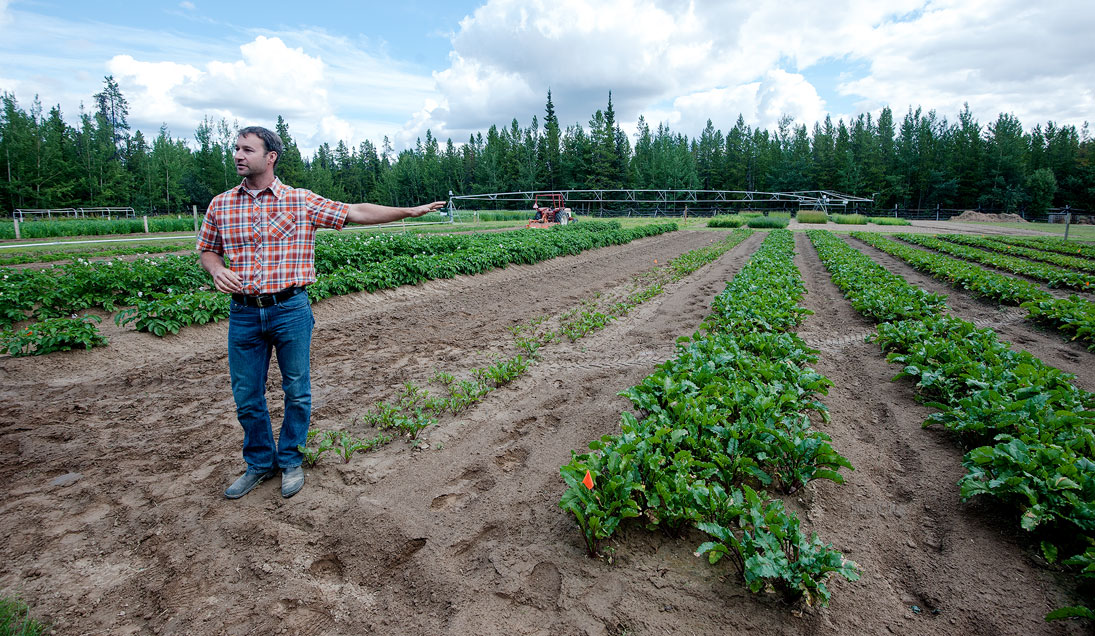
The blossoming interest in local growing was evident as visitors took in a tour led by agrologist Matthew Ball along with agriculture branch director Tony Hill and agriculture research technician Bradley Barton over the piece of land, which is just under one hectare.
Standing at each test plot, Ball outlined exactly what growth was happening and the research around it.
He began by noting the beets growing in a large plot in the central area of the site.
Research there is looking at how synthetic fertilizer compares with natural fertilizer, with there appearing to be a good crop this year on both sides.
As Ball talked about the ongoing research on each part of the site, he also provided useful advice to local gardeners.
“Make sure you mend your soil,” he said, pointing to different areas showing differing growth of the beet greens.
He pointed to the need to think about fertilizers and compost in ensuring there are enough nutrients in the ground.
Insects can also be an issue, Ball said, pointing to a few leaves springing up from the ground that have seen an obvious issue with insects.
On the test plots, insecticides and pesticides aren’t used to treat the produce grown there, he said.
Beets grown at the site this year will go to the Whitehorse Food Bank to be distributed among its clients. Last year, the agriculture branch provided 50 kilograms of snap peas grown at the site to the food bank.
A number of potato varieties have also been planted this year in an effort to look at how well different types will grow in the area and what the market may demand.
As he noted, looking at market demand is not only about considering the amount of potatoes various varieties can produce; it’s also about looking at taste and what people want.
The potatoes will likely be featured as part of the annual North of 60 Banquet held in the late fall which features Yukon-grown food prepared by local chefs.
Ball noted this year’s crop of potatoes was already set back once due to a frost, an issue that’s standard for anyone growing potatoes in the North.
A discussion among the tour group on how to deal with frost noted a number of methods such as watering in order to heat the soil overnight and using row covers, which also helps in keeping insects out.
As one person pointed out, they can also simply be left in the ground for a time following a frost.
The potatoes won’t be damaged by the frost if left there, but bringing them out during a frost can make them mushy, Ball explained.
A fruit orchard on the site includes haskap berries, black currants and apples.
As Hill pointed out, the apples come from a root stock of a Siberian crab apple tree, with the more edible apple stock grafted to the top of the tree.
“We’ll see how long they’re going to last,” he said.
The currants and haskap berries are seeing much more success with a number of haskap commercial growers also producing the fruit that can be described almost as a cross between a blueberry and grape.
The hardy haskap berries stock that can survive in temperatures down to -50 C can also be harvested in early August, proving beneficial for the territory, says Hill.
While much is learned through the growth at the test plots, the fruit orchard has also served up a gentle reminder of a gardening basic with one plant.
Pointing to a row of dwarf cherry plants, Ball noted the first plant has been slow to grow and isn’t doing well. He pointed to the sign in front of it that describes the fruit orchard, a reminder to think about what might get in the way of allowing sun to get to garden plants.
Another test plot is being used to compare different types of organic compost – the city’s, a farmer compost, bonemeal, potash and fishmeal.
Ball wisely advised local gardeners not to use fishmeal at home due to the risk of bears, pointing out this marks the first year a bear has come through the test plots.
While results are expected to provide a good idea of the different effects of compost; the agriculture branch isn’t expecting to learn much from another experiment that’s seen half of one plot cut its irrigation while the other side be provided with regular irrigation.
“Unfortunately (for the experiment), this year, it’s rained all the time,” Ball said.
The experiments and projects are a few of many that have been done over many years.
This morning, Ball explained most crops grown there are in place for at least four years, allowing time for the produce grown to have good, bad and average growing seasons to get a good sense of how it does in that climate.
Certain areas – such as the berry orchard – exist in perpetuity, though different plants are taken out if they’re found they don’t produce.
An agriculture resources committee made up of five representatives from the industry, as well as Ball and Barton representing the government, plan what will be researched at the site.
It’s done in an effort to support the industry and learn more about food production in the territory, he noted.
Also on-hand at Wednesday’s event was the Yukon Agricultural Association, offering information on the association and pointing to services such as its rental equipment.
The territory’s mobile abattoir was also at the site, with Graham Rudge offering tours of the facility, deemed a certified inspection facility.
Be the first to comment