Reports offer snapshot of social, economic issues
Yukon Government reports released Wednesday paint the most detailed statistical picture of poverty and homelessness the Yukon has ever had, say the people behind their creation.
By Justine Davidson on December 23, 2010
Yukon Government reports released Wednesday paint the most detailed statistical picture of poverty and homelessness the Yukon has ever had, say the people behind their creation.
The first – Dimensions of Social Inclusion and Exclusion in Yukon, 2010 – is based largely on numbers from Statistics Canada and filled out with information gathered during a household survey done by the Yukon government last summer.
It gives a comprehensive description of everything from how much Yukoners are earning to how far we commute and whether we vote.
These social indicators were chosen because they reflect people's level of participation in their community, according to senior statistician and report author Rachel Westfall's introduction.
"Using a social inclusion lens, we must consider whether people have access to society's assets,” she writes.
"... We also need to consider whether people have access to participatory activities,” as well as identifying barriers such as lack of education living in a remote area without transportation.
It reveals some troubling disparities, such as the fact that although Yukon brags one of the best-educated populations in the country (82 per cent of us have completed Grade 12 and two-thirds have medium to high literacy), a whopping 41 per cent of aboriginal men haven't graduated from high school. And only six
per cent of aboriginal men have a university education, as opposed to the 25 per cent of non-aboriginal men.
It also shows that although women in the Yukon generally have a more education than men, they earn considerably less, and the gap is widest at the highest level of schooling.
Overall, Yukon women earn 11 per cent less that Yukon men, but women who have graduated from university earn almost 24 per cent less than men with the same education.
Part of that disparity is likely due to the stay-at-home-mom factor, as 39 per cent of women say it is difficult to work or go to school because of child care responsibilities, compared to just 11 per cent of men who said the same thing.
As with all Canadians, Yukoners with less education are more vulnerable to a host of issues: They earn less, they are more likely to be overweight, and suffer from mental and physical health issues, and they are less likely to participate in community activities ranging from sports to voting.
The second report expands on the challenges facing lower-income Yukoners. It is a snapshot of Whitehorse residents who are homeless, vulnerably housed or at risk of housing challenges.
The 2010 Whitehorse Housing Adequacy Study is not representative of the whole population, as the Dimensions report is, but rather focuses on those with the greatest need for affordable or supportive housing and living in the capital city.
Of the 748 people who filled out the survey, 107 were either homeless or living somewhere temporarily without paying the rent. Of the remaining 641, the vast majority (86 per cent) are renters.
While most of those renters are living in a rented apartment, trailer, house or room, seven per cent were living in hotel or motel room and almost 11 per cent were in subsidized housing.
The report bears out the hot topic of this month's Whitehorse Centre byelection, showing that more than 30 per cent of respondents live downtown, and a further 17 per cent live in neighbouring Riverdale.
This is a typical finding, as people who access social services generally live in the city centre, where the most services are offered.
When people were asked what the best thing about their residence was, 36 per cent said location, with half of those people saying they valued their home because they were "quiet, clean, safe, good for kids.”
Responses to the same question ranged from: "The best thing is my beautiful yard. I work hard on my flowers and garden. I like to have my coffee out there;” to: "It's still in one piece.”
Fifty-eight people went no further than saying, "It's a roof over my head.”
Improvements or repairs were a major concern, as 307 respondents said the first thing they would change about their housing would be better facilities, repairs or upgrades.
For some, it was a cleaner yard or more bedrooms, while for others, it was essential utilities.
"I wish I had the basics for a home,” said one respondent, "like running water, electrical sources and an indoor bathroom. Basic amenities.”
Sixty-one per cent of people identified one or more concerns they had about the condition of their homes, with mould, mildew and dampness being the number one complaint and plumbing problems coming a close second.
"I would like to have a landlord who would fix things so I don't have to live with mould and a saggy ceiling in my basement,” one respondent said. "I don't like to be told there is no problem when there obviously is a problem.”
However, more than half the respondents (55 per cent) said they would rate their housing as OK, good or excellent.
Most people said they had financial concerns, and 57 per cent said they sometimes run short of grocery money.
Sixty-five per cent of people said they are kind of or very limited in their housing options, and finding an affordable place was the number one barrier – being unable to pay the damage deposit and down payment was also a common problem. Half of the respondents said it is hard to find any vacancies at all.
A vast majority (almost 81 per cent) of people surveyed are spending more than 30 per cent of their income on housing.
"Housing costs are considered excessive” when they exceed 30 per cent of the household income, the report states.
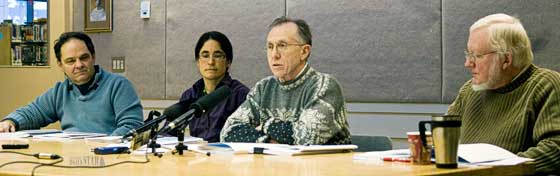
The intention of both reports is to help inform a housing strategy for the territory, Mike McCann, the director of the Yukon's social inclusion and poverty reduction office, said at a press conference Wednesday.
Both reports are available online at the Yukon government website and paper copies are available on request from the Department of Health and Social Services.
Public meetings are in the works, and will help inform a government housing strategy scheduled for release in the late spring or early summer of 2011, McCann said.
See related story below.
Be the first to comment