Report released into double-fatality plane crash
The Transportation Safety Board (TSB) has released its Air Transportation Safety Investigation Report regarding a fatal plane crash last May in Whitehorse.
By Gord Fortin on December 17, 2019
The Transportation Safety Board (TSB) has released its Air Transportation Safety Investigation Report regarding a fatal plane crash last May in Whitehorse.
The report addresses the pilot’s use of the wing flaps, and his decision to maintain a take-off manoeuvre when the aircraft was not climbing sufficiently.
The report began with a rundown of the events that led up to the crash.
The privately-owned four-seat Cessna 170B crashed near the Erik Nielsen Whitehorse International Airport last May 27.
The accident killed the two male occupants. Charles Eric Benson, 56, and Jeffrey Brian Babcock, 58, both from Alaska. Babcock had been the pilot.
The Cessna was registered to Benson. According to the report, both men were commercial pilots.
The pair had flown to Minnesota to retrieve the plane and fly it to Anchorage, with each taking turns piloting it.
The plane had experienced some issues with its controls during a take-off in Minnesota, so that take-off was abandoned. Investigators could not find the source of this issue.
On May 25, the men flew from Minnesota to Coutts/Ross International Airport near Coutts, Alta. They had made four stops on this leg of the trip, and flew for 14 hours that day.
The next day, they flew to Fort St. John, B.C. They made two other stops and and flew for 12 hours.
On May 27, they flew to Whitehorse, with stops in Fort Nelson and Watson Lake, where the Cessna was refuelled. They spent 11 hours in the air that day.
According to the report, Benson and Babcock intended to fly to Anchorage after refuelling in Whitehorse.
At 5:20 p.m., Babcock was ready to take off. The plane was fuelled and the flight path was filed. He was cleared for take-off eight minutes later.
The plane left Taxiway F toward Runway 14R and began its take-off.
The craft first left the ground with 5,800 feet of runway left. The plane was put in a right-wing-low attitude, which was maintained throughout the take-off. The Cessna slowly climbed.
The aircraft began an uncommanded descent 50 feet into the air and with 900 feet of runway remaining.
The Cessna hit the ground at 5:30 p.m., 150 feet from the end of the runway, near Perimeter Road. The plane bounced and veered past the airport’s fence.
It stalled, which caused the left wing to drop. The aircraft’s stall warning horn sounded at this point.
The pilot was able to recover for a moment, which stopped the horn.
The plane stalled again. It rolled to the right and went off its flight path.
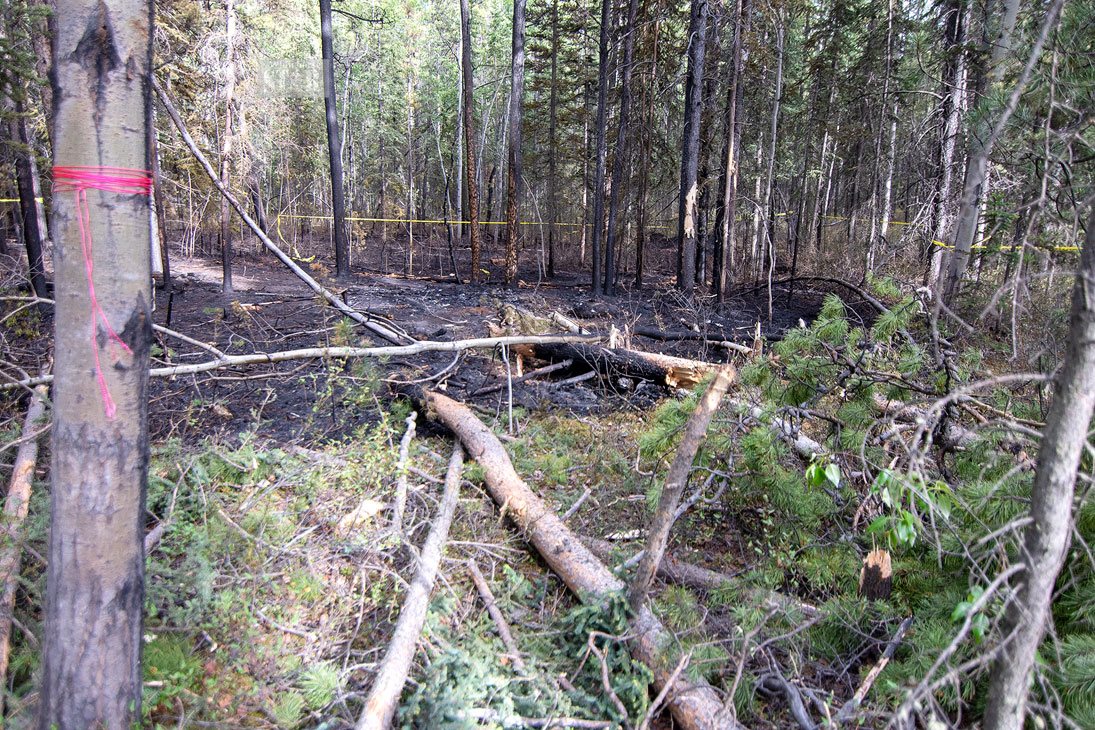
It crashed in a wooded area, and was severely damaged.
“An on-board video recorder continued to record both audio and video after the aircraft came to rest,” the report said.
The plane still had electricity after the crash, and it caught fire not long after impact. The fire consumed the plane.
Although both men died, the emergency local transmitter was turned on.
The report touched on the weather conditions at the airport at 5 p.m. It was 24 C, with a few clouds at both 8,000 feet and 13,000 feet above ground level. The wind was 12 knots and gusting to 19 knots.
According to the report, the Cessna’s last 100-hour engine inspection had been performed on Aug. 7, 2018.
Another inspection was done before the purchase, on May 5, 2019. Investigators obtained a letter from the inspector which stated the engine’s cylinder compression was 72/80 psi, which was acceptable.
“Records indicate that the aircraft was certified, equipped and maintained in accordance with existing regulations and approved procedures,” the report said.
As for the two men themselves, Benson had been a helicopter pilot in the U.S. military and held a commercial pilot certificate. He was certified to fly single-engine land, rotorcraft - helicopter and to operate airplane and helicopter instruments.
He had recorded 1,400 hours of flight time. Most (1,240 hours) involved flying helicopters, while the remaining 160 hours involved flying a single-engine fixed-wing plane.
Babcock had held a U.S. commercial pilot certificate. He was rated to fly a single-engine land plane, single-engine sea plane and operate airplane instruments. He also was rated as a flight instructor.
The logbook was lost in the fire. Investigators learned from Babcock’s employer that he had amassed 9,563 hours in the air. They also learned he had been experienced with multiple Cessna aircraft.
Some documents and a video recorder were recovered from the wrecked plane. The recorder was sent to Ottawa for further analysis at the TSB Engineering Laboratory.
The engine was examined at the scene. This confirmed there had been compression in the engine’s cylinders.
“Due to the impact damage and the post-impact fire, the investigation could not conclusively identify any issue that would have prevented the engine from producing full power,” it said in the report.
A video of both the take-off from Watson Lake and Whitehorse was found on the recorder, and compared.
The Watson Lake take-off saw the Cessna performing at a propellor speed of 2,360 r.p.m. In Whitehorse, it was 2,230-2,241 r.p.m.
The fire made it impossible to determine the plane’s weight at take-off in Whitehorse.
That said, investigators collected some information to estimate that the gross weight had been 2,200 pounds.
Based on the aircraft’s performance chart, the plane, with its flaps up, needed 936 feet to become airborne from the Whitehorse runway and 2,340 feet to “clear a 50-foot obstacle.”
At the estimated weight, the Cessna should have climbed 580 feet per minute.
“The aircraft used about 1,600 feet to become airborne and never climbed above 50 feet during the entire take-off,” the report concluded.
The plane’s flaps were set to 40 degrees. They dropped to 30, then 20. This would have increased drag, according to the report.
“The Cessna 170B owner’s manual clearly states that the use of the flaps at higher-density altitudes is not recommended,” it said in the report.
“It is important to follow the aircraft manufacturer’s recommendation to ensure the aircraft performs as designed.”
Investigators could not determine why Babcock maintained the take-off as the wind slackened and it became clear the plane could not climb.
“If the aircraft is not performing as expected during take-off and there is sufficient runway remaining to bring the aircraft to a stop, pilots should consider discontinuing the take-off,” the report said.
Be the first to comment