Report recounts fatal 2006 derailment
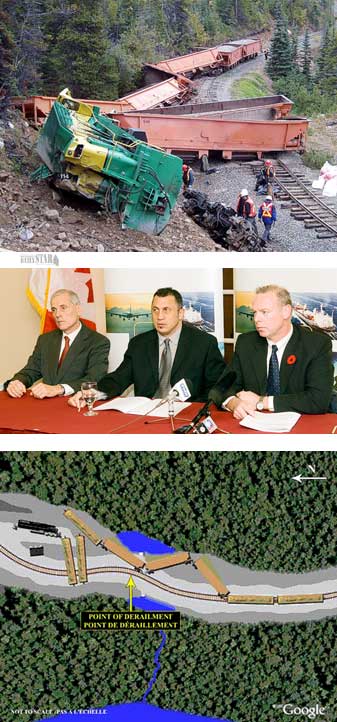
The Transportation Safety Board of Canada has released its findings in its investigation of the Sept. 3, 2006 White Pass Yukon Route train derailment.
By Stephanie Waddell on November 6, 2008
The Transportation Safety Board of Canada has released its findings in its investigation of the Sept. 3, 2006 White Pass Yukon Route train derailment.
The derailment killed a Carcross man and left other crew members injured.
The train was overloaded and suffering from a diminished brake system with a crew of employees who were without the proper guidelines and training, the report concluded.
"It's a combination of factors," Terry Toporowski, the board's regional senior investigator in the railway and pipelines branch, told reporters this morning in Whitehorse.
Those factors include the overloaded cars and make-up of the train, steepness of the grade, ineffective brakes on the cars and absence of comprehensive operating instructions of safe descents in steep mountains.
Other factors were the train's speed and the state of the charge on the air brake system on the grade, the speed the train reached before the brakes were applied and the absence of a functioning dynamic brake on the locomotive.
Without regulations, safety procedures and guidelines, railway workers learned from senior staff.
"They took what they thought was safe because that's how they were educated," Toporowski said. "There were no rules in place to prevent them from doing what they did."
He spoke during a press conference for the report's release at the Westmark Whitehorse Hotel.
He was joined by Dan Holbrook, the board's manager of western regional operations in railway and pipeline investigations, and Ian Naish, director of investigations in the branch who was on-hand to answer questions in French.
The report notes that at Log Cabin, the crew, made up of an engineer, conductor and two heavy equipment operators, loaded the eight cars.
Before heading off to Bennett, B.C., a brake test was done. The engineer asked the conductor to set a retainer (a valve which helps operate the brake system) after telling him how it's done.
The air brake was then released and the train took off, stopping about 55 kilometres in, where the conductor then set the rest of the retainers on the cars.
As the train continued on, the engineer eventually moved to an independent brake after releasing the automatic brake in an effort to avoid stalling.
Descending down a 3.3 per cent grade, the train started to pick up speed, while the engineer continued to use the independent brake to control the speed.
As the speed reached 29 kilometres per hour, the engineer increased the automatic brake use, "just short of a full service brake application."
Smoke was seen coming from the train's wheels.
"At about Mile 35.5 (Kilometre 57), the train speed was approximately 32 kph and the locomotive engineer, realizing that the train was a runaway, placed the automatic brake into emergency and made an emergency radio broadcast," reads the 33-page report.
"However because there was no direct radio link, neither the dispatcher nor the roadmaster heard the call."
The train continued going faster, derailing at about Kilometre 59 after the conductor jumped out.
The derailment killed Bruce Harder, one of the two heavy equipment operators, with the other three crew members suffering injuries.
In December 2006, Transport Canada issued the White Pass and Yukon Route a letter of non-compliance and a notice citing its violations under the Railway Safety Act.
The railway was also issued an order in June 2007 that it not operate trains between Bennett and Carcross unless there's a system ensuring the crew on the train can communicate with the rail traffic controller.
Transport Canada continued to issue orders to the White Pass and Yukon Route outlining actions the railway would have to take.
The report notes that since 2007, White Pass has been updating Transport Canada on the measures it's taken in response to the orders and notices that were issued.
They include:
-
installing retaining valves on all its trains and cars;
-
stenciling load limits on its cars;
-
providing the proper training, instruction and guidelines for its staff;
-
reinforcing safety procedures already in place;
-
providing job and safety manuals to staff;
-
acquiring satellite phones for the trains;
-
providing a number of bulletins to employees on operations;
-
coming up with a corrective action plan;
-
hiring a full-time safety manager; and
-
documenting and filing all maintenance.
"We're proud of the steps we've taken," White Pass president Gary Danielson said in an interview this morning following the document's release.
Before noting the work the company has done though, he said he's thankful for all the work the board has done and pointed out the railway did its own internal investigation on the tragedy in an effort to make sure nothing like that happens again.
He noted while the railway has taken steps to improve its safety, it has always had safety in mind, but the company didn't always document those measures as it should have.
There's also been a good relationship with Transport Canada with the federal agency checking in with the rail line annually.
"We're proud of our safety record," Danielson said.
The railway is much more aware of the importance of safety, he said.
"Everyone's a lot more cognizant of it," he said.
The board's investigation had originally been expected to take a year, but that timeline was extended to more than two years as it also went through two other major investigations.
Comments (1)
Up 0 Down 0
Lee-ann Harder on Nov 6, 2008 at 4:09 pm
I am quite relieved to hear this outcome and at the same time I am deeply saddened that this blatant negligence and serious lack of safety awareness had to cost my brother his life. I can only hope others will be placed in safer working environments because of this and that ALL companies will look at their responsibilities in educating, training and providing safe work places.