Report recommends more first nations curriculum
A comprehensive list of education reform recommendations and research was released this morning for public review and reaction.
By Sarah Niman on February 8, 2008
A comprehensive list of education reform recommendations and research was released this morning for public review and reaction.
Education Minister Patrick Rouble said he is not prepared to comment on the education reform report three years in the making, saying instead he'll wait until March.
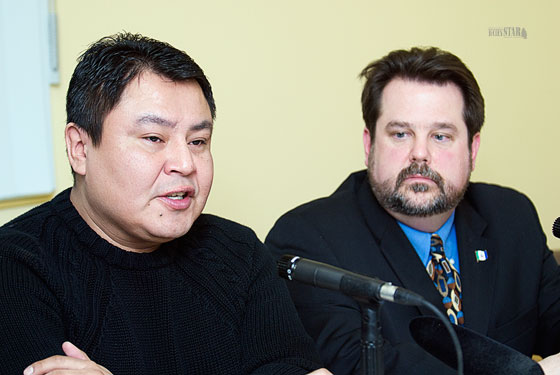
The territory's Education department and the Council of Yukon First Nations (CYFN) unveiled the Education Reform Project final report at a news conference.
"I am not going to comment on specific recommendations," Rouble said.
He said he feared commenting now would impact future meetings with education stakeholders, wherein the report recommendations will be discussed, and implementation strategies will be weighed.
This meeting is slated for March, and will be open to anyone with a vested interest in the education system, including parents and school staff.
In the meantime, the 250-page report, containing 35 different papers, is available at most territorial and first nation government offices, and online.
The report serves to identify a number of the current problems plaguing the education system, with an emphasis on those experienced by first nation students.
Among the list are high absentee rates for rural first nation students, poor literacy skills of first nation students, the need for childcare, the structural difficulties faced by the French-language school board, youth substance abuse, and expensive school nutrition programs.
"If students fail or don't graduate, it is usually a result of absenteeism or substance abuse," reads the report, in a dismal description of territory-wide school problems.
Chief Joe Linklater, on behalf of the CYFN, offered a few clues as to what Yukon chiefs are saying about the report, which is aimed at reducing the gap between first nation and non-first nation student success rates.
"Many first nation students are subject to a range of negative experiences that adversely affect their ability to succeed in the existing education system," reads the report.
The concept of an all-first nations secondary school in Whitehorse has been raised in previous discussions surrounding the education reform project.
The report identifies the idea as a "possibility," and suggests considerations for first nations members and the government to entertain if such an idea is further considered or even implemented.
Linklater, chair of the Yukon Chiefs Council on Education, said the idea may remain just an idea.
"I'm not sure an all-first nations high school would be of full benefit," he said. "I'd rather see more culture brought into the high schools, and expose non-first nation students to our culture."
Indeed, Linklater referenced research that indicated in the near future, the majority of Yukon students will be first nation members.
The document suggests first nations curriculum be integrated into the Yukon's public school system accordingly.
"It is hoped that incorporating cultural education in the curriculum will not merely provide information to students, but facilitate their personal growth," reads the document.
Efforts to incorporate first nation language training is another issue raised by the report, saying, "A comprehensive language curriculum, including a cultural component, is needed."
Linklater admitted that while the idea of language training in Yukon schools is ideal, implementing the curriculum may be difficult.
"Some things we need to look at are; are there enough language instructors?"
There are eight major first nation language groups in the Yukon: Gwich'in, Han, Kaska, Northern Tutchone, Southern Tutchone, Tagish, Tlingit and Upper Tanana. Linklater said while there are those who speak the languages, finding those linguists with teaching qualifications is another challenge.
Overall, first nation teacher numbers were found not be what was expected when the Yukon Native Teacher Education Program was launched in 1989, and it is suggested that better recruitment practices be used, as well as offering day-care facilities to the program's prospective teachers-in-training.
The affliction of Fetal Alcohol Spectrum Disorders (FASD) is also being felt, where the "students with FASD are out of synch with the school system every step of the way."
The report recommends an FASD pilot project, funded by YTG, which would see specialists working with FASD students and the staff.
Linklater said what he takes from the report is the focus shifting from departmental policy to community-driven curriculum.
"In the past, what we've seen is the department and its stakeholders handcuffed by policy.
"This sees closer working relations, and changes being made at the community level."
This shift in governance focus will allow for a tailored educational experiences that first nations are looking for, he said.
Chiefs have, in the passed, stressed the importance of integrating land-based learning practices. Under the proposed reforms, community schools could integrate such curriculum as needed.
When Linklater was asked how far this freedom stretched, he answered that, as always, any curriculum or education policy changes would "still have to work within the confines of the legislation."
Under regulations in land claim final agreements, however, Yukon first nations have the power to draw down education authority if the eventual education reforms don't meet their expectations. This would see the first nation in charge of providing education to its members, setting its own curriculum and guidelines.
While the report seeks to identify which issues specifically affect first nations communities and traditions, it also aims to reconcile the concerns of both first nation and non-first nation students, said Rouble.
In light of trades staffing shortfalls felt across the territory, for example, the report recommends changes to trades programs in secondary school to make training easier and more accessible for communities.
The report recommends lengthening the Yukon school year by at least 12 days to correspond with the B.C. school calendar.
Citing general enrolment decline rates in the territory, the report also toys with the idea of closing some Yukon schools. Any decisions would come from an independent committee of first nation and territorial governments, the public and the schools, it reads.
The details of how, exactly, curriculum and policy decisions are made will be discussed at the implementation strategy sessions in March.
The idea of this report, Rouble explained, is to lay the framework for educators and stakeholders decisions at the March meeting, when specific policy and curriculum decisions will be made.
Chief Liard McMillan of the Liard First Nation was slated to attend the report presentation, but was unable to in light of the difficulty travelling in the extreme cold conditions.
Comments (10)
Up 0 Down 0
Dennis Guthrie on Mar 14, 2008 at 1:50 pm
Sheila - I agree with you 100%. I don't think that anyone is being closed minded about First Nations culture. I just want basic education to come first. I want both my children and yours to be able to succeed in whatever they choose to do when they grow up and to do that they must be able to compete with children from across Canada and around the world. We need to strengthen the education system, what I fear is that the current proposal will weaken it instead. Culture and religion of any kind (including mine) should be taught at home. Children should also be exposed to many other cultures besides there own and that is where the school system comes in, to expose children to cultures other than their own in small doses.
Up 0 Down 0
Sheila on Mar 13, 2008 at 9:01 am
I am a mother of two First Nation children who are in the public School system in Whitehorse. My children truly enjoy the cultural activities that are part of the school system. It is hard to believe that people in the Yukon still have a closed mind. Yukon First Nation people will be heard, and are proud of our heritage. Regardless of whether FN curriculum will be taught in the schools in the Yukon. The real issue is that the current school system is failing all students both non native and native. Education is the priority for the children. As a First Nation parent I want my children to receive the best education and the Yukon system is not meeting those needs. We should all work together. One final thought how is learning about FN culture different from learning about other cultures in the world.
Up 0 Down 0
Bonnie on Feb 24, 2008 at 4:27 pm
I feel a all Native School would be detrimental for our youth. With all of the residential school trauma would we not be putting these students back into a segregated feeling??? I really think it would be a whole new set back of more damage. As for bringing in a higher quality FN curriculum... not sure why that would work we already have good courses in place that start out well attended by the FN but to only have very little attendance by the end. This only shows the disrespect one has for their own culture! How can we better this issue? I feel the main issue is pushing the students through school socially especially if they are illiterate is another area of destruction.... how do you think these students are going to feel in grade 10 or higher socially when they can't read or write? I really feel that is more the issue for low attendace of school.
Up 0 Down 0
Anthony on Feb 19, 2008 at 1:44 pm
Norma, I don't think more first nations curriculum is needed, but possibly a higher quality FN curriculum. I know that kids in Kindergarten are take FN language classes. Experiential classes should be expanded to give kids a change to get on the land in both a tradition sense and in a purely learning/science sense. More electives could be offered at high school levels but I doubt they'd be very popular. I wonder how much is taught about other cultures (other than FN) which have representation in Yukon today? Aside from French, I bet not a lot. Standardised testing is already showing that Yukon students are at he low end of the bell curve when they roll out of grade 12 and going Outside for post secondary training is intimidating enough with being hamstrung with substandard K-12 learning. The whole system needs to be revamped, it is simply broken, the Education Act Review is lipstick on the pig.
Up 0 Down 0
Norma Shorty on Feb 18, 2008 at 6:51 am
It is wonderful to see our Yukon Chiefs so involved in education alongside the Yukon Minister of Education. That relationship shows progress. While it is true that First Nations may see many of the same wants as recorded in 1972...I must say that our relationships with those who work in our educational institutions certainly have changed. The top down approach to public education is balancing out and our children will benefit from this relationship. As First Nation educators we do have a lot of work to do in developing our own curriculums which enhance our ways of knowing and still appeals to the entire classroom too. Thanks for all your hard work.
Up 0 Down 0
Brandi on Feb 16, 2008 at 12:17 pm
Does Mr. Linklater not accept that, we as First Nations will always be classed SECOND in Canada. Even tho so and so says we were here first....I as a First Nations mother agree to keep our children in the schools that we have now...How can we intergrate with non first nations student?
Up 0 Down 0
A First Nation Mother on Feb 15, 2008 at 10:33 am
I don't believe that having a seperate school will help anyone!! Especially since Yukon is so multi-cultural.
We seem to forget that is was already tried through the Indian Residential Schools. As a survivor, I reliaze today how hard my life was because I had a hard time to adapt to society. Why would we want to put our children and grandchildren through that!! The SEGREGATION where one felt that they did'nt belong, meanwhile, the land was our in the first place. That legacey must be broken. I totally disagree with a seperate school. I feel that they should be all schooled together, to ensure what we survivors went through never repeats its self. Further more it would be very crippling to the First Nations communitiees. Like taking big steps backwards.
Thank-you
Up 0 Down 0
NT aboriginal person on Feb 12, 2008 at 11:15 am
As an aboriginal person and residential school survivor, culture and language had been lost to the residential school process.
Coming back into my community did not offer much for my children. In the school system in my community, it was very apparent that only those children that belong to certain families can succeed. No matter how well my children did in the Native Language class in sewing, field trips (fishing) and language, it was made so that they would fail.
So, if this is apparent in my community, then I think that I will not accept an all FN school in my community.
Because I was in a residential school away from the community and did not go to the school, then it was judged that I did not belong to the inner circle.
My children had to endure abuse and assaults from children that were from the community. I had to come into the class to sit while they studied so they can be left alone.
There are many other abuses within the community not talked about. Sexual and physical abuse is wide spread.
There is a need for assistance for families affected by past abuses so we can continue on in a healthy way.
Thank goodness I have my parents that can help me with my traditional teachings but still lack in the language section.
If there is a fair way of delivering these services with a respected language and cultural trainer, then it would succeed.
But if it is not fair, it will not work.
Up 0 Down 0
Vlad Petrlak on Feb 9, 2008 at 6:57 am
Absolute nonsense. Thanks god I don't have any school going kids.
Up 0 Down 0
Dennis Guthrie on Feb 8, 2008 at 2:03 pm
This report is so backwards I can't believe anyone is buying into it. If you want to make sure your kids don't get a good education, then by all means endorse this garbage. Culture has no place in the education system. Every child across Canada should receive the exact same education so that all our children have the same chance to succeed. If this goes through then all Yukon children will be miles behind children from down south. I for one will not be putting my children in any school that concentates on anything other than the true educational basics.