Photo by Whitehorse Star
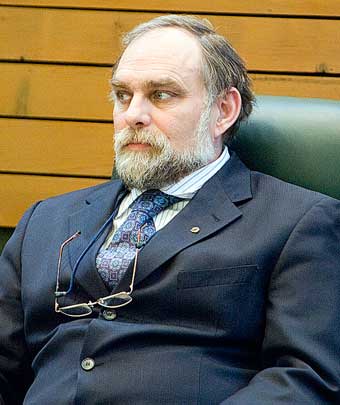
STEVE CARDIFF
Photo by Whitehorse Star
STEVE CARDIFF
The Yukon government has expanded its policy of forgiving fees required to keep mineral claims inside the Peel watershed in good standing, says a government spokesman.
The Yukon government has expanded its policy of forgiving fees required to keep mineral claims inside the Peel watershed in good standing, says a government spokesman.
Jesse Devost said the decision was made in late January.
Instead of applying the policy to just those 3,100 claims set to expire between Feb. 4, 2011 and Feb. 4, 2012, the government has extended the relief program to all 8,300 registered claims, Devost explained in an interview.
He said it was felt that since all claims are affected by the ongoing land use planning for the Peel watershed, it made sense to apply the relief to all claims.
It costs $100 per year to keep claims in good standing, though companies can also apply the cost of work completed toward the fees.
If, for instance, a company has a block of 200 claims grouped together and it conducted a $1-million exploration drill program on just one claim, it could apply that $1 million toward the fees for all 200 claims, for up to five years.
With its decision, the government is essentially foregoing $310,000 it might have collected this year.
As well, companies with assessment work in the bank will not have to burn any of it: a company that had four years of assessment credit in the bank on Feb. 4 will still have four years in the bank next Feb. 4.
The relief program announced last year only applied to the 2,450 claims scheduled to expire between Feb. 4, 2010 and Feb. 4, 2011.
Mike Wark, executive director of the Yukon Chamber of Mines, said industry is pleased the government is providing the relief to all mineral claims, and not just those set to expire in the next 12 months.
While companies still have the right to work their claims as the land use planning process continues, in reality it's very difficult to raise money for any work in the Peel watershed because of the uncertainty created by the planning process, he said.
NDP mining critic Steve Cardiff objected to last year's relief program. He reiterated his feelings this week about extending and expanding the program.
Not only has the government kept it hush-hush despite its claims to transparency, he charged, but it's another example of helping companies which knew full there was a planning process underway, but insisted on rushing in and staking thousands of claims.
He said the companies knew they would be required to complete assessment work or pay annual fees to keep their claims in good standing, and they should be made to do just that.
The issue demonstrates the government never really had a management plan, Cardiff said. It also suggests it should have listened when it was asked to freeze staking in the Peel watershed back at the beginning of the planning process, added the Mt. Lorne MLA.
Energy, Mines and Resources Minister Patrick Rouble said today the relief protects the interests of all parties.
Companies are not being forced to go in and work, which sits well with the pro-conservation movement, which doesn't want to see any industrial activity inside the watershed, he explained.
Rouble said on the flip side, companies are having their investments protected while the planning process moves to completion.
"This is one of the ways to balance the interests of all parties,” the minister said.
In its formal submission to the planning commission this week, the Tr'ondek Hwech'in of Dawson City indicated there is no room in its heart for those companies which rushed in to stake claims once the planning process began.
The Tr'ondek Hwech'in, like the other three First Nations which are a party to the planning process, is calling for 100 per cent wilderness protection of the Peel.
When it comes to dealing with companies which had pre-existing interests in the watershed prior to the planning process, the First Nation has a certain sympathy for somehow accommodating those interests, says it submission.
It has no sympathy whatsoever for accommodating the 7,000 claims staked after the process started, when a freeze on staking should have been implemented in the first place, says the submission.
The post-2005 staking rush saw the number of registered claims shoot up from 2,261 to over well over 10,000 at one point.
The Tr'ondek Hwech'in's submission described the staking rush as an affront to the spirit and intent of its aboriginal land claim agreement.
In order to encourage thoughtful and responsible discussion, website comments will not be visible until a moderator approves them. Please add comments judiciously and refrain from maligning any individual or institution. Read about our user comment and privacy policies.
Your name and email address are required before your comment is posted. Otherwise, your comment will not be posted.
Be the first to comment