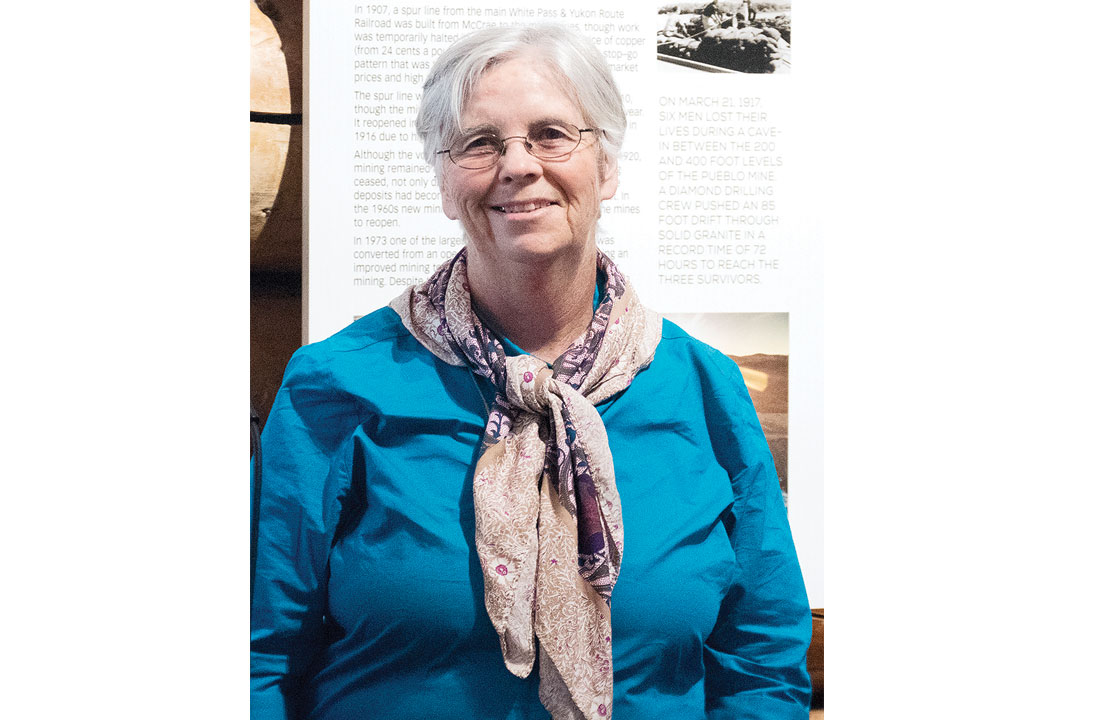
Photo by Vince Fedoroff
REMEMBERING A FABLED WRITER – Tarnel Abbott, Jack London’s great granddaughter, is seen during Monday’s event at the MacBride Museum. She is headed to Dawson City for a special festival to be held in London’s honour.
Photo by Vince Fedoroff
REMEMBERING A FABLED WRITER – Tarnel Abbott, Jack London’s great granddaughter, is seen during Monday’s event at the MacBride Museum. She is headed to Dawson City for a special festival to be held in London’s honour.
His stories brought the North to the world, and his short time in the Klondike is the stuff of legend.
His stories brought the North to the world, and his short time in the Klondike is the stuff of legend.
But there’s always more to the story, and that seems especially true for Jack London.
On Monday afternoon, the literary icon’s great granddaughter, Tarnel Abbott, addressed about 25 people gathered inside the MacBride Museum.
They heard Abbott discuss not only her great grandfather, but the cast of colourful characters who helped shape the person London became.
Abbott lives in California, but is in the territory this week for the Jack London festival happening in Dawson City this weekend.
Over the course of her hour-long presentation, she provided details of London’s life as well as his mother’s, her great great grandmother Flora Wellman, reading from two papers she had published, setting out to counter the rumours and myths that seem to haunt the memory of her ancestors.
She noted many of the documents and biographical information that have been published about Wellman paint her as an unloving mother toward her son, and who was supposedly emotionally unstable and only interested in seeing London succeed with his writing so she could benefit from his wealth. And the list goes on.
Abbott has done significant research on her family’s history in addition to the knowledge passed down over the years.
However, Abbott sees in Wellman a strong-willed woman who followed her own path and likely suffered from postpartum depression after London was born.
She was also an enterprising woman who worked hard to provide for her family and encouraged her son, also passing down socialist ideals to her son.
Wellman left her upper-class Ohio home and moved to San Francisco.
There, she lived in a common-law relationship with astrologer William Chaney and worked as a music teacher and spiritualist, claiming she could communicate with the dead.
When Wellman told Chaney she was pregnant with his child, it’s believed he demanded she get an abortion, and that she refused. He then left her and, after a failed suicide attempt, she was cared for by a friend.
When London was born on Jan. 12, 1876, Wellman named him John Griffith Chaney.
Not thriving as an infant, Virginia Prentiss was hired as the baby’s wet nurse. She would continue to play a central role in London’s upbringing.
It was the Prentiss family who introduced Wellman to John London, who she married when Jack was about eight months old.
Wellman taught her son to read when he was four. Records show she continued to keep up on how he was doing in school, despite a busy schedule as she continued working to improve the family’s position.
One of his step-sisters doted on her little brother throughout their childhood to the point of insisting her father was indeed Jack’s and burning all evidence she could find of any reference to Chaney.
It was later on in life that Jack came across newspaper articles of his mother’s suicide attempts, naming Chaney. Jack wrote to Chaney, but Chaney responded by stating he could not be Jack’s father because he was impotent.
As Jack grew up and set out on his own well-recorded adventures, there are records of his mother’s correspondence with him – including one where she notes her worry after not getting word from him for three weeks – and many of his works dedicated or inscripted to her.
His writing – much of which focused on his few short months in the North during the Gold Rush – have gone on to be translated, and are well-known all over the world.
It was Wellman, Abbott noted, who encouraged him to pursue his writing rather than taking a job with the postal service, and Wellman who ensured he earned his high school diploma.
Jack’s life has been well-documented, though Abbott noted in an interview following her presentation his family history is not always so well-known.
It’s strange for her to visit some Jack London exhibits and displays about his life and not see any acknowledgement of his two daughters, Joan (Abbott’s grandmother) and Becky, from his first marriage to Bessie Maddern, or the generations that have followed.
Jack and his second wife had one child who died shortly after birth.
Jack died on Nov. 22, 1916, and his death was shrouded in mystery for many years.
Abbott believes it was caused by an accidental overdose of morphine, a drug he used to alleviate the pain caused by uremia, which is caused by kidney stones.
His fabled history continues to live on in the lives of his descendants.
Abbott grew up knowing much of her family’s history. However, it wasn’t until after her father’s death about 15 years ago that she delved deeper into researching that history.
She noted that many of the presentations and exhibits about London’s life have not made mention of his children.
It’s odd, she said, to visit those museums and exhibits and see no mention of Joan nor Becky. That is changing, with one museum planning to include his family history as well.
Abbott also hopes that her research into her family history and her presentations both in the Yukon and elsewhere will give London fans a better idea of where he came from and who his mother was.
“It’s important to know he had this fascinating mother,” Abbott said.
She describes her great great grandmother Wellman as a ground-breaking woman who forged her own path and encouraged her son, passing down her socialist ideals of a better world.
“The Brotherhood of Man” was something London wrote about. One of the last things he penned was the possibility of a society operating on utopian ideals.
London was very-much a product of Wellman.
As for her favourite work by London, Abbott couldn’t name just one.
Call of the Wild stands out (and she noted she enjoyed it more during her most recent reading of it), as does To Build A Fire, People of the Abyss, The Sea-Wolf, and The Iron Heel.
Over the course of the weekend, Abbott will be at the many events celebrating the work of her great grandfather.
Things will get underway at 7 p.m. Thursday at the Dawson City Museum with a screening of the 1991 production of White Fang (London’s original story).
On Friday, events will be focused largely at the Jack London Museum, with a talk beginning at noon, followed by the formal opening ceremony at 2 p.m. Abbott will then address festival-goers at the museum.
Her talk will be followed with a screening of the 1935 film Call of the Wild at the museum beginning at 4 p.m.
Then, at 7 p.m. at the Danaja Zho Cultural Centre, festival-goers will see the premiere of FX Goby’s animated To Build a Fire and a theatrical performance of Tracks, based around London’s time as a hobo.
Saturday’s schedule includes an interpretive dog walk, screenings of Lost Cabin, about the discovery London’s Dawson cabin, and the 1969 film To Build A Fire, a discussion focused on London’s time in the Klondike.
Also on tap is a stampeder dinner, featuring the type of food stampeders would have eaten during the days of the Gold Rush.
Finally, on Sunday, things will wrap up at the Jack London Museum with a talk on London’s Klondike story, followed by a marathon reading of Call of the Wild.
In order to encourage thoughtful and responsible discussion, website comments will not be visible until a moderator approves them. Please add comments judiciously and refrain from maligning any individual or institution. Read about our user comment and privacy policies.
Your name and email address are required before your comment is posted. Otherwise, your comment will not be posted.
Be the first to comment