Photo by Whitehorse Star
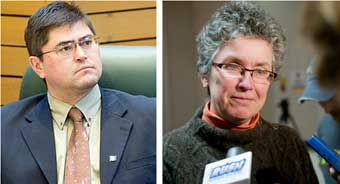
Darius Elias and NDP Leader Liz Hanson
Photo by Whitehorse Star
Darius Elias and NDP Leader Liz Hanson
The NDP and Liberals are slamming the Yukon Party for its rejection of the land use plan recommended for the Peel River watershed.
The NDP and Liberals are slamming the Yukon Party for its rejection of the land use plan recommended for the Peel River watershed.
Liberal Environment critic Darius Elias is calling last Friday's announcement a betrayal of the planning process.
NDP Leader Liz Hanson, meanwhile, insists it's a breach of the spirit and intent of the Yukon aboriginal land claim agreements.
Elias was also critical of the timing, suggesting the government has been silent on the recommended plan since it received it a year ago.
"And when they do come out and say something on Christmas Eve, they are quite adamant they do not support the plan,” said the MLA from Old Crow. "We could see this coming.”
Elias said the government's claim that it will keep working with the four affected First Nations to try to provide a joint response to the planning commission amounts to more of the Yukon Party's "stalling and avoidance tactics.”
Energy, Mines and Resources Minister Patrick said last Friday the government finds the proposed land use plan is inconsistent with the land claim agreements, is not balanced and is overly complicated.
Further attempts will be made over the next two months to develop a joint response to the six members of the planning commission, he said.
The recommended plan calls for vast wilderness protection. While it was welcomed by the pro-wilderness lobby, the mining sector called it a death knell for industrial development inside the planning area.
Under the process, the government and the First Nations are free to file individual responses to the recommended plan. Once the commission receives and reviews the responses, it's expected it will issue a final recommended land use plan.
The Tr'ondek Hwech'in Han Nation, the First Nation of Na-Cho Nyak Dun and Gwich'in Tribal Council have been quite vocal in their desire for maximum wilderness protection of the Peel watershed.
Both the New Democrats and Liberals support the plan recommended by the planning commission.
Elias said the Yukon Party is taking a short-sighted approach to the planning initiative. The Peel, he emphasized, is a unique pristine wilderness area which needs protection for all time.
"Our elders always say you have to look 100 years into the future,” said Elias, whose Vuntut Gwitch'in First Nation has a relatively small piece of traditional territory inside the planning region.
Unlike the other three First Nation governments, the Vuntut Gwitch'in have not come out with a firm position on the recommended plan.
The newly elected leader of the NDP said the government is way off-track when it says the recommended plan is inconsistent with the final land claim agreements.
Those pacts, Hanson said, were developed by the best minds in the country. There is none of the ugly issues that arise over the interpretation of historic aboriginal treaties, she said.
Hanson said the recommended land use plan is in keeping with the provisions of the final agreements, and it was crafted by a competent commission of members appointed by both the government and the First Nations.
"We have a problem if they do not see this plan does reflect the objectives set out in Chapter 11,” said the new representative of Whitehorse Centre who was sworn into office Monday morning
"What it does in my mind is call into question this government's commitment to these agreements.”
Hanson said there's a pretty big gap to fill for the parties to reach consensus by the end of February if the government takes the view the recommended plan is inconsistent with the final agreements.
Furthermore, she said, the government continues to stand guard for industry on a piece of pristine wilderness that has not produced a single ounce of ore in the 100 years mineral claims have existed in the Peel watershed.
The area is just too remote and full-time access too expensive to construct anything, she said.
Hanson suggested mining in the Peel is not financially feasible, and that it's far more valuable as a natural landscape – which should be protected.
See editorial
In order to encourage thoughtful and responsible discussion, website comments will not be visible until a moderator approves them. Please add comments judiciously and refrain from maligning any individual or institution. Read about our user comment and privacy policies.
Your name and email address are required before your comment is posted. Otherwise, your comment will not be posted.
Comments (5)
Up 0 Down 0
Jack malone on Dec 23, 2010 at 4:54 am
@ Nile. Another uninformed comment from you. You state that the FN want to protect the Peel since "they can't make any $ from it". Wrong. The self-governing Yukon First Nations receive a share of all mining and oil and gas royalties that occur anywhere in the Yukon - whether on Non-Settlement Lands (ie. public lands) or Category B or Fee Simple Settlement Land. Although, as pointed out above, the Yukon's royalty rates are low, they are forgoing any potential royalties in the Peel by proposing the entire area of the Peel be protected.
Up 0 Down 0
ES on Dec 23, 2010 at 4:03 am
There are billions of tonnes of extractable resources outside of the Peel, IN THE YUKON. Greedy miners! There's enough there already so get busy and dig it up.
The Peel watershed is a mine that can last forever. Look at Banff. It's a gold mine! I'm not saying we need to develop it like Banff but the potential for tourism $$$ can far outweigh mining gains over the long term. The world is getting smaller and smaller as you read this and areas like the peel are quickly becoming Jewels that will have much more economic value than a 10 year mine ever will.
Put on your long term vision goggles people. We have to stop being so short sighted.
Up 0 Down 0
Bob Wagner on Dec 23, 2010 at 4:02 am
I just wonder whose best interest is involved in not protecting this area? Most mining companies in the Yukon are not based here. Chinese multinationals and Chinese government backed mining companies are currently driving the vast majority of mining development in the Yukon. The high paying jobs in mining are definitely not in the Yukon. Head offices and investors are, by far, located somewhere other then the Yukon.
The profits from Yukon's resources invariably go outside the Yukon. Royalties on those resources are a joke (Yukon's royalty on gold is based on a price of $16/ounce - current world gold price $1400/ounce.) A large part of the future workforce needed for mining in this territory will come from somewhere else (the days of mining towns are over). These workers will live and pay taxes somewhere else. For this we should give up a world class wilderness area that can never be restored to what it is now. The planning commission was correct in advising caution.
Bob Wagner
Up 0 Down 0
Nile on Dec 22, 2010 at 2:39 pm
NDP are scared of loosing votes to the Greens in the next election.
FN want it protected because it's not on their land and they can't make any $ from it.
People don't realize that the Peel is the size of Norway! Protect some of it? Yes. The whole thing? Not in the best interest of the Yukon.
Up 0 Down 0
JC on Dec 22, 2010 at 8:44 am
Now, did anyone really expect the Liberals, NDP, and FN to support the Yukon Party decision. Duhh!