Photo by Photo submitted
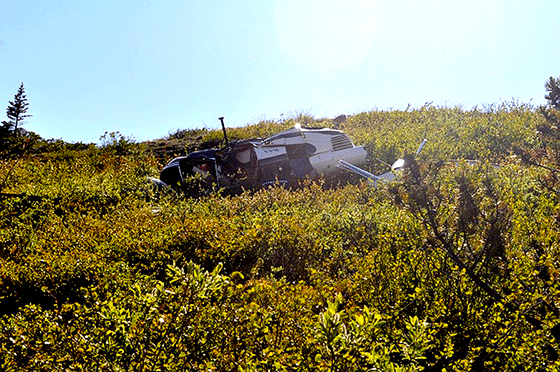
DOOMED CHOPPER – Yellowknife pilot Paul Rosset died after this helicopter crashed near Carcross last year. Photo courtesy TRANSPORTATION SAFETY BOARD OF CANADA
Photo by Photo submitted
DOOMED CHOPPER – Yellowknife pilot Paul Rosset died after this helicopter crashed near Carcross last year. Photo courtesy TRANSPORTATION SAFETY BOARD OF CANADA
Officials are blaming a failure to check wind conditions for a 2012 helicopter crash near Carcross which killed the pilot.
Officials are blaming a failure to check wind conditions for a 2012 helicopter crash near Carcross which killed the pilot.
Paul Rosset, 56, of Yellowknife, was flying the R44 Raven II for Whitehorse's Horizon Helicopters when it crashed on Nares Mountain on July 10, 2012.
Two passengers, both contract employees with Environment Yukon, were injured in the crash, one seriously.
The Transportation Safety Board of Canada released its report on the crash today.
The flight was taking the government employees to bear-bait sites in the Carcross area.
According to the safety board's report, the helicopter left the Erik Nielsen Whitehorse International Airport just before 9 a.m. and reached the first site at 9:17.
The trio would visit nine more sites in the region west of Carcross before stopping to refuel at 11:48, then visiting nine additional sites in the northwest and southwest.
"Throughout the day, high winds prevented them from inspecting some sites at higher elevations,” the report notes.
Later that afternoon, the helicopter landed in Carcross to refuel and began its trip back to Whitehorse, with planned stops along the way.
The final leg of the day was to a site east of Carcross.
The flight followed the north shore of Tagish Lake and approached the wildlife survey site from the west.
The report notes that the pilot had been at this site numerous times in the past.
"The investigation determined that the pilot overflew the site from the south and proceeded to turn 180° to the right,” the report says.
"The helicopter then slowed to a hover, and began descending over the east side of the crest.
"Moments later, the helicopter experienced a gust of wind from the west, which caused it to drift to the left towards the eastern slope (lee side) of the crest.
"The helicopter then began an uncontrolled vertical descent.”
The chopper hit the eastern side of the slope. It slid down the side of the mountain, coming to rest nearly upside down on its left-side roof
In analyzing the crash, the investigators point out the importance of a helicopter doing a reconnaissance pass before landing.
"Conducting a reconnaissance pass is an industry standard, and is taught at mountain flying schools,” the report notes in its analysis section.
"The pilot had completed a mountain flying course; however, for unknown reasons, he did not carry out a reconnaissance pass before attempting to land.”
Barry Holt, a senior investigator with the safety board, told the Star today that taking the time to fly through wind while moving forward is important before attempting to hover and land.
"It allows the pilot to feel the wind as he is moving through it, and recognize what that does to the helicopter,” he said.
The document also note that downdrafts often exist on the lee side of a mountain, the opposite side to where the wind is hitting.
In the case of this crash, "While conducting the approach to land in these downdraft conditions, insufficient power was available to maintain rotor rpm, and a rate of descent developed from which recovery was not possible,” the report says.
Rosset had about 15,000 total flight hours, including 1,100 on helicopters.
He was not wearing a helmet at the time of the crash.
"Despite the recognized benefits of head protection, there is no regulatory requirement for helicopter pilots to wear helmets,” the report notes.
"If helicopter pilots do not wear helmets, they are at increased risk of incapacitation, serious injuries or death in the event of an accident.”
Investigators note that, since the accident, Horizon Helicopters Ltd. now requires all pilots to wear helmets during flight operations.
In order to encourage thoughtful and responsible discussion, website comments will not be visible until a moderator approves them. Please add comments judiciously and refrain from maligning any individual or institution. Read about our user comment and privacy policies.
Your name and email address are required before your comment is posted. Otherwise, your comment will not be posted.
Be the first to comment