RCMP welcome inquest jury's recommendations
A coroner's jury has ruled the 2010 drowning death of Mayo RCMP Const. Michael Potvin accidental.
By Ashley Joannou on November 7, 2012
A coroner's jury has ruled the 2010 drowning death of Mayo RCMP Const. Michael Potvin accidental.
On Tuesday evening, the jury of six members came back with 10 recommendations to go with their ruling.
Coroner's juries do not assign fault nor blame in a case, and their recommendations are not legally binding. The role of the recommendations is to help prevent a similar event from recurring.
In this case, most of the recommendations were aimed at improving RCMP safety practices.
They include that random spot checks be done at RCMP detachments to ensure new safety inspection rules are followed, that weekly safety meetings are held and that a command checklist and report be created for when a detachment is taken over by a new commanding officer.
The recommendations also call on Commissioner Doug Phillips to recognize Mayo residents Jimmy Simon, Jeremy Germaine and Benny Moses "for their valiant efforts in the rescue.”
The three men jumped into a boat on the evening of July 13, 2010 when they saw the Mayo RCMP's riverboat had capsized in the Stewart River.
Using sticks to manoeuvre the boat, they were able to reach Cpl. Brent Chapman, who was clinging to the side of the craft.
Potvin, 26, was swimming to shore.
He never made it. His body was found 17 days later nearly 60 kilometres downstream.
Marine experts testified that the weight of the boat's 150-horsepower motor, along with a smaller recently-added auxiliary motor and holes in the vessel's cut-down motor well combined to enable water to come into the back of the boat.
The boat's bilge pump was not functioning, and the vessel had electrical problems which prevented tools like the fuel gauge from working.
Neither Potvin nor Chapman was wearing personal floatation devices when the boat capsized.
The inquest was shown evidence of a history of RCMP officers of various ranks not wearing the safety equipment while in the boat.
Before the jury left the courtroom Tuesday afternoon to consider its ruling, Potvin's father, Mark, read a letter from his son's widow, Allison. The letter, in its entirety, can be found on p. 9 of today's Star.
In it, Allison Potvin says there isn't a day that passes that she doesn't think about what happened to her husband and ask herself questions about it.
She writes that she wants her son, Jack, who was born after the tragedy, to remember that the community rallied together to support the family after his father's death.
She hopes people will focus on forgiveness instead of pointing fingers.
"So here is my request and my wish to everyone who is involved or has an interest in what has happened to Michael (and I speak solely for myself and no one else),” she writes.
"My wish is that we take as much positivity from this tragedy as possible. My wish is that instead of pointing fingers, we find forgiveness. I hope that we learn from our errors and that those who are able to make changes for the better do so.”
Mark Potvin, who has been representing the family at the inquest, said he agrees with all the recommendations.
He echoed his daughter-in-law's call for forgiveness.
"I don't blame anybody for doing it. Nobody did anything intentionally. This was all a case of either laziness or stupidity. That's all it was,” he said after the recommendations were read.
"They all made mistakes and none of them meant to make mistakes. Everyone was doing what they thought they should be doing.”
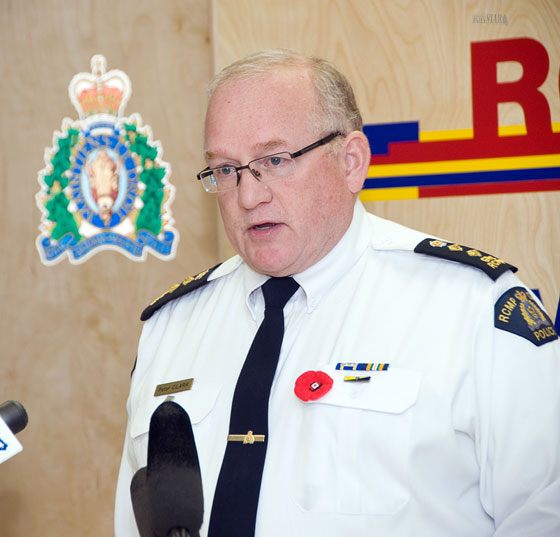
In a statement this morning, Yukon RCMP Chief Supt. Peter Clark, called the jury's recommendations "wise and helpful.
"The events of that day have obviously changed us forever. The RCMP owes it to Mike to make as much good as we can from this tragedy,” he said.
"Making the RCMP become a better organization and helping everyone become safer on the water will honour everything that Mike and his loved ones have already sacrificed.”
Clark acknowledged problems within the RCMP that were highlighted during the inquest.
"During the inquest, evidence was heard about a vessel with a history of poor maintenance and structural modifications,” he said.
"We heard about policies and safety practices that were not consistently followed by the RCMP before the event and we heard about inattention to policy, that being the requirement to wear a personal floatation device and how that contributed to this tragic result.”
The RCMP have already taken actions to prevent future incidents, he said.
During the inquest, the jury heard of new RCMP water policies put in place after Potvin's death, including improved inspections, and rules for modifying vessels.
Each officer in the Yukon has been issued his or her own personal floatation device, instead of keeping the equipment at the detachments.
Usage is monitored by supervisors, he said.
Clark said the RCMP have learned "difficult and important lessons” which all Yukoners should take to heart.
"Ensure your vessel and safety equipment is properly maintained, take the time to learn what the hazards are in your area and please, no matter how skilled or experienced you feel you are, and how well-equipped you think you are, always wear your personal floatation device,” he said.
"It's no good close by; we never plan on going in the water; it happens quickly, and you don't have time to put it on.”
As for whether the Yukon RCMP should have been investigating the death of one of its own, Clark said he supports independent investigations wherever possible.
"In this case, the investigation was a coroner's investigation, and under the territorial Coroner's Act, we are the investigative body,” he said.
"If the coroner feels we are not appropriate, we certainly have a discussion with her and do everything we can to respond to her needs.”
The territory's top officer pointed to multiple, independent outside investigations done by federal officials with Human Resources and Skills Development Canada, the Transportation Safety Board and Transport Canada.
Clark said the jury's recommendations complement policies that have already been put in place.
The Yukon RCMP have a divisional safety committee which includes representation from the communities and Whitehorse headquarters, he said.
There are policies in place to help new commanders arriving in a community, and spot checks are performed to ensure policies are being followed.
Clark said he is not aware of any non-compliance being found during those spot checks.
"This attention to boating safety on the Yukon waterways is a living legacy for Const. Michael Potvin that we ask all Yukoners to embrace,” he said.
The presiding coroner for the inquest was Karen Ruddy, a territorial court judge.
Be the first to comment