Photo by Vince Fedoroff
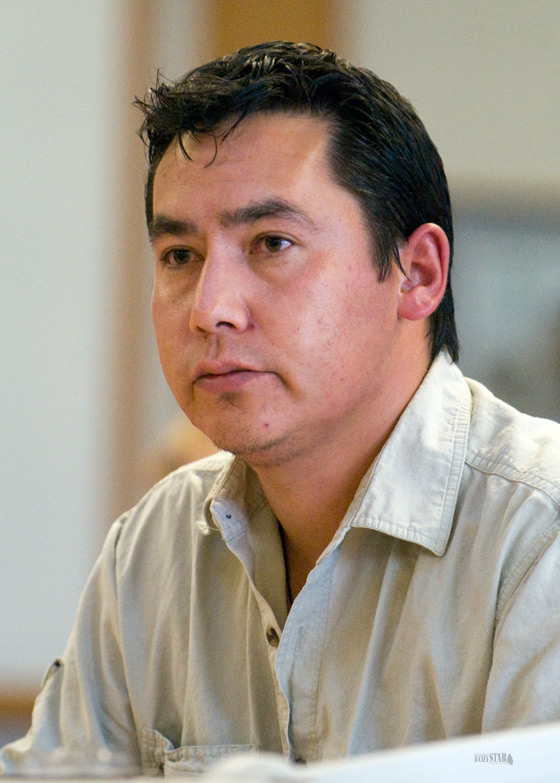
A MESSAGE FOR COUNCIL - Sean Smith expresses his powerful attachment to the land around his trapline during Monday evening's city council meeting.
Photo by Vince Fedoroff
A MESSAGE FOR COUNCIL - Sean Smith expresses his powerful attachment to the land around his trapline during Monday evening's city council meeting.
City council has put off its decision on the second reading of an amendment to the Official Community Plan (OCP) to allow for a quarry off the old Livingstone Trail.
City council has put off its decision on the second reading of an amendment to the Official Community Plan (OCP) to allow for a quarry off the old Livingstone Trail.
It did so at its regular meeting Monday night, after three delegates spoke out against the development.
"I've got strong feelings about the land," Sean Smith, who has a trapline near the proposed quarry site, told reporters following the decision.
"I love the land. It's part of me, it's part of who I am, it's part of my family, it's part of my people and it's part of my culture, and that's one very strong reason why I came out here."
A member of the Kwanlin Dun First Nation, Smith inherited the trapline from his grandfather, Fred Smith, who died in 2005.
Along with getting set to follow in his grandfather's footsteps to teach others how to live off the land, Smith has also done work over the past few years monitoring at the Southern Lakes caribou herd.
At Monday's meeting, he told council the OCP's wildlife habitat map isn't accurate. The site is home to many animals, migratory birds and close by Croucher Creek, a salmon-bearing waterway leading to the Yukon River., Smith said.
Experience has shown him that with nearby development comes a loss of wildlife.
Both he and, in separate presentations to council, his parents, Ann Smith and Brian Walker, argued there are other locations the city could use to get the rip rap it needs for the sewage lagoon.
The city could use existing quarries to obtain the approximately 1,000 cubic metres, or 200 dump truck loads, of rock needed to maintain the sewage lagoon, council was told.
Walker has addressed council previously with concerns about traffic the project would bring to Long Lake Road, where the family lives.
Last night, he told council he would gladly deal with more traffic coming from hauling rock from other areas of the city, if it meant protecting the area.
"I must apologize to city council for not understanding the full scope of the Livingstone Trail sewage lagoon rip rap project," Walker said as he began his presentation.
The traffic concerns he initially expressed when the project first came forward have become just a minor irritation compared to the concerns over the impact such a development would have on a pristine environment, he said.
The 92.7 hectares of vacant Commissioner's land the city is seeking to designated Natural Resource from the current classification of Natural Open Space is too large for what the city actually needs, he said.
Both he and Sean Smith also argued the timber from the area, which the territory's Department of Energy, Mines and Resources has expressed interest in harvesting, wouldn't be of much use.
The development could also put the area "on the thin edge of the ledge for future resource extraction," Walker argued.
He and Sean also raised questions coming out of their research on the site about a quartz claim in the area that's been made by a city employee, noting it's unclear whether the claim was on behalf of the city or as an individual.
Meanwhile, Ann recalled the history of her father's trapline, noting that in 1995, Fred was compensated for the impact the sewage lagoon would have on the trapline.
"My family (has) not been consulted," she said.
While the city sent a letter to the Kwanlin Dun First Nation, which owns the land where the family lives and the trapline area, it didn't directly inform the family of the plans. The city's policy is to inform owners of land in the area of developments, rather than the tenants.
While the trapline hasn't been registered since about 2001, Sean explained that is due to his grandfather being ill between 2001 and 2005. He was then taking courses on trapping, but plans to register the trapline.
The family has used it to live on the land through the years. Ann noted vandals destroyed the cabin on the trapline last month, showing council photos of the damage.
Questioned by Coun. Florence Roberts on how long the trapline concession has been in the family, Ann noted she isn't sure but suspects it was in her family when traplines were first registered with the territory.
"It would go back probably to the (19)50s," she said. "That's when things started changing for our people."
The family, she said, has inherited the responsibility to respect the trapline and the right to pass it on to future generations.
After the three presentations, Coun. Dave Austin noted he'd like more information before voting on whether to go through second reading of the OCP amendment and made the motion to defer the matter by two weeks.
Coun. Dave Stockdale was the only member to vote against the deferral, asking what council could learn and what could change in two weeks.
"There's been a fairly strong case made for preserving the trapline in this area of land," he said. "I don't know what we'll learn in two weeks that would change my mind on this particular development."
Roberts argued issues around whether the entire site is needed for the rip rap can be looked at. Earlier, Austin had commented the quartz claim should also be looked at prior to another vote on the matter.
"Maybe we don't need the whole area," Roberts suggested.
If the concerns around the trapline can be addressed while still meeting the city's needs, she added, she would like to consider that option.
A two-week delay is also not a "drastic" amount of time to defer the matter, Austin noted.
The deferral was then passed.
Outside city hall following the vote, Sean told reporters the city seems to be trying to mitigate the impact on the trapline and nearby area.
"Mitigations are weak overall, in the overall picture, behind the ecological integrity of wildlife and fish," he said.
"It's my main concern. It's why I work in projects involving them. It's my concern because, you know, we only have so much. There's only so much land."
He noted, though, he will work with the city "to a certain degree" on mitigation, but ultimately he would like the city not to proceed.
"There's many other options to where they can get their rip rap material from," he said.
Whether the matter could end up in litigation, Sean said he would "play it by ear" for now and see what the city comes forward with.
With the amendment currently in second reading, Sean pointed out it will have to go through that, followed by third reading, and other processes, including approval by the Yukon Environmental and Socio-economic Assessment Board, before the project can go ahead.
Coun. Jeanine Myhre was absent from last night's meeting.
In order to encourage thoughtful and responsible discussion, website comments will not be visible until a moderator approves them. Please add comments judiciously and refrain from maligning any individual or institution. Read about our user comment and privacy policies.
Your name and email address are required before your comment is posted. Otherwise, your comment will not be posted.
Be the first to comment