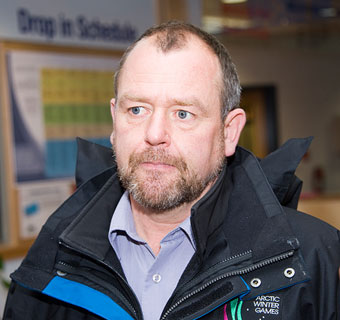
Photo by Whitehorse Star
Brian Crist
Photo by Whitehorse Star
Brian Crist
The Yukon government will not go ahead with developing the Stevens Quarry in the city's north end.
The Yukon government will not go ahead with developing the Stevens Quarry in the city's north end.
In a 10-page decision document released last Friday on the Yukon Environment and Socio-economic Assessment Board (YESAB) website, the government stated the quarry development slated for this spring is off.
"The decision body rejects the (YESAB) recommendation,” it's noted in the rationale for decision. "In result, the project is not permitted to proceed.”
Scores of residents in the quarry area signed a protest petition in 2012, after the plans became public.
They were concerned about such potential impacts as noise, dust and increased heavy truck traffic.
Even some residents living across the Takhini River from the planned quarry site were worried about how the dust would affect their homes and, in some cases, their crops and animals.
The government's attempt to develop the quarry in the early 1990s prompted a similar outpouring of dissent.
This time, the government takes issue with how the YESAB's recommendations on the project "were framed” when they were handed down on Jan. 10.
"The assessment recommendation singles out certain recommended terms and conditions and purports to acceptance of those singled-out terms and conditions,” reads the decision document.
"The assessment recommendation goes on to provide that if the singled-out terms and conditions are not accepted, then the assessment recommendation is that the project not be allowed to proceed.”
However, the government continues to argue that that approach is not authorized under the Yukon Environmental Socio-economic Assessment Act (YESSA).
"Section 56(1)(b) provides that if the Designated Office determines that the project will have serious adverse effects, but that those effects can be mitigated by certain terms and conditions, it must recommend that the project proceed subject only if, under s. 56(1)(c), the designated office determines that the serious adverse effects of the project cannot be mitigated by certain terms and conditions.
"Further, the designated office may not base its recommendations on whether any particular recommended terms and conditions are subsequently adopted in the decision document.”
In its recommendations, the YESAB identified conditions that would mitigate the "serious adverse effects” of the quarry, and therefore there's no basis for a recommendation that the project not go ahead.
"For these reasons, we treat the assessment recommendation as being a recommendation that the project proceed subject to certain terms and conditions, as contemplated at s. 56(1)(b) of YESSA,” it's stated in the decision document.
The government then goes on with its reasons for not going ahead with the project, pointing to the numerous comments that came from the public, Ta'an Kwach'an Council and the Laberge Renewable Resources Council on the impact the quarry would have on quality of life.
Included in those comments was a 160-signature petition opposing the project. It identified issues such as dust and suggested the landscape in the area could be destroyed with the operation.
"The analysis contained in the evaluation report tends to confirm that there is some basis for concern in this regard,” the decision document reads.
"While we do not have confidence in the methodology and analysis employed in the evaluation report, we generally accept that the potential for substantial effects of this nature is real.”
The mitigations and conditions recommended are "undeniably onerous,” it continues.
"If the assessment recommendation is accepted, we would be allowing a project to proceed that is significantly different from the project as proposed or scoped.
"In our view, it should have been presented as such in the assessment recommendation. While we do not accept this approach, we do accept that this project as proposed and scoped should not proceed.”
The quarry was a territorial project, but it was the city which did the planning work and identifies potential sites for quarry activity.
The decision by the territory means the city must now "go back to the drawing board” and look at other areas that could be used for quarrying, Brian Crist, the city's director of infrastructure and operations, said in an interview Tuesday.
The Stevens Quarry was picked as the next major quarry area for its large supply. A conservative estimate puts the area as supplying the city's quarry needs for the next 20 years, Crist stated.
The planned quarry's location in the north end of the city would have meant a shorter transportation time to the Whistle Bend subdivision.
Whistle Bend will be the major focus of development in the coming years.
The government's decision has a definite impact on the city's long-range planning, though in the short term, the existing quarry in the McLean Lake area will continue to be used.
Crist pointed out the city's Official Community Plan also points to potential quarrying sites in areas like Sleeping Giant Hill, the Copper Haul Road, Ear Lake and sites in the McRae area.
More work will have to be done to determine what direction will be taken for the city's next major quarry site, he added.
In order to encourage thoughtful and responsible discussion, website comments will not be visible until a moderator approves them. Please add comments judiciously and refrain from maligning any individual or institution. Read about our user comment and privacy policies.
Your name and email address are required before your comment is posted. Otherwise, your comment will not be posted.
Be the first to comment