Photo by Star photo by VINCE FEDOROFF
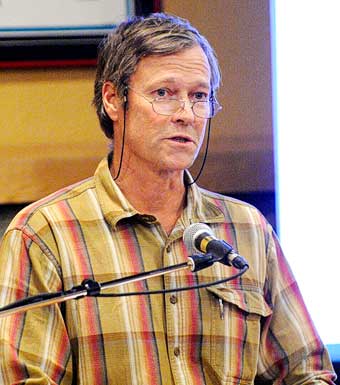
PLANNING DILEMMA – Peel planning commission chair Dave Loeks likened finding middle ground between mining and conservation interests to an Aesop fable.
Photo by Star photo by VINCE FEDOROFF
PLANNING DILEMMA – Peel planning commission chair Dave Loeks likened finding middle ground between mining and conservation interests to an Aesop fable.
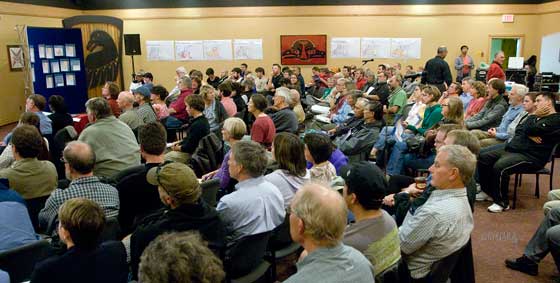
Photo by Star photo by VINCE FEDOROFF
Over 150 people attended the hearing on the Peel watershed.
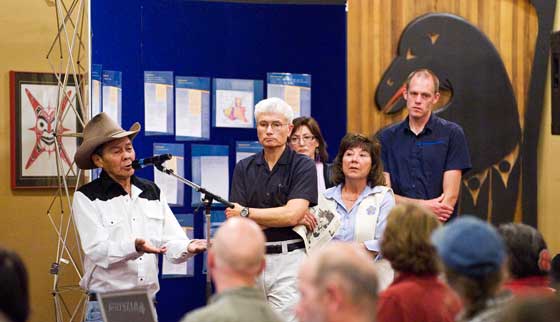
Photo by Star photo by VINCE FEDOROFF
AN ELDER'S APPEAL – Jimmy Johnny, a member of the First Nation of Nacho-Nyak Dun, speaks of the significance of the Peel watershed and the importance of protecting the region for future generations to a packed room at last evening's public consultation on the recommended Peel Regional Land Use Plan.
After attempts to please everyone pleased no one at all, Peel planning commission chair Dave Loeks said the commission had no choice but to defer to the precautionary principle and protect the values mining interests would undermine.
After attempts to please everyone pleased no one at all, Peel planning commission chair Dave Loeks said the commission had no choice but to defer to the precautionary principle and protect the values mining interests would undermine.
Loeks made the remarks last night in Whitehorse at a public consultation on the recommended Peel Watershed Regional Land Use Plan.
Two distinct positions emerged from the raft of comments the commission has received on the issue, said Loeks: some value the region for its resource potential, and others believe the region has an intrinsic value and must not be disturbed.
The Peel land use planning process, which began in 2004, has pitted members of industry, who want more access to the region, against conservationists and First Nations, who are demanding maximum protection.
When presenters from Energy, Mines and Resources (EMR) produced an overhead graphic indicating several more phases before a conclusion is reached, it caused one attendee to mutter under his breath, "and when they finish this, I'll be dead.”
From the mining industry's perspective, future resource exploration in the region will die if the Yukon government accepts the commission's recommendation that 80 per cent of the 68,000-square-kilometre watershed be off limits to mining and the remaining 20 per cent be accessible by air only (not including a small corridor bisected by the Dempster Highway).
An EMR-produced map of exploration activity in the Yukon as of August 2010 indicates exploration in the Peel watershed is virtually nonexistent, while the rest of the territory is pocked with projects.
And that's just fine with conservation groups and First Nations, whose members and supporters were out in full force at last evening's public consultation, held at the Yukon Inn.
More than 150 packed the hotel's Fireside Room and hearty applause throughout – including two standing ovations – for pleas to leave the Peel as is made it clear the conservation side were in the majority.
A 2009 Yukon Conservation Society-sponsored survey indicated that 78 per cent of Yukoners believed the main priority in the watershed should be environmental protection.
Loeks said the planning commission based its recommendations on dictates from the Umbrella Final Agreement – the landmark 1993 document and foundation for aboriginal land claims and self-government in the Yukon – that land use planning should be guided by principles of sustainable development.
But Sandy Babcock, president of the Yukon Chamber of Commerce, called the Peel commission's recommendations, "... a less than impartial product, inconsistent with the definition of sustainable development as defined in the Umbrella Final Agreement.”
Babcock, and later Michael Wark, executive director of the Yukon Chamber of Mines, spoke of the significant investment mining brings to the territory.
According to Wark, between 2000 and 2008, resource exploration in the Peel region contributed $48 million to the economy.
Wark warned that without adequate infrastructure for access to existing claims in the Peel, those claim holders will expect, "compensation when access is denied.”
When the planning commission was formed six years ago, it asked for a moratorium on staking, but the request was denied until the Yukon government finally halted claim staking at the beginning of this year.
Between 2004 and early 2010, mineral claims and other resource dispensations in the watershed rose from 2,500 to more than 10,000.
While Wark and Babcock insisted mining and environmental interests can coexist in the Peel watershed, representatives from the tourism industry and pro-conservation groups disagreed.
Blaine Walden, president of the Yukon Tourism Association of the Yukon, recalled a season when uranium
exploration in the Peel reached fever pitch, and the serene outdoor experience he promised rafting clients was shattered by helicopters and prospectors.
Mike Dehn of the Yukon chapter of the Canadian Parks and Wilderness Society challenged the assertion mining could occur in a manner which would respect and protect the environment.
"Where has (this) happened in the world? Nowhere,” said Dehn, adding that with the Peel removed entirely from the exploration and development table, miners still had free staking access to more than 80 per cent of the territory.
"This doesn't sound balanced to us,” Dehn said.
Karen Baltgailis, executive director of the Yukon Conservation Society, disputed the idea that complete protection of the Peel would hamper the mining here or hurt the Yukon's economy.
"Yukon doesn't need the Peel watershed to have a booming mining industry,” said Baltgailis, citing the $140 million the mining industry predicts will be invested in the Yukon in 2010, on par with 2007's record year.
"We don't have to (open the Peel to mining) to have a thriving industry or a thriving economy.”
In order to encourage thoughtful and responsible discussion, website comments will not be visible until a moderator approves them. Please add comments judiciously and refrain from maligning any individual or institution. Read about our user comment and privacy policies.
Your name and email address are required before your comment is posted. Otherwise, your comment will not be posted.
Comments (8)
Up 0 Down 0
Don McKenzie on Sep 21, 2010 at 10:50 am
Thanks Joel. And to Kinzie Grant, if you bothered to read my previous post, what part of it do you fail to understand? The Elsa's and Faro's of yesterday, have no place in the Canadian mining industry of today. In the case of Elsa, as those properties go back into production, it is a part of the license that remediation of the historical mining is part of the license, as it would be if a mine ever happened again at Tulsequah. We, the mining industry, changed. You haven't. You are stuck in an old mentality. Perhaps, you are just underinformed about what we do these days. Either way, no matter what I say, I doubt if your mindset will change, as people like you tend to remain close-minded, right to the bitter end. I wish I could hang around and continue this little back and forth with you, and your like, but in the morning I am headed back to work in the oil and gas industry in Alberta. There I shall do my bit to bring you the oil products you require to make your life as comfortable as it is. The plastic surrounding your computer, comes from hydro-carbons that I help produce. The fuel for your house and car, same thing.
So if you respond to me, even though I will be gone, I hope I am going to be on your thoughts as you touch the plastic keys on your computer. When you turn the thermostat up, think of me. When you push down on your gas pedal, think of me. And perhaps one day, thank me, and the thousands of others like me, who make you life so comfortable.
Up 0 Down 0
Joel on Sep 21, 2010 at 5:13 am
That was actually really well stated Don. Congrats
Up 0 Down 0
Kinzie Grant on Sep 20, 2010 at 9:41 pm
As a former Yukoner, I have witnessed the "investments of the mining industry", notably in Elsa, where looking out on the tailings and sludge I saw the the future of mankind and his greed. You can listen to their words, but what do you really see?
Up 0 Down 0
Don McKenzie on Sep 20, 2010 at 3:50 pm
Hey Francis. I got the feeling that you are someone who is a retiree, who has her government pension, and sees no need for the world to keep going forward. I got news for you, the rest of us still have to work and pay taxes to keep that money coming for you and your programs. We don't work, no new hip for you. I like your little quip about how I should go to China, but think you should do that yourself. Perhaps then you will get a clue as to the huge amount of work North American miners do, to minimize their foortprint in the wilderness. And that work continues everyday, to minimize our footsteps further. It must be wonderful for you to look down your nose at people like me. I work hard providing you with the necessities of life. I have worked in mining, oil and gas, transportation, and a few other industries in my life. I have been one of the one who has made your lifestyle possible. So why don't you just get your nose out of the the clouds, and if you can't thank me, at least acknowledge that your life would be radically altered, without people like me. People like you go around with your holier-than-thou attitude, with next to no knowledge of which you pontificate, and really frost my cookies. Do you honestly beleive that today's mining practices are anything like they were 40 years ago? GROW UP. GET EDUCATED. I have seen historical mining scars, and I work in today's world. What we do in the woods today, in no way resembles what happened even a few short decades ago. I take great pride in working in industries that produce the things that the world needs. Today's mining workforce is a highly educated work force. We abide by stringent regulations, and by and large, we, believe it or not, are environmentalists. This world is also our home. We go in and make the smallest footprint possible, and our methods are becoming less intrusive everyday. And guess what, WE LIKE THAT. But do you see that, noooo. You are stuck in an old point of view, that only expresses your lack of knowledge. But, why don't you get your butt away from that computer, that was made, courtesy of mining, and go and learn what we are REALLY doing these days. Hopefully a little knowledge will open your eyes. And then I won't have to listen to your narrow-minded drivel again.
Up 0 Down 0
Nile on Sep 20, 2010 at 10:22 am
WOW! I actually agree with Don on this one!
Up 0 Down 0
Francias pillman on Sep 20, 2010 at 10:13 am
Settle down don. I just love the whole "sky is falling" mentality when people would rather have a pristine environment rather than another Faro. You people stomp around like little children in a sandbox if you don't get what you want. I hear China is all about destroying their enviroment the name of an Economy. Maybe you should pack your bags and beat the rush.
Up 0 Down 0
Don McKenzie on Sep 20, 2010 at 2:45 am
Kill an industry, kill the economy. Just how many millionaires travel the Peel Watershed? Enough to employ the thousands of people who want to feed their families? When Karen Baltgailis provides more than just a couple of jobs for her eco-buddies, then she can start to say with more authourity that we don't need mining to have a healthy industry or economy.
Up 0 Down 0
Dave Loeks on Sep 17, 2010 at 2:40 am
Correction: Dave Loeks is a Commission member and spokesman; not its Chair.