Protect precious watershed, Yukoners say
A large majority of Yukoners – 78 per cent – want maximum protection for well over half of the Peel River watershed,
By Chuck Tobin on September 25, 2009
A large majority of Yukoners – 78 per cent – want maximum protection for well over half of the Peel River watershed, according to survey results released Thursday afternoon.
The survey by DataPath Systems was commissioned by the Yukon Conservation Society, the Canadian Parks and Wilderness Society (CPAWS) and the Tourism Industry Association (TIA).
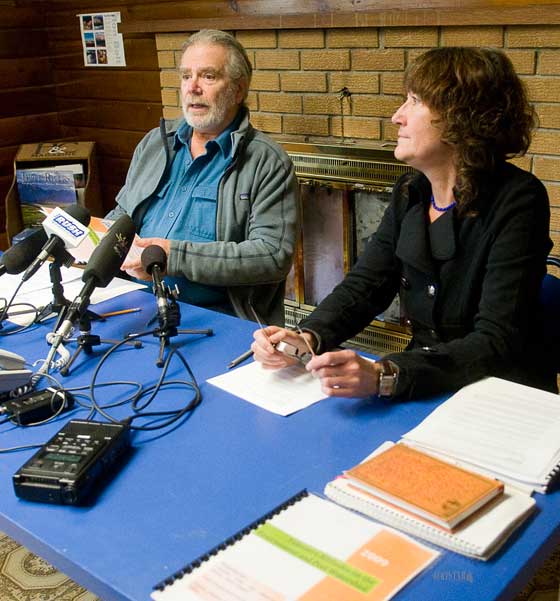
"We are very excited we have some really clear results that indicate Yukoners strong desire for protection in the Peel,” CPAWS executive director Mike Dehn told reporters during a press conference held to announce the results.
He and executive director Karen Baltgailis of the conservation society also emphasized the survey clearly indicates Yukoners are prepared to take their passion for the Peel to the polls in the next territorial election.
Of the 508 surveyed by phone and e-mail, 90 per cent indicated their vote in the next election will be influenced by the environmental policies of the different parties.
"Most Yukoners (65 per cent) who felt their vote would be influenced are in support of a strong protection policy for the Peel watershed.”
Protection, they explained, means no roads or industrial activity.
The Peel planning exercise has ignited an explosive debate between industry and the pro-conservation sectors, ever since last February, when the Peel Watershed Planning Commission released its three land use options for the 68,042 square kilometres.
The commission massaged public input on the three options into a final draft plan, and released it last April for another round of public and government review.
Industry maintains the draft plan is much too restrictive, and would eventually kill industrial pursuits in the resource-rich Peel watershed.
Pro-conservationists argue the draft plan allows far too much industrial activity and road access which would crush the pristine qualities out of one of the world's last tracts of true wilderness.
The planning commission is currently working on finalizing its recommended plan, scheduled for delivery to four affected first nation governments and the Yukon government by the end of November.
Donna Larsen, owner of DataPath Systems of Marsh Lake, said Thursday the company went "above and beyond” the normal routine to make sure the survey questions were unbiased. Everybody knew how heartfelt and sensitive the Peel debate is, and she made sure the questions would be scrutinized thoroughly, she said.
There was, she pointed out, a pre-test survey to test the neutrality of the questions.
In mid-July, while the survey was going on, however, John Witham, a former president of the Yukon Chamber of Mines who was surveyed, wrote a letter to the Star indicating it was clear to him the survey was slanted toward conservation.
Larsen, on the other hand, pointed out the last of the 18 questions asked respondents if they could tell who commissioned the survey by the nature of the questions, and there was clearly no issue.
Some of what the survey says:
• 75 per cent of Yukoners agree (strongly or completely) that the main priority for the Peel watershed should be the environment, wildlife and wilderness protection. Only 10 per cent disagree (strongly or completely.)
• Conversely, only 12 per cent strongly or completely agree that the main priority should be mineral and oil and gas exploration and development, while 66 per cent strongly or completely disagree.
• 41 per cent of Yukoners responded that road access should not be allowed anywhere in the Peel watershed.
• 50 per cent felt that roads should be allowed in some parts of the Peel watershed but not in any river corridors nor important wildlife and wilderness areas.
• Nine per cent supported roads being allowed everywhere in the Peel watershed where necessary for mining and oil and gas development.
• Approximately two-thirds of all Yukoners agree that tourism can be managed for little or no harm to the land, water or wildlife, and that wilderness tourism is compatible with long-term health for the Peel.
• Conversely, one-half to two-thirds of Yukoners feel mining cannot be managed to do little or no harm, that the quality of the wilderness could not be restored and that mining is not compatible with the long-term health of the Peel watershed.
• Both first nations traditional cultural activities and scientific research (inside the Peel planning area) have nearly complete support by Yukoners.
• Tourism in general (82 per cent) and guided outfitting hunting and fishing (75 per cent) have the strong support of Yukoners.
• Fewer than one-third support mining (31 per cent) or oil and gas exploration (30 per cent).
• 64 per cent of Yukoners felt first nations should have complete or strong influence on the decisions determining the future of the Peel Watershed. (Only four per cent felt first nations should have no influence).
• 13 per cent of Yukoners feel mining claims should have complete or strong influence.
• One-third of Yukoners (32 per cent) feel mining claims should have no influence on the decisions made.
• The majority of Yukoners (58 per cent) felt all claims in the protected area should be removed, but only those staked prior to the start of the land use planning should be compensated. (Of the 10,500-plus claims in the planning area, 8,000 have been staked since the planning exercise began four years ago.)
"It is very clear the Yukon public has a strong interest and want the Peel watershed managed to protect the environment,” said Dehn.
Baltgailis said it's also clear the Yukon has moved beyond the Gold Rush stereotype where free spirits come to the Yukon to dig for gold and make their fortunes.
"What this poll shows is the real mother lode today is our natural environment.”
Dehn said the survey was important to provide the governments and political parties with an unbiased view of where most Yukoners sit on the issue.
It's clear most want more than 50 per cent of the Peel protected, he reiterated.
"I would hope the Yukon government would listen to the desire of the Yukon people.”
With the release of the results Thursday, the survey partners will now begin sitting down with the various governments, political parties and any other interested organizations to go over the data, Baltgailis said.
Three of the four affected first nations have stated quite strongly they are in favour of maximum protection of the Peel watershed.
Premier Dennis Fentie, on the other hand, has been accused of forcing officials with the Department of Environment – particularly the parks branch – to water down substantially their submissions to the Peel planning commission.
The premier has said he was only doing his job in making sure officials followed policy and procedure when making those submissions to the planning commission.
It will almost be entirely up to the Yukon government to accept, reject or alter the final recommended plan, as 97 per cent of the planning area is territorial Crown land.
Baltgailis said it's difficult to predict how long it will take for the Yukon and first nation governments to finalize the plan once the commission delivers its final recommendation at the end of November.
Therefore, she noted, it's difficult to say how the Peel debate will play into the next election: as a land use plan still incomplete and subject to political influence heading to he polls; or as a finished plan the Yukon Party government will have to stand by in the next election.
But the environment and the Peel will be on the minds of Yukoners when they mark their X on the next territorial ballot, that much is certain, said Baltgailis and Dehn.
Asked whether it is realistic to expect the government to actually buy out 2,000 or more mineral claims, Baltgailis responded: "Is it realistic to think that any of those 10,000 claims could be developed into a mine?
"I think it is entirely realistic to say that the Peel is one of the most important regions in the world to protect.”
The Peel watershed, Dehn added, is a "playground” used by junior exploration companies to milk investors.
It's all about people getting in, making some money, then getting out, Baltgailis said.
She noted the existence of a world-class iron ore deposit on the east of the planning area that has been on the map for decades. It's not economically viable, as it it would take a $4-billion railway just to get the ore to Carmacks, she pointed out.
Baltgailis and Dehn suggested a pristine wilderness will generate a significant amount of economy for the Yukon through tourism and outfitting, for generations.
By the June 30 deadline for public comment on the proposed draft plan, the Peel planning commission received just over 1,500 submissions.
Of those, almost 1,000 were form declarations sponsored by the Yukon Chamber of Mines, signed by those who work in the mining and exploration industry, the supporting service sector or who those just support mining.
Baltgailis has always insisted their survey was not commissioned in response to the chamber lobby, but was in the works before June 30.
The conservation society contributed $2,000 of the $15,000 survey cost, while CPAWS and TIA each put in $6,500, Dehn explained.
Comments (6)
Up 0 Down 0
Heather on Sep 29, 2009 at 7:28 am
Joseph Campbell:
You are sorely misinformed about CPAWS and what you've 'been told' about their alleged hypocrasy.
Perhaps do a little more research before you put your thoughts on the table.
WAY TO GO CPAWS!
Up 0 Down 0
Francias Pillman on Sep 28, 2009 at 12:56 pm
To Joseph: You are 100% on these so called conservation societys. Especially the sierra club. All pawns, all puppets.
Up 0 Down 0
Joseph Campbell on Sep 25, 2009 at 1:30 pm
Now just who does those 78 percent represent. I'm an old miner, but I wasn't polled through the telephone or email. This whole thing was paid for by the conservation societies. Now, does that look a bit odd? Personally, I never did nor will ever trust the conservation organizations. They will lie and deceive to get what they want. I don't know how many people know this but CPAWS is just a Canadian proxy of the billion dollar Sierra Club in the US. I've been told they get much of their money from buying stock in mining companies in developing countries. Why am I not surprised!
Up 0 Down 0
Joel Luet on Sep 25, 2009 at 9:40 am
If I had been one of the people polled I, too, would have supported complete protection of the entire Peel River watershed. I have been privileged to travel in the Peel watershed and, in it's intact state, it is a jewel far more valuable than anything that can be mined from it. It is nice to have this poll confirm my feelings that there are many Yukoners who feel the same way. Let's hope the powers that be are paying attention. My vote in the next election will also be strongly influenced by the environmental policies of those seeking my vote.
Up 0 Down 0
Max on Sep 25, 2009 at 8:33 am
Good on ya, YCS, CPAWS and TIA!!
Up 0 Down 0
dave sharp on Sep 25, 2009 at 7:58 am
News just in....82% of Yukoners couldn't find the Peel watershed on a map of the Yukon.