Photo by Whitehorse Star
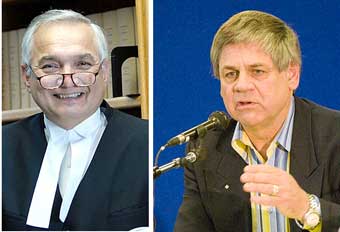
Judge Heino Lilles, Yukon MP Larry Bagnell
Photo by Whitehorse Star
Judge Heino Lilles, Yukon MP Larry Bagnell
A new criminal law proposed by the ruling federal Conservative Party won't change much in the Yukon, because the territory already follows the principle the government is proposing.
A new criminal law proposed by the ruling federal Conservative Party won't change much in the Yukon, because the territory already follows the principle the government is proposing.
However, the law would limit the amount of discretion a judge can use in sentencing, and that concerns one senior territorial court judge.
The Truth in Sentencing Act - tabled in the House of Parliament last Friday - would put a cap on the amount of extra credit for time served judges can give to offenders.
Typically, an offender is given extra credit for time served before trial for two reasons: in part to make up for the fact there are usually fewer services and overcrowded conditions in the facilities where accused people are held, and to factor in the statutory parole offenders are granted after serving two thirds of their sentence.
Part of a raft of new crime bills, the Conservatives are proposing a maximum of 1 1/2 times credit, and when giving that credit, the sentencing judge must give clear reasons for doing so.
In some jurisdictions, judges give as much as three-for-one credit.
"I think one of the objectives behind the legislation is to improve transparency in sentencing," Noel Sinclair, a Whitehorse-based Crown prosecutor, said of the bill Monday. "...There is a concern that past sentencing has been perceived as more lenient than it actually is."
But judges in the Yukon generally give a maximum of 1 1/2 times credit for pretrial time served anyway.
"It's been a long-standing agreement among our judiciary," Shauna Curtin, the director of court services, said Monday of the Yukon's sentencing practice.
The territory is not like B.C. or Alberta where accused people are held in often overcrowded remand (pretrial) centres where they cannot access basic rehabilitation services such as Alcoholics Anonymous.
Here, everyone goes to the Whitehorse Correctional Centre, and everyone has access to the programs offered there.
The only time people may be excluded from a program - group counselling, for instance - is when they are considered a serious security and safety risk, said Yukon Department of Justice spokesman Dan Cable.
But there are still conditions that call for more than 1 1/2 times credit, says a senior territorial court judge.
Judge Heino Lilles points to a recent case he oversaw where a man was violently sexually assaulted by two other inmates while he was being held before his trial. He was then put into segregation for his own protection. Lilles gave that man - who, as a victim of sexual assault, cannot be named - double credit for time served.
Lilles warned that a judge's discretion is an important part of the process.
"Those facts convinced me that a higher factor should be used," Lilles said. "If the new legislation prohibits using a higher factor in exceptional cases, an injustice may result."
Another change included in the bill would forbid the courts from giving extra credit for any time served because of bail or court order breaches.
Yukon MP Larry Bagnell said Monday he supports the bill, which passed first reading last Friday.
"Nationally, a lot of people are asking for it," he said, citing the attorneys general from B.C. and Alberta who raised concerns that offenders and defence lawyers are letting cases languish before going to court in order to get a shorter sentence through an extra time credit.
"I think it's hoped that (the new law) will cut down on that and help to move things through the court process in a more timely fashion," Sinclair said.
But Bagnell does put a caveat on his support.
"The government needs to invest more in the training and rehabilitation programs nationwide," he said from Ottawa. "They have these tough on crime bills but they haven't added any anger management or education programs, so people are still coming out of prison with a higher chance of reoffending.
"We have obviously failed to deal with crime in our society because so many people are coming back to jail."
The territorial Department of Justice is revamping its correctional services. The overhaul will include a new jail and increased services for inmates.
People sentenced to terms longer than two years are sent to federal prisons in B.C. or Alberta.
In order to encourage thoughtful and responsible discussion, website comments will not be visible until a moderator approves them. Please add comments judiciously and refrain from maligning any individual or institution. Read about our user comment and privacy policies.
Your name and email address are required before your comment is posted. Otherwise, your comment will not be posted.
Comments (1)
Up 1 Down 1
E. Campbell on Mar 31, 2009 at 11:17 am
Heino Lilles is retired. He should spend his leisure time at the golf course and stay out of politics. I too worked in Corrections for years. There should be no good time while awaiting trial. Lilles was far to easy on the criminals. Often they were back home before his court day was over. What the Yukon needs is more of them in jail instead of out on the street making trouble. Its obvious now that the so called rehabilitation programs aren't working. Our system up here is a revolving door. Most often when they get out, they just see that time as vacation. When they feel vacation time is over they will get back in some way. No more good time after their second trip. I believe in strike 2 your in - for the max. We the law abiding citizens deserve it.