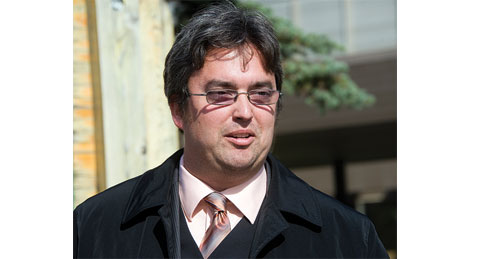
Photo by Whitehorse Star
Pictured Above: LIARD McMILLAN
Photo by Whitehorse Star
Pictured Above: LIARD McMILLAN
Premier Darrell Pasloski is leading the Yukon down a path to instability, says Chief Liard McMillan of the Liard First Nation.
Premier Darrell Pasloski is leading the Yukon down a path to instability, says Chief Liard McMillan of the Liard First Nation.
McMillan and the Kaska leadership from the Ross River Dena Council and northern B.C. met with Pasloski Friday morning.
They discussed the premier's plan to remove the requirement for the Kaska's consent prior to oil and gas development in southeast Yukon.
The Kaska have threatened legal action if the Section 13 of the Yukon Oil and Gas Act is removed. They sent Pasloski a letter asking that they meet Dec. 7 to see if they could avert a train wreck.
"We came forward today in good faith, and basically we received a slap in the face from the premier,” McMillan said in an interview Friday afternoon.
"It is a slap in the face for our elders, it is a slap in the face by a government that says one thing and does another.”
Pasloski said this morning he told the Kaska leaders he will be repealing Section 13.
He emphasized his government wants desperately to work co-operatively with the Kaska.
It's just time to move on, Pasloski said.
He said the government has spent millions of dollars over the last 10 years trying to work out an arrangement with the Kaska to allow for oil and gas development with the Kaska's full participation.
It's all on the written record, but the parties have failed to finalize an agreement, the premier pointed out.
"I told them I felt it was time as leaders to put the people first,” said Pasloski. "It's time to make a decision to move forward for these communities of Ross River and Watson Lake.
"There's has been a lot of money spent on lawyers and consultants, and it's time to focus on people.”
The territory's oil and gas resources belong to all Yukoners, and allowing opportunities for oil and gas development would benefit all Yukoners, he said.
Furthermore, said Pasloski, maintaining the power of veto for the Kaska is not fair to the other First Nations which surrendered the veto when they finalized their land claim and self-government agreements.
The premier said it's his government's interpretation that the provision to obtain consent was meant to be temporary in nature; only until aboriginal land claim settlements had been finalized.
The Liard First Nation and Ross River Dena Council are two of the three Yukon First Nations without a settlement.
Eleven First Nations have signed agreements.
How the Kaska will respond if Section 13 is repealed is a matter for consideration, but they will respond, insisted the chief of the Liard First Nation.
McMillan said the Kaska have and will always have the power of veto over oil and gas activity on their traditional territory.
Removing Section 13 will not take away that authority, not as far as the Kaska are concerned.
"There will be no activity of any kind without our consent – oil and gas, mining, forestry....”
Repealing Section 13, said McMillan, "would place the Yukon on a very slippery slope.”
Amendments to the Oil and Gas Act have received first reading, and were scheduled to be before the legislature for second reading this afternoon.
The requirement to obtain the consent of First Nations was included in the Oil and Gas Act as a means of gaining support from the Yukon First Nations in 1997 for the transfer of authority over oil and gas from Ottawa to the Yukon.
Energy, Mines and Resources Minister Brad Cathers has also indicated in writing to the Kaska the consent provision was only meant to be temporary, as a measure of comfort to the First Nations while they finalized their modern day treaties.
Since the Kaska have not finalized a claim and are not trying to negotiate a settlement, it's time to remove the requirement for consent, Cathers has said in writing.
The Kaska, backed by the support of all the other Yukon First Nations, maintain there is no sunset clause on the 1997 commitment to obtain consent prior to development.
The Yukon government, they argue, does not have the legal right to remove it unilaterally, and it's not going to take the courts long to figure it out.
Cathers and officials in his department have known for well over a year that there is renewed interest from the oil and gas industry in southeast Yukon and the Kootaneelee gas fields.
A company has just purchased controlling interest in the Kootaneelee gas fields, and has indicated there's likely marketable potential in the shale gas deposits in the southeast.
Shale gas requires hydraulic fracturing to release the gas.
There is a movement afoot in the territory calling for a moratorium on fracking until Yukoners have had an opportunity to fully understand the technology and what, if any, impacts it has on the environment.
Many say fracking is a modern day plague that destroys groundwater and leaves behind a cocktail of poisonous chemicals.
Industry, however, maintains the hydraulic fracturing has been in common use for 50 years, and is not a threat to the environment.
McMillan said Pasloski and his minister appear drunk on the thought of an oil and gas rush on the Yukon.
"Perhaps the premier and the minister are too busy drinking their frack cola and pissing on the Kaskas' aboriginal rights and title to be really focused on where this government needs to go for the good of the Yukon,” the chief said.
At a special meeting of its chiefs last week, the national Assembly of First Nations passed a motion supporting the Kaskas' rights and title over their traditional territory.
In order to encourage thoughtful and responsible discussion, website comments will not be visible until a moderator approves them. Please add comments judiciously and refrain from maligning any individual or institution. Read about our user comment and privacy policies.
Your name and email address are required before your comment is posted. Otherwise, your comment will not be posted.
Comments (3)
Up 0 Down 0
Shaun LaDue on Dec 11, 2012 at 12:35 pm
I speak only for myself and my experience as a Kaska Dena, I do not speak for my people. I can not condone what this government is trying to do. The Kaska Nation has been listening to the elders, and the elders have been saying that there is to be no land claims - that is my understanding. We are taught that we must listen to our elders and learn from them. Many of our elders have had good lessons to teach us. We use the land and all that grows on her - as Mother Earth has intended. If we are to use the land and all that grows on then we can not poison the water or dig deep into the belly of Mother Earth - there is no respect in doing such a thing. Asking us to stand aside while the government takes away our right to veto oil and gas development means that we veto the right to hunt and gather medicinal herbs - read food for our children and our elders. Would you like it if we took away your right to drive your car to Superstore to buy your groceries? I didn't so. There is more to this story than a bunch of stubborn First Nations politicians versus government. Mussi cho.
Up 0 Down 0
Up in arms on Dec 11, 2012 at 2:36 am
When you start threatening to move in and do something on land that someone else owns get ready for a fight. Not a legal fight, I have nothing to do with this but I can say two things for sure. 1) I completely disagree with fracking but more importantly 2) I would defend my land with more than words so I'd hope the First Nations groups will too.
Though all conflicts should try to be resolved with words, sometimes words fail and I pray that doesn't happen here because people are getting SICK of this government.
Up 0 Down 0
Arn Anderson on Dec 10, 2012 at 12:20 pm
We do not know what they disagreed on prior to this, whether it's one issue or twenty issues on why they couldn't get it done. That's not mentioned at all, but more problems are arising from this and I bet, now its going to get worse. You guys can argue who is right and who is not but the bottom line is compromise has left the building.