Political will called essential for police reforms
Changing the way the Yukon RCMP do their job will take more than just recommendations from the currently sitting policing review committee.
By Justine Davidson on October 1, 2010
Changing the way the Yukon RCMP do their job will take more than just recommendations from the currently sitting policing review committee.
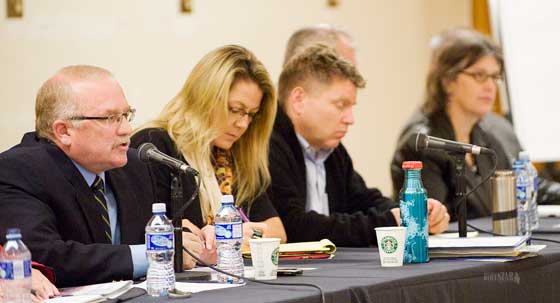
"It will take political will,” committee member Rick Smith at Thursday evening's public meeting in Whitehorse. "Otherwise, you're right – it will look like a tourism brochure. It will sound trite.”
The comment, made by the deputy minister of Community Services who oversees ambulance services in the territory, came at the end of a two-hour session which was subdued compared to last month's well-attended public meeting.
Many of the same issues were raised, however. The people who stood up to the microphone wanted to know what would be done with their input, and what concrete changes they would see coming out of this months-long process of public forums and private committee meetings.
"I'm looking at this booklet, with the beautiful mountain on the front; it looks like a tourism booklet, but I'm wondering what will be done with it,” said one young woman, prompting Smith's response.
The handout she was referring to is an update on the committee's work, published for Thursday's meeting.
It notes a number of "common themes” which have come up during the 40-odd public and private meetings, as well as through written submissions.
It noted that while at every meeting someone expressed gratitude for the work the RCMP do, the committee "also heard that the trust and confidence that some citizens once had for the RCMP has eroded.”
That sentiment was expressed last night by a cab driver who said he lost all faith in the RCMP when he was taken to court on a careless driving charge.
"My lawyer told me to tell the truth,” he said. "so I did. But the officer, she lied.”
The man said he was convicted based on false statements made by the arresting officer, and there was nothing he could do about it.
"I have a child and a wife, and I tell them, you can't trust police.”
He didn't bother appealing the conviction, nor did he complain to the officer's supervisor, he said, because he already knew the officer's word would be taken over his regardless of whether he was talking to a judge or a sergeant.
"I'm so helpless; there's nothing I can do.”
The comments brought discussion back to another recurring theme: What members of the public should do when they feel they have been treated unjustly by the police.
Several other members of the public brought this up last night in the context of women calling for help in domestic disputes and not getting the assistance they need.
Sometimes there is no investigation, while sometimes no one even shows up, said one woman.
"If you're not getting the proper response to a situation from the front-line constable, bring it to the attention of that officer's superior,” urged Supt. Peter Clark, the territory's commanding officer. The public needs to report unprofessional and negligent behaviour "to keep young officers accountable,” he said.
But as one speaker countered: "If a woman is calling the police, she is already at the end of her rope ....
You can't expect a woman in that position to call the person who didn't help her to complain.
"We need a better answer.”
Answers in the form of concrete actions and changes were not forthcoming at last night's event.
The way the review is set up, the committee receives input. It does not suggest possible solutions at the these public forums, although the committee members said they are working on recommendations in their closed-door sessions.
The review process is also happening within the ranks of the RCMP, Clark said. It was prompted, as the public process was, by the death of Raymond Silverfox in RCMP cells. Following an inquest into the death this year, Clark said he was "shocked” by the "callous” treatment Silverfox received from RCMP officers and cell guards.
That case, as well as the case of two Watson Lake-based constables who were charged then acquitted after trial of sexual assault, were both raised indirectly at last night's meeting.
A young man stood to ask what happens to officers who commit crimes, ranging from assault to negligence, in the course of duty.
The first step is to call in an independent police force to do the investigation, Clark said.
It is not appropriate for the RCMP to be investigating their own, he added. "In fact, it's even difficult for another police force to investigate the RCMP.”
This same sentiment has been echoed across the country in the past few years, prompting calls for civilian bodies to investigate cases which involve alleged criminal actions on the part of the police.
Whether that will be part of the Yukon's new policing agreement currently under consideration by cabinet, Clark couldn't say. He hasn't yet seen the confidential document.
The policing agreement essentially gives the minister of Justice the authority to remove officers from service, set priorities, goals and objectives for the territorial Mounties; control certain financial aspects of the division and select the commanding officer.
Clark said he hopes the revamped policing agreement will put more power in Yukoners' hands.
"Policing has got to be local,” Clark said. "We can't be policing out of Ottawa.”
Whitehorse ceremony to honour fallen northern officers .
Be the first to comment