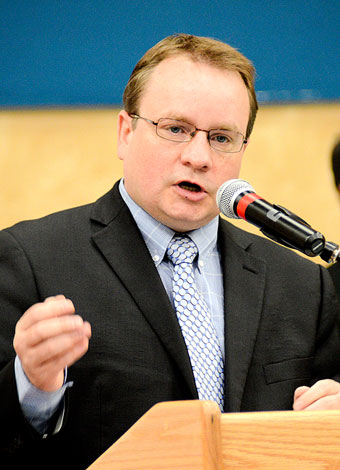
Photo by Whitehorse Star
Energy, Mines and Resources Minister Scott Kent
Photo by Whitehorse Star
Energy, Mines and Resources Minister Scott Kent
A new policy allowing small producers of renewable energy to sell excess electricity back to the grid was delivered Tuesday.
A new policy allowing small producers of renewable energy to sell excess electricity back to the grid was delivered Tuesday.
Energy, Mines and Resources Minister Scott Kent said his government and Yukoners in general are concerned about having a future with clean energy.
Promoting the use and generation of renewable energy through a policy that encourages conservation and provides a financial incentive to pump excess energy onto the grid is a step toward the future,
said Kent.
The minister said the next few months will also see another policy announced for large independent producers, along with more about a new major hydro development that Premier Darrell Pasloski has
committed to.
"This is the thin end of the wedge,” Kent said of Tuesday's announcement. "We have some exciting announcements coming forward in terms of our clean energy future.”
The minister pointed out approximately 95 per cent of the Yukon's energy is already produced by renewable hydro generation.
Discussions around the micro-generation policy reach back to 2009 and are in keeping with the Yukon Party's 2009 energy strategy, he said.
Like others in the business, Kent isn't sure how much interest there will be or how the financial arrangements will work. He did point out, however, that the policy calls for review after two years.
Under the policy, individual homes and businesses will be able to sell excess power to the grid, provided it's produced using sources of renewable energy – micro-hydro, wind, solar and biomass. The
calculation will be made once a year, not monthly.
Private producers will be responsible for all costs of their equipment to produce energy, and all costs associated with hooking the system into the grid.
The two electrical utilities, Yukon Energy and Yukon Electrical Co. Ltd., will be responsible for purchasing, installing and maintaining the
metering equipment required to measure the two-way flow of energy.
Generating systems of different sizes will require different levels of consultation with the two utilities and the Yukon government, which is financing the policy and paying for the surplus energy sold to the grid.
Shane Andre of the government's Energy Solution Centre explained the upcoming price for surplus energy varies from communities on the unified grid and isolated communities off the grid.
The price is based on what it would cost in the different communities for the two utilities to produce the same amount of energy, he explained.
Andre said in isolated communities powered by diesel generation, the government will pay 30 cents per kilowatt hour, because that's the estimated cost of producing a kilowatt hour from diesel generation.
The government will pay 21 cents per kilowatt hour of excess energy on the main grid, because that is the estimated cost of producing a kilowatt from a new source of energy, he explained.
The estimated cost of a kilowatt hour from hydro-generation on the main grid is 8.75 cents per kilowatt. But having to produce that same kilowatt with a new source is estimated at 21 cents, Andre said.
He said the beauty of the new policy lies in how it first of all encourages conservation, then pays micro-generators for selling the energy they've conserved back to the system.
Asked to explain, Andre went through the math, using a micro-hydro project proposal with a generating capacity of five kilowatt hours. A similar but smaller proposal just outside the city limits is currently
before authorities for approval.
• 24 hours x five kilowatts of generation per hour equals 120 kwhs of energy per day.
Calculated using an efficiency rate of 90 per cent, that translates into 39,420 kilowatt hours of energy a year.
• Records show the average Yukon home – not heated by electricity – consumes about 1,000 kwhs a month or 12,000 kwhs per year.
• There would potentially be a surplus of 27,420 kilowatt hours coming from the residential project.
At 21 cents per kwh, that works out to $5,758 per year available for sale back to the grid.
The cost of the system up for approval is estimated at between $20,000 and $25,000.
Andre said the policy not only promotes conservation by micro-generators so they can maximize the surplus available for sale but also provides an incentive to keep their system running smoothly.
With the release of the Yukon's policy Tuesday, Nunavut and Newfoundland are the only two jurisdictions in Canada without a similar incentive policy, he pointed out.
Yukon Electrical spokeswoman Laura Carlson said this morning they have had a number of inquiries over the last year but what that translates into, it's impossible to say.
There's a number of solar energy projects in the city, she said.
Carlson pointed out Yukon Electrical is currently involved in a 4.7-kilowatt solar project with the Kluane First Nation of Burwash Landing.
Anne Middler of the Yukon Conservation Society said the policy is the right step in terms of empowering Yukoners to promote conservation while providing an incentive to supply renewable energy to the grid.
The Yukon, however, has a long way to go to beef up the main grid with sources of renewable energy, she said.
In order to encourage thoughtful and responsible discussion, website comments will not be visible until a moderator approves them. Please add comments judiciously and refrain from maligning any individual or institution. Read about our user comment and privacy policies.
Your name and email address are required before your comment is posted. Otherwise, your comment will not be posted.
Comments (6)
Up 3 Down 1
north_of_60 on Nov 1, 2013 at 5:13 am
@ hmmm & MaxMack are correct.
Additional energy is of little value to the grid unless it directly displaces diesel fuel; i.e. when the generators are running. Small producers can enjoy the savings of generating their own power, and the significant convenience of dumping excess onto the grid instead of needing an expensive battery bank. However they shouldn't expect to get paid for that energy unless it results in less diesel fuel used. Spilling water and paying for additional un-needed energy is foolish and inefficient.
Up 5 Down 0
carcajou on Oct 31, 2013 at 3:35 pm
If you're personally concerned about diesel fuel providing some of your electricity, then go look at Yukon Energy's website:
http://www.yukonenergy.ca/customer-centre/tips-tools/current-energy-consumption
Then, when it's colder than about -25 you can see when the generators start running. When that happens go turn off the breaker to your hot water tank till the peak load passes, usually from about 7 to 9 in the morning. Your action will cause a small amount of diesel fuel to not be burned. If a few thousand of us did that we would use a lot less diesel fuel.
If we have the technology to put wind turbines on the hill that stand still when the diesel generators are running, then shouldn't we be able to automatically control hot water tanks so we don't burn as much diesel fuel?
Up 5 Down 0
Max Mack on Oct 31, 2013 at 10:18 am
@hmmmm
The policy set into play is going to do exactly that. It is designed to pay a premium for "renewable" sources, such as power, wind, etc.
The vast majority of home-owners lack either the capital or the know-how to invest in these systems. So, who is it really designed for?
Guess who will eventually pay for what will amount to risk-free investment for corporations?
Up 5 Down 0
hmmm on Oct 31, 2013 at 5:21 am
Be very careful here people. YTG is going to set up the public to pay for the private sector to sell power back to the grid at an inflated price. This is similar to what the BC Government did to BC Hydro. They made BC Hydro sign IPPs with these private companies and pay more for power than the going rate. It is costing BC Hydro tens of millions of dollars to fund the private sector companies and that means with public money.
Up 6 Down 0
north_of_60 on Oct 31, 2013 at 5:09 am
"Anne Middler of the Yukon Conservation Society said ... The Yukon, however, has a long way to go to beef up the main grid with sources of renewable energy, she said. "
Oh really?
The main grid is already 97% renewable hydroelectricity. The diesel generators only run on cold dark winter mornings when there is very little if any solar energy available.
If the goal is to use less diesel then store more water behind the dam at this time of year.
Up 3 Down 1
Sebastian Jones on Oct 30, 2013 at 11:31 am
Using Shane Andre's example, the return on the investment of $25,000 is a whopping 20%/ year.
Sounds like a pretty good investment!
Sadly, most of us do not live with a suitable source of micro hydro and would need to go solar pv, which would generate more like 5,000 watts a year, which would earn (save) you $1050 a year, and if it cost you say $10,000 for the panels and, well we don't know what it will cost to get tied in to the grid, say $5,000 for the sake of argument, then it would take 14 years to pay off the installation, not including any interest if you had a loan. It amounts to a 7% return, still not bad!