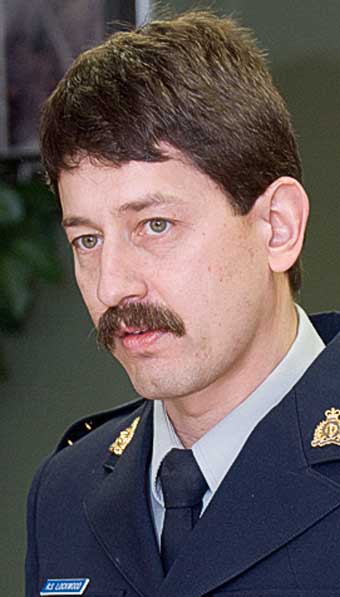
Photo by Whitehorse Star
Sgt. Roger Lockwood
Photo by Whitehorse Star
Sgt. Roger Lockwood
The Whitehorse RCMP will be investigating themselves following the in-custody death of Raymond Silverfox, a process that some say is deeply flawed.
The Whitehorse RCMP will be investigating themselves following the in-custody death of Raymond Silverfox, a process that some say is deeply flawed.
Silverfox was picked up by the police on Tuesday morning from the Salvation Army on Fourth Avenue at Black Street in Whitehorse.
Twelve hours later, he was found unconscious in his cell and taken to Whitehorse General Hospital, where he died just after 9 p.m.
On Thursday, the federal Public Complaints Commission announced it will be monitoring the internal investigation through its Independent Observer Program.
The program was first launched in B.C. in 2007, and since then has sent an observer to oversee nine RCMP investigations in that province.
"We are only looking at impartiality issues, not adequacy issues," Kevin Brosseau, the commission's director of operations, said in an interview today.
"For example, was it (a junior) officer doing the investigation, or was it a senior officer who is in no way connected to the officers involved in the incident?"
The Whitehorse RCMP detachment has called on Mounties from B.C. to assist in the investigation, Sgt. Roger Lockwood said Thursday.
He added today the public complaints commission will likely be called on during future internal investigations.
But even with outside officers on the case, there is still the problem of "the thin blue line," says a lawyer familiar with police-on-police investigations.
Howard Rubin is a Vancouver lawyer who has worked on several high-profile cases involving the RCMP, including the death of Ian Bush, a 22-year-old B.C. man who was shot to death by a police officer while in custody. He had been caught with an open bottle of beer outside a hockey arena.
It was this case that prompted the development of the Independent Observer pilot project.
Rubin told the Star today that in his experience, police-on-police investigations are intrinsically flawed.
That's because officers are generally reluctant to say anything that might get another officer in trouble, especially when they are being interviewed by a fellow cop.
"Police won't speak against other officers," Rubin said.
And the presence of an outside observer doesn't help, he continued, because they are only privy to the evidence compiled by the RCMP.
Rubin said that in order for a truly independent investigation to be done, someone outside of the RCMP should be the one to take statements from officers.
"I don't consider them independent," he said of the commission.
Brosseau agreed that the observer has no powers to conduct their own inquiries. They do, however, keep a close eye on the integrity of the police work and pass any concerns to their superior.
Ultimately, he said, it is up to the police to implement or ignore the recommendations of the observer.
The Yukon coroner's office will also be involved in the investigation and will similarly make recommendations to the various parties connected to the incident.
Silverfox is the third person to die while in the Whitehorse police cells since 1999.
In order to encourage thoughtful and responsible discussion, website comments will not be visible until a moderator approves them. Please add comments judiciously and refrain from maligning any individual or institution. Read about our user comment and privacy policies.
Your name and email address are required before your comment is posted. Otherwise, your comment will not be posted.
Comments (1)
Up 0 Down 0
Susan Rogan on Dec 8, 2008 at 7:13 am
I happen to believe that this death was not the responsibility of the police based on what I can read into the situation.
However, since the article is actually about police investigating themselves, I want to say that I still remember the destruction of the tape in RCMP custody of Jeff Monkman's 130 km an hour drive up the Carcross Road when he flipped the vehicle and a woman was killed.
The tape showed Monkman's speed and driving and would have been good evidence.
Mysteriously the tape was 'stretched' while on pause repeatedly, I believe that was the story, until it was ruined and could no longer be viewed. No copies were made of the tape despite the fact that it was viewed over and over. Do I believe that the destruction of this tape was accidental? Not really.
Accidental or not, it is completely indefensible that this evidence was ruined by the RCMP. I do not actually believe the tape was ruined by mistake, sorry but there it is, however if it actually WAS, what does that say about the people handling evidence?
Anyway, as far as the public is aware, nothing was done about it, nobody blamed or faulted. In my mind this sticks as an example of what happens when the RCMP investigate themselves.
The RCMP should most definately be investigated by a civillian body whenever investigations are called for. There have been enough examples across the country of deaths at the hands of the RCMP, and enough outrage at the results of the self-investigations that it would be good for the RCMP as well as the public to have such investigations taken out of their hands. It would add legitimacy to the exoneration of the 'members' as they call themselves, should they in fact be found innocent of ill conduct. One would assume they would welcome this.