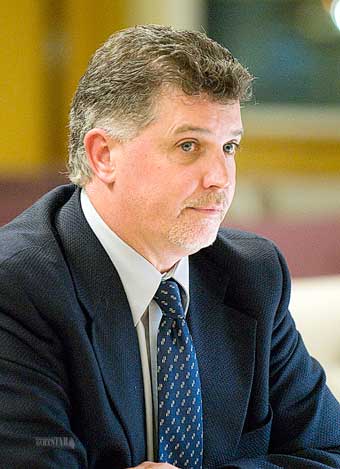
Photo by Whitehorse Star
Whitehorse Transit manager Dave Muir
Photo by Whitehorse Star
Whitehorse Transit manager Dave Muir
An overhaul of the city's bus service that could provide some routes with hourly service may cost the city an extra $653,582 each year in running the buses.
An overhaul of the city's bus service that could provide some routes with hourly service may cost the city an extra $653,582 each year in running the buses.
On Tuesday, Whitehorse Transit manager Dave Muir unveiled the suggested interline schedule and system for buses that he would like to see begin next year.
"Once people get the hang of it, they won't even need a schedule," said Oliver Halickman, a driver who sits on Transit's scheduling committee, told council members and staff at a noon meeting.
The new system proposes a more continuous service without a central location for transfers, as exists at the current Ogilvie Street transfer station downtown.
The schedule for the new system is also designed for residents to more easily remember, arriving continually at so many minutes past the hour.
The suggested Riverdale South/Hospital/Porter Creek Express route, for example, would hit Main Street at 20 minutes after each hour, F.H. Collins Secondary School at 23 minutes past each hour and so on, leaving riders having only to remember the minute when it arrives.
Included in the plans are five routes, three of which run through Riverdale.
"It is one of our highest ridership areas," Muir said.
Along with the express route from Riverdale to Porter Creek running every hour, there would be two Riverdale North routes. The Riverdale North/Hospital/Copper Ridge route would travel through the neighbourhood on an hourly basis, heading up Two Mile Hill to the Canada Games Centre, then through Copper Ridge and back downtown to Main Street.
Meanwhile, the Riverdale North/Kopper King/McIntyre/Hillcrest route would go through the major intersections of Klondike Road at Alsek Road and Lewes Boulevard up Second Avenue to Two Mile Hill onto the Alaska Highway to the Kopper King before coming back to McIntyre, the Canada Games Centre and onto the Alaska Highway for stops at Burns Road and the airport before heading back downtown again.
The final two routes would get riders from the downtown area into neighbourhoods like Porter Creek, Crestview, Takhini, Lobird and Copper Ridge.
The Porter Creek/Crestview route would start downtown heading up Second Avenue, onto Mountainview Drive and into Porter Creek, followed by stops in Crestview before coming back downtown again.
Finally, the Lobird/Copper Ridge/Takhini/College express would head out Robert Service Way, stopping at Falcon Drive and Finch Crescent first, followed by Lobird before returning downtown and heading up to Yukon College and into Takhini before coming back downtown.
Missing from the schedule is any route along Fourth Avenue, with each of the five runs travelling along Second Avenue.
The success of another city initiative is to blame for the lack of a route along Fourth Avenue. As Muir explained, the "traffic diet" that was designed to slow traffic along the major road has done just that to the point that buses would not be able to adopt the proposed schedule system.
On Second Avenue, bus drivers will be able to meet their schedule with the bus stops still within the 250-metre radius the city has established as the distance riders are willing to walk to get to a bus.
While the city ended its downtown loop transit route earlier this year, Muir said the various routes running along Second will provide buses cycling through the downtown on a regular basis throughout the day.
The proposed schedule shows, for example, buses on Second at Main Street about every 20 minutes through the week running in each direction for the various routes.
"It's a bit of a replacement for the downtown loop," Muir said.
Staggered breaks for drivers would eliminate disruptions to the service. Over time, regular users are more likely to know that if they miss one bus, they can catch another at so many minutes past the hour because the bus will arrive at the same time past the hour throughout the day. That would help eliminate the need for riders to carry a schedule.
As Muir pointed out, it would also help staff who find themselves having to resort to the printed schedule when riders call to find out the time of the next bus at a particular stop.
The interline system also means that when one bus is behind schedule, it wouldn't throw the schedule off the entire system, it was noted.
The new system would move the city closer to meeting its sustainability goals, said Shannon Clohosey, the city's sustainability projects manager.
She cited the benefits of reduced greenhouse gas emissions, less stress on the roads and other positives from having residents travel by transit.
She pointed out that for the past 50 years, communities around the country have been built to accommodate vehicles.
"Cities are shaped by their transportation systems," she said.
While a city not focused on sustainability can have a transit system, Clohosey said, you can't have a sustainable city without a transit system. But for a transit system to work, it has to be seen as easy to use.
"It has to be extra-convenient to compete with the convenience of the car," Clohosey said.
As transit officials noted, the new schedule is aimed at making the system more convenient for riders, though Muir said it would likely take some time for it to catch on.
In the first year, it's expected there could be a 30 per cent increase in ridership. That's based on figures from free transit or colder winter days, when ridership rises by about 30 per cent.
Meanwhile, the convenience of the system could also bring the number of transfers for residents down from 25 per cent to 10 per cent, Muir suggested.
The proposed schedule was also made up with consideration for the trail system that would allow riders to choose between bus stops based on what schedule works better for them, it was pointed out throughout the meeting.
Although the city would not need any new buses up front to get the system going, Muir said, there are some requirements to get it going.
They include new turn-arounds on the Takhini route (a change that is needed anyway, as the current turn-around is on Kwanlin Dun First Nation land) and at the Kopper King, a roundabout or traffic signals at Lewes Boulevard and Nisutlin Drive, changes to existing
stops and work done on trails to make them more walkable, with possible signs.
Drivers would also move to more full-time hours of 35 to 40 hours each week rather than the more part-time hours they have now.
Council has been given until an August council and senior management meeting to come back with any concerns or comments for staff.
Coun. Doug Graham noted his only major concern is the lack of a Fourth Avenue route. Coun. Florence Roberts wondered about the possibility of bringing in residents from the rural areas around the city, something Muir suggested may be looked at after this system is up and running.
Muir stressed the proposal stems from the work of a number of city departments, ranging from planning to engineering and others.
The city's current system costs $1.6 million to operate annually, with the new one expected to cost $2.2 million.
Based on the 30 per cent hike in ridership, it's expected it would generate an extra $180,000 annually.
In 2008, ridership on the system stood at 270,000.
In order to encourage thoughtful and responsible discussion, website comments will not be visible until a moderator approves them. Please add comments judiciously and refrain from maligning any individual or institution. Read about our user comment and privacy policies.
Your name and email address are required before your comment is posted. Otherwise, your comment will not be posted.
Comments (8)
Up 0 Down 0
Christine Mader on Jul 16, 2009 at 9:49 am
You're dead wrong on this, Francias Pillman: there are actually people in Copper Ridge who paid off their mortgages already! So, please, don't put us all in the "same basket"!
Chris
Up 0 Down 0
Anthony on Jul 15, 2009 at 4:53 pm
Lighten up Francias (sic)
I live in Copper Ridge and take the bus regularly. Most workdays (while still you're sleeping) the bus is full as it makes the run from downtown through the Village, Arkell, Logan, Copper Ridge and Granger and back again.
BTW, I only have two cars and my mortgage has 7 years left. You sound jealous, perhaps you should have stayed in school and made something of yourself.
It's not too late.
Up 0 Down 0
Francias pillman on Jul 14, 2009 at 4:57 pm
They don't need service in copper ridge. Everyone has 5 cars and a home they will never live to see paid off. Big money whitehorse needs less buses and more dog sleds on the road. And why should arn zip it? Because its the truth? You people accept any garbage the news station tells you, but when someone comes along and turns it into a funny antidote you people flip out. Get a grip please. In the meantime sign me up for the carbon credit airline. I like watching my money fly away, kinda of like peoples fake carbon reality. Which so many are begging to pay for. Sad thing is, there wouldn't be such a thing as global warming or climate change if there wasn't a thing called MEDIA. Please do society a favor and reevaluate what you call reality.
Up 0 Down 0
Vinyl village idiot on Jul 14, 2009 at 5:20 am
I started using the bus last winter to get home from work and it worked quite well but if they continue to 'tweak' the schedule too much I think they may end up dienfranchising riders.
A question for Dave Muir, Why has the south end of Copper Ridge been neglected on the routes? It is well over 1.5 km (unprecedented in Whse) to the bus stop form the furthest reaches of Copper Ridge, nobody is willing to walk that far/long in the summer let alone winter.
Arn: If you've got nothing intelligent to say then zip it.
Up 0 Down 0
Arn Anderson on Jul 12, 2009 at 12:24 pm
Heres a more sensible plan: Get David Suzuki to come up here and fund private jets for everyone in town to get around town and we can put up some stupid climate change stickers on em. Think of it as a carbon credit offset program.
Up 0 Down 0
Jeff Roe on Jul 11, 2009 at 3:12 am
I have lived in Whitehorse in the past and their transit system back in mid 80's-mid 90's was actually pretty good. However what they are proposing is actually what many cities have been doing forever...with a Riverdale to Porter Creek,etc its a good plan. However it would make more sense for them to run one way down 2nd and the other way down 4th. That way it would serve more.
Up 0 Down 0
Sam Bergmann-Good on Jul 11, 2009 at 12:21 am
Finally finally something is being done about the bus service! I've literally had dreams of how to fix this outdated broken transit system. Why is there a central transfer location in the first place? Whitehorse should attempt to adopt Vancouver's excellent system albeit on a smaller scale. This looks like a step in the right direction.
Up 0 Down 0
Scooter on Jul 10, 2009 at 10:39 am
It sounds like this may be an actual good idea for the transit system for once. What's going on at the City that they are actually coming up with half-decent ideas?
Oh, that's right.
It's an election year...
I hope this "new" adjustment to our battered and essentially useless transit system makes it without too much political fussing.