Photo by Whitehorse Star
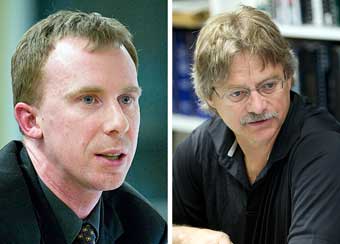
City planner Mike Ellis and City Manager Dennis Shewfelt
Photo by Whitehorse Star
City planner Mike Ellis and City Manager Dennis Shewfelt
The Whitehorse of the future could be a city with buildings of up to six or seven stories,
The Whitehorse of the future could be a city with buildings of up to six or seven stories, a larger Chadburn Lake Park Reserve with different boundaries, and more cabin suites on private property.
That would occur if recommendations proposed in the latest draft of an updated Official Community Plan (OCP) are adopted.
The 53 changes to the current OCP, the overriding planning document for the city, were released Thursday prior to an evening council and senior management meeting to discuss some of the changes.
The first hour of the three-hour session was closed to the public as council discussed specific land issues on privately held properties. It was then opened to the public as discussions moved into the overall policy.
"There's still a public process to go through now,” acting Mayor Dave Stockdale said in an interview following the meeting.
After an initial public process which included 21 public meetings to get an idea of what residents wanted included in the latest OCP, city planners drafted the 53 proposed changes.
The changes that go back for public comment will depend largely on what comes out of last night's session and a Dec. 17 meeting with council, city management stressed.
While city council members agreed on many of the recommendations, it was clear last night that they don't see eye-to-eye on all.
Stockdale's visions of "a restaurant and row boats on Chadburn Lake” received a few laughs as council looked at the possibility of realigning the boundaries of the Chadburn Lake Reserve and broadening its area to more than 76 square kilometres.
City planner Mike Ellis explained that the boundary realignment is proposed in part because it was originally created in an effort to protect the city's drinking water.
With the city now set to use ground water entirely for its source, the new boundaries move a little further away from the lake with some of Grey Mountain now proposed as the park area.
Recognizing the public call for more greenspace, city planners are proposing that 60 per cent of the city be protected compared to 35 per cent in the current OCP.
"It's giving certainty to the public on what areas are protected,” Ellis told reporters during the afternoon briefing as he displayed the map for the Greenspace Network Plan.
"This represents our vision for greenspace in the city,” he said.
Along with the Chadburn Lake reserve, park space is proposed for McIntyre Creek at 37 square kilometres, Paddy's Pond at 1.3 square kilometres and McLean Lake at 1.6 square kilometres.
The proposal left Coun. Florence Roberts wondering about areas like Mary Lake and Wolf Creek where a number of residents have called for park space.
Changing the boundaries of the Chadburn Lake reserve would require approval by the Yukon government.
Space in the city would also be protected if the city supports a move to ban mineral staking in municipal boundaries. To do so though, the city would have to convince the Yukon government to move forward with the ban.
The proposal had Stockdale questioning what would happen if the "mother lode” was in Whitehorse and there was no access to it.
"You can't sort of throw the baby out with the bath water,” he said.
As staff pointed out though, the current claims staked in the city would be grandfathered in and could continue to be staked by those with the claims.
Coun. Doug Graham argued that if the "mother lode” was here it likely would've been claimed by now.
While exploration companies wanting to stake claims in the city may find themselves out of luck with the new OCP, developers may be in luck armed with the ability to construct taller buildings.
City staff proposed that any reference to the number of allowable storeys in a building be removed while the maximum building height jumps from 20 metres to 25 m.
That means buildings could likely be built six to seven storeys high, city manager Dennis Shewfelt said. By comparison, the High Country Inn on Fourth Avenue is 15 m.
Graham told planners that as long as the city fire department could handle a fire 25 m up, he doesn't have a problem with it.
Other council members argued they would rather have developers approach the city on a case-by-case basis if they want to build that high.
Council agreed that there should be some design guidelines for the downtown.
Other changes proposed for developers would see minor residential and commercial uses at outdoor recreation sites. Secondary sites, such as small cabins, are also proposed to be permitted on private properties.
As planning manager Mike Gau explained, the move is in keeping with the city's sustainability plan.
In keeping with the plan as well are policies which support neighbourhood expansion and development within the city's existing urban areas, such as the new Ingram neighbourhood next to Arkell; the expansion of Takhini North and the new Stan McCowan area.
By court order, the city is also planning to remove its referendum policy on green spaces.
The proposal comes after the B.C./Yukon Court of Appeal ruled in the city's favour earlier this year that the document cannot be changed by a petition for referendum.
The court case centred around Marianne Darragh's argument for protection within 500 m of McLean Lake. She got the required number of signatures for a referendum on the issue, but the court ruled such amendments to the OCP must be initiated by council.
"It contradicted the principle, enshrined in the Municipal Act, for council to give fair hearing,” Shewfelt explained at last night's meeting. "It neutered the public hearing process.”
Thus, the proposed OCP removes the referendum policy on greenspace.
Standards for developments along the highway could also change.
Planners are proposing to expand the allowable uses along the Alaska and Klondike highways, increasing the development regulations with more landscaping requirements and adding additional pedestrian crossings on the Alaska Highway.
Other changes outlined in the proposed OCP would:
• create development incentives for new construction;
• institute green standards for building;
• change the natural open space designation to future development in order to be more clear on what the designation means;
• include a section on active transportation and walkable communities;
• delete policies that are no longer necessary or have been achieved;
• change "shall” to "may”;
• include sections on first nations land and interpretation of maps; and
• adopt the plan by a bylaw rather than as a bylaw.
After the meeting, Stockdale said he feels more in touch with this plan than he has in the past when the OCP was up for review.
"We're going slowly on it,” he said, noting that while he doesn't have a lot of major concerns with it right now, it's hard to say what will come out of public consultation.
Council will meet again on Dec. 17 to discuss the changes further before a public meeting on the draft is held in January.
Mayor Bev Buckway and Coun. Dave Austin were absent from last night's meeting.
In order to encourage thoughtful and responsible discussion, website comments will not be visible until a moderator approves them. Please add comments judiciously and refrain from maligning any individual or institution. Read about our user comment and privacy policies.
Your name and email address are required before your comment is posted. Otherwise, your comment will not be posted.
Comments (2)
Up 0 Down 0
Max on Dec 7, 2009 at 8:01 am
The City continues to ignore residents on key issues:
* the referendum issue is a continuing sore point, and attempting to eliminate it in the OCP is indicative of Council's single-minded determination to ignore and bully residents who don't agree with them. The OCP consultations do not allow citizens to have meaningful input and do not qualify as sufficient consultation. Case in point: the McLean Lake petition.
* increasing allowable building height may appeal to developers/investors and the City (who can't seem to let go of the "densification" fad), but it does not appeal to residents. We don't want buildings above the existing height, especially downtown.
* expanding the boundaries of green spaces that do not abut residential areas (e.g. Chadburn Lake) does nothing for the concerns about loss of green space "in our backyard". This is a blatant effort by the City to claim that it has increased "green space" protection, while simulateously removing protection adjacent to residential areas.
* Changing "natural open space" to "future development" is further evidence of the City's intentions to develop existing green spaces that abut residential areas (e.g. Riverdale). Once again, the City has not listened to its residents.
Up 0 Down 0
francias pillman on Dec 4, 2009 at 10:04 am
6 or 7 stories? I hope there's a huge.earthquake, then maybe you people who come up with these garbage will see how stupid their decisions are.