Photo by Whitehorse Star
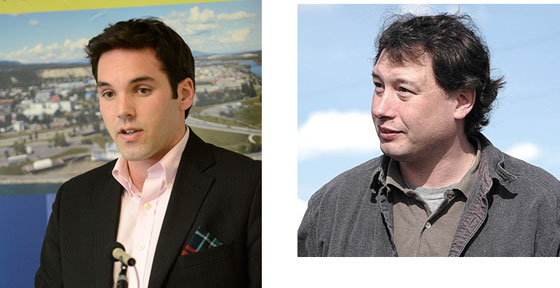
Environment Minister Currie Dixon and Environment Yukon biologist Tom Jung
Photo by Whitehorse Star
Environment Minister Currie Dixon and Environment Yukon biologist Tom Jung
Thinning the Aishihik wood bison herd to 1,000 animals is among the primary objectives of the new bison management plan officially adopted Tuesday.
Thinning the Aishihik wood bison herd to 1,000 animals is among the primary objectives of the new bison management plan officially adopted Tuesday.
Ensuring the herd remains free from contact with plains bison to the west in Alaska and south in Alberta and B.C. to maintain genetic purity is also among the recommendations contained in the 24-page document.
Hunting, says the plan, is to be the primary tool for population control.
The management plan was developed last year by the wood bison technical team through a series of public and internal meetings. It was put out for review and delivered to the government earlier this year.
Environment Minister Currie Dixon announced the plan's acceptance.
"A co-operatively developed management plan for the Aishihik wood bison herd ensures that the varied interests in the conservation and management of the population are heard and addressed,” Dixon said in a press release.
Environment Yukon biologist Tom Jung said now that the general principles of the plan have been adopted, it will be left to the technical team to chart a course to fulfill the objectives.
The team is made up of representatives from the Yukon and several First Nation governments, along with representation from different groups and organizations, such as the Yukon Fish and Wildlife Management Board.
Exactly how the estimated population of 1,300 will be reduced by 300 and maintained at 1,000 bison is a task the team will have to address, Jung explained.
He said however it decides to approach the reduction, the intent is to have it completed within the five-year life of the management plan, using annual harvest opportunities.
There have already been several changes to strengthen hunting pressure since the initial test hunt in 1998, explained Jung.
The government, he added, just announced the tag fee for bison has been dropped from $50 to $10 as another measure to encourage more hunting.
Jung said the technical team will also develop the guidelines regarding what action should be taken if bison are seen inside the bison-free zones established to the west and south to prevent contact with plains bison.
Most likely, it will mean providing hunters with an opportunity to take the animal or animals, or it would be left to conservation officers, he said.
From 1988 to 1992, 170 wood bison were introduced in southwest Yukon as part of a national wood bison recovery effort.
Despite original intentions to maintain the herd at no more than 500 animals, the population took off.
Predation by wolves and bears was non-existent up until recently, and the annual harvest has not been able to keep the herd in check.
Once listed internationally as endangered, the status of the wood bison has been upgraded to threatened.
During the last hunting season, from the late fall of 2011 to last March 31, hunters harvested 132 Aishihik bison.
As the herd swelled in size, concerns were raised about the impact the growth was having on the moose and caribou populations, and their habitat.
There were also concerns about more conflicts with highway motorists, and the impact the large roaming animals were having on fencing and other personal property.
The draft management plan proposed maintaining the population at below 500 animals, at 500, at 1,000, or between 1,000 and 1,250.
It was the stated desire of the Champagne and Aishihik First Nations to reduce and maintain the herd at the original management goal of 500.
The national recovery plan, on the other hand, recommends individual herds be maintained at no fewer than 1,000 animals to ensure vitality.
An aerial census in the summer of 2011 put the herd at an estimated 1,230 bison.
Another count is scheduled for next summer, subject to budget approvals, Jung explained.
The management biologist said last year's count estimated 20 per cent of the population were calves, which is well above what would be expected in an average year.
In order to encourage thoughtful and responsible discussion, website comments will not be visible until a moderator approves them. Please add comments judiciously and refrain from maligning any individual or institution. Read about our user comment and privacy policies.
Your name and email address are required before your comment is posted. Otherwise, your comment will not be posted.
Comments (6)
Up 0 Down 0
Dustin Munro on Sep 8, 2012 at 4:57 am
The bison population size of the park should be determined by what the carrying capacity is. If the population is below that capacity,let it grow to that size,then reduce the number by probably 200-300 so all the bison have enough food in the winter. Allow hunting of about 150 and do translocation for the remaining reduction number. They should be translocated to places like Siberia where there has been reintroductions from the Elk Island population and other regions of Eastern Russia. The plains bison should probably be totally removed and through translocation to areas where they were wiped out.
Up 0 Down 0
bobby bitman on Sep 6, 2012 at 8:06 am
Thank you Jay Dangles. You have provided some good information and also reasonable argument for keeping the numbers fairly low. I do not feel good about humans creating 'management plans' in general, but am open to hearing why they are being considered. Thing is, you often do not get the information you need to take an informed position on a lot of issues, including this one. With 130,000 caribou, and 40,000 moose or whatever the exact numbers are in the Yukon, I thought 1000 bison sounded quite measely, so it's good to hear why people think it should be this way.
Up 0 Down 0
JayDangles on Sep 6, 2012 at 12:18 am
Bobby, allow me to shed some light,
Fact: Animals compete with each other for more than just food. There are things like summer/winter range, habitat for raising young, breeding etc. and for Yukon animals like moose, some just crave a level of privacy from other animals. In addition, although wolves are only recently discovering how to hunt bison, the fact that they exist may draw more predators, and provide easier travel corridors throughout the area.
I have seen a large reduction in moose in areas where the bison have moved in, simply because a moose does not want to be overrun by bison. For example, although a moose will primarily eat willow during winter months, if a herd of bison are occupying their wintering valleys, eating the grass below... moose may be forced to search for new areas. I have also watched bison feeding 1000 ft above a band of rams.
The same applies to sheep and caribou, although they may not share the same food source, if bison choose to occupy a key area for these animals, they will have to move away from traditionally safe areas.
Now, don't get me wrong, I absolutely love bison, they are an amazing animal and should stay in the Yukon forever but I do agree the numbers should be kept in check, as they do have the potential to create all kinds of future problems.
As for accidents on the road...there used to be an issue prior to hunting, now I'd imagine the numbers of human/bison collisions are greatly reduce to nothing; however one only needs to travel south of Watson to realize the full potential these large animals can have on a roadway.
It is good to be skeptical, especially of what you read in the paper. But keeping the bison here, but at around 1000 animals is a good idea... an impossible idea mind you.... but a good one.
Up 0 Down 0
Bobby Bitcommon on Sep 5, 2012 at 11:25 am
We should not let well off Yukoners take these animals- they can afford to buy their meat.
They should be harvested by government people and sent to disaster areas.
Up 0 Down 0
Jackie Ward on Sep 5, 2012 at 9:55 am
Humans have no business determining how many animals should live or die. Until humans can manage themselves then leave the animals ALONE.
Up 0 Down 0
bobby bitman on Sep 5, 2012 at 7:22 am
Concerns about motorists, have there been any accidents? Concerns about caribou and moose, are there in fact any impacts? Do they eat the same food for instance? Some real facts explaining exactly why it is bad to have more than 500 or 100 bison in the territory would be appreciated. I think they may be very good for the caribou and moose population if people hunt them instead, and my understanding is the moose eat twigs and caribou eat lichen, while bison eat grasses. So what are the conflicts here with the other animals? And I have not even heard of close calls, let alone accidents with bison on the highways. Just asking for some facts so I can understand the issue, and whether this actually is an issue, or whether it is just more justification for funding for 'management'. Hate to be skeptical, but would like the facts.