Pivotal learning institution officially opens
In 2011, the Yukon’s economy was bubbling.
By Chuck Tobin on September 16, 2016
In 2011, the Yukon’s economy was bubbling.
There were three producing hardrock mines. Expenditures in mineral exploration were at an all-time high.
It was in 2011, with an industry on fire, that then-Yukon College vice-president Karen Barnes met with Claire Derome, a mining consultant with senior executive experience in the industry.
Barnes was thinking it might be a fitting time to explore opportunities for Yukon College to provide more programming and training to meet the needs of the mining and exploration companies, Derome recalled in an interview Thursday.
So when Derome went home to northern Quebec for Christmas that year, she invited Barnes to visit early in the New Year, to have a look at the mining country Derome knew.
They travelled to different communities, and they visited the Val-d’Or Mine Training Centre.
Not long afterward, with financial support from the Yukon’s Department of Economic Development, Derome was heading a feasibility study looking at providing industry-specific training at Yukon College.
Guiding the team was an advisory committee that included aboriginal chiefs, senior mining executives and academics.
The study was wrapped up in the summer of 2012. The Centre for Northern Innovation in Mining was created in 2013 with an $11.2-million contribution in capital funding from the federal and Yukon governments, with a further $5.8 million from the Yukon for programming over five years.
To date, 172 students have benefited, 52 of which received training in their hometowns of Dawson City, Pelly Crossing, Ross River, Carmacks and Mayo through the use of the centre’s $1.8 million Mobile Trades Training Trailer.
Three students in Mayo have just completed their pre-apprenticeship program in heavy equipment mechanics using the mobile trailer as their classroom and a local shop to work on equipment. Eight others completed the skills-for-employment program.
The centre has worked with the Yukon Research Centre to explore the use of northern vegetation in water treatment and mine site reclamation.
A one- and two-year program is now being offered in geology technology. Graduates are “snapped up.”
The Centre for Northern Innovation in Mining has established a partnership with University of Fairbanks to share the underground training facility at Delta Junction, Alaska.
These days, the acronym CNIM rolls off the tongue of those who know it as if it’s been around for 100 years – “see-nim.”
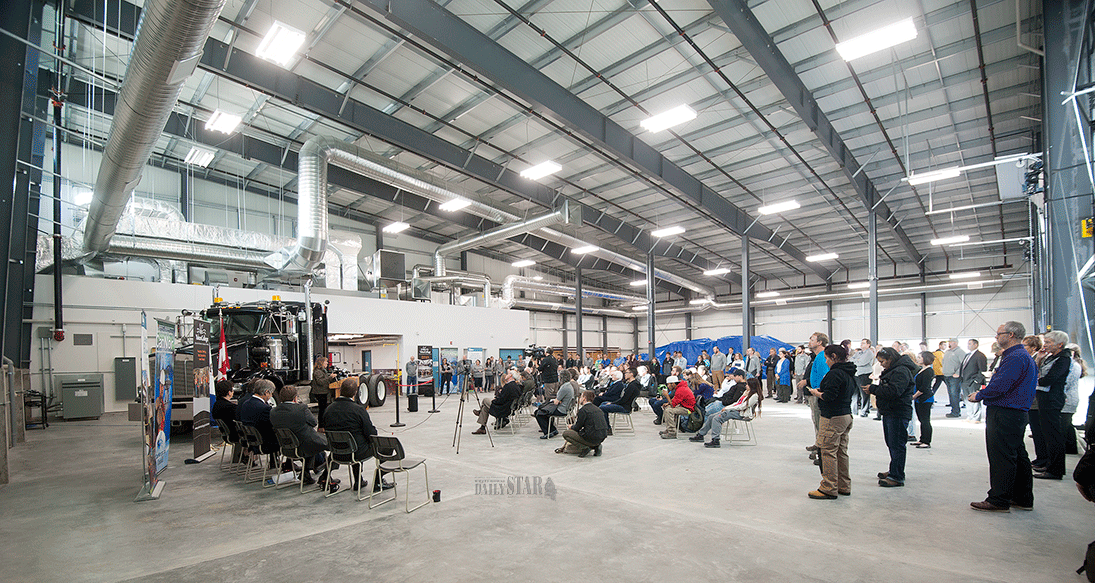
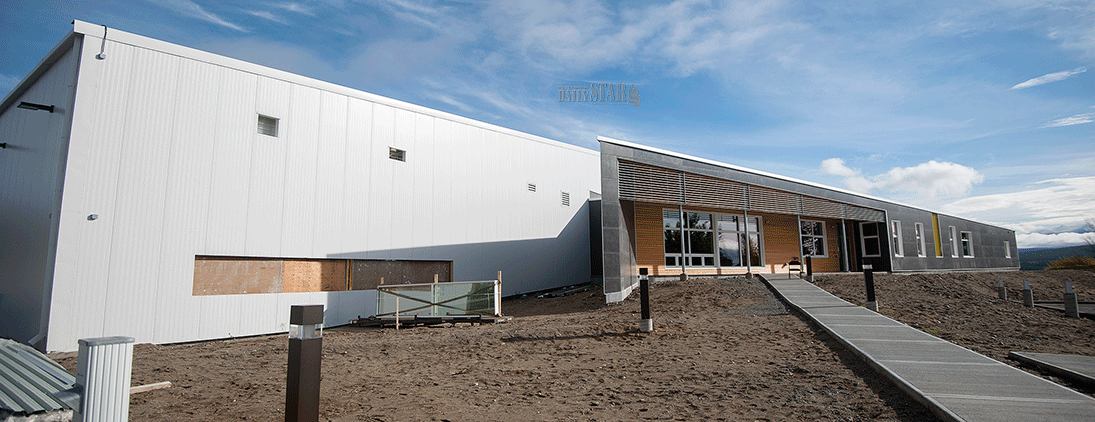
Yesterday, it officially opened the doors to its flagship, an 18,000-square-foot, state-of-the-art building with 10,000-square-feet of shop space and an 8,000-square-foot academic wing, tucked in behind the Yukon Arts Centre.
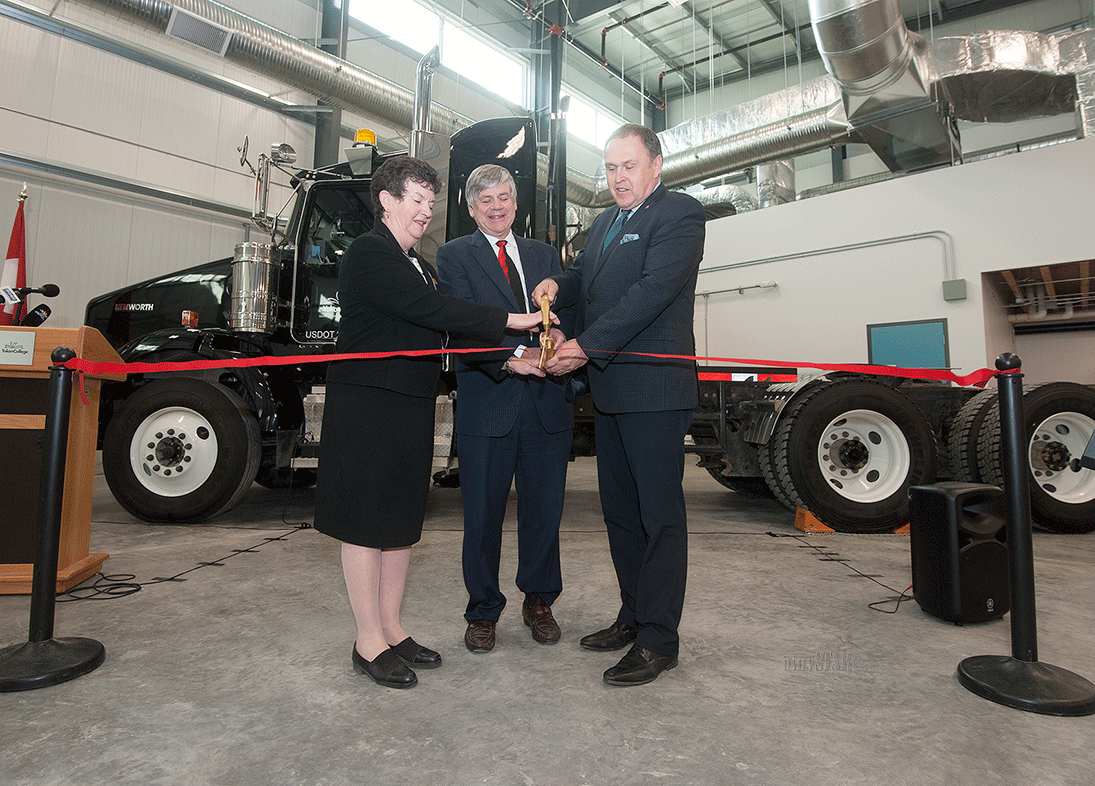
“It gives me great pleasure to see this building completed, and to see CNIM able to deliver programming in its own dedicated space,” Premier Darrell Pasloski told a large audience gathered in the shop for the ribbon-cutting following a VIP tour of the facility.
The Kenworth tractor used to haul around the mobile training trailer served as the backdrop.
“The creation of this Centre for Northern Innovation in Mining has been a group effort that includes co-operation between different levels of government, First Nations, the mining industry and Yukon College.”
Yukon MP Larry Bagnell spoke, as did Energy, Mines and Resources Minister Scott Kent.
There were students, instructors, senior executives of the mining industry, and members of the local contracting industry who helped build the $8.3-million centre.
Yukon College chancellor Geraldine Van Bibber was there, as was Paul Flaherty, chair of the college’s board of governors.
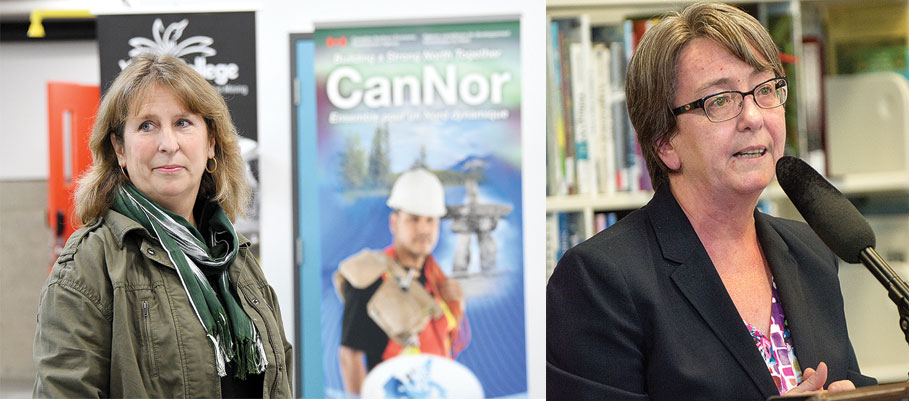
Shelagh Rowles, the CNIM’s executive director, told the audience when the idea for a training centre was still just a vision, she and her team were looking at something in the area of 10,000-square feet.
As they toured other trades and technology facilities in southern Canada, however, they were told to go big, go big and be flexible, she said.
“We economized as much as possible with a focus on what would benefit our students the most and we were able to design a building that is a teaching tool in itself with heating, ventilation, wiring, and plumbing systems exposed to act as a living demonstration of building systems,” said Rowles.
“And by opting for a pre-fabricated workshop space, we were able to end up with an 18,000 square foot building – almost double the size we were originally thinking....”
The academic wing features three classrooms, six offices, a common area and washrooms with lockers designed to resemble a common dry at a mine site.
The ventilation system automatically adjusts to the needs of specific classrooms, depending on the number of students in class. The lights go dim when nobody is around.
Notes put up on the white board by instructors can be downloaded to laptops, smart phones and other personal devices.
Then there is the “red zone” that separates the academic wing from the shop floor.
Students, instructors, everybody knows as they leave the academic wing and move through the red zone – and it can’t be missed – to the shop, all personal safety gear is required.
Rowles emphasized that while the centre arose out of the needs of the industry, the skills students leave with are very much transferrable to other industrial settings.
They’re taught safety protocol, first aid and must achieve WHMIS certification – Workplace Hazardous Materials Information System.
“As far as employment, it has been amazing,” Rowles said of opportunities available for students who’ve gone through the variety of courses and programs offered through the CNIM.
Rowles said the first cohort of students who will call the new facility their classroom for the next 20 weeks will include 12 students in the pre-apprentice electrical program and 12 in the pre-apprentice carpentry program.
As part of their program, together they will build a 1,000-square-foot storage area that will be attached to the new building, she pointed out.
Come next year, she said, programming could be entirely different, depending on the guidance provided by the CNIM’s governing council, which includes several representatives of the mining industry.
In her address to the audience, Rowles specifically thanked Kobayashi and Zedda Architects for their design and a number of local contracting companies that built the centre.
Several individuals were recognized for their work overseeing construction of the project. They included longtime carpentry instructor Don Gillies and Pat Hogan, the project management consultant.
Members of the building committee were recognized, as were members of the governing council.
“Finally, I would like to extend a special thanks to Karen Barnes and Claire Derome – their vision for what CNIM could be really started the ball rolling – and it has been a privilege to work with them to make today a reality – to serve our students and see lives change through trades and technology training.”
Following the opening, Brad Thrall of Alexco Resource, the first chair of the centre’s governing council, said in a brief interview that programming provided by the centre is indeed responsive to the needs of industry.
Just yesterday, he pointed out, Alexco finished up another environmental monitoring program at Keno Hill, in partnership with the CNIM and the First Nation of Nacho Nyak Dun.
If you want to achieve success, partnership is key, Thrall said.
“At the start is was just an idea,” said Derome, as the last of the guests were leaving the shop floor through a 25-foot by 25-foot garage door large enough to accommodate big equipment.
“It is amazing that all of these people were able to put this together.
“... I am really happy to see this happening, that it was just not a report collecting dust on a shelf. Shelagh was really instrumental in keeping this going.”
Comments (7)
Up 4 Down 9
Bobo LaRouque on Sep 18, 2016 at 7:50 pm
Will mine clean-up be taught at this MTC (mining training center)being that's an inevitable conclusion for most of these under funded mines in this ignored area of mining.
What does this center think of heep leech mining with cyanide and the history of the Belknap mine in Montana or the Jungle Rum mine in the Northern Territory of Australia?
Up 6 Down 0
ProScience Greenie on Sep 18, 2016 at 1:45 am
Pretty sure I saw the words geology and technology used together in this article Yukoner. Some science and engineering in that most likely.
Apparently the better mine engineers, geologists and techs know their way around a scoop tram. And the better scoop tram operators in this territory know a fair bit about geology and mine engineering. That's good.
Up 12 Down 9
Josey Wales on Sep 17, 2016 at 10:21 am
Fantastic we needed a big building to heat, not enough of those in the government inventory.
In typical fashion the timing is stellar.
Given our decades old fabricated economy seems as futile as building a church in Turkey or asking your wife to drive to the pilgrimage in Mecca.
OK that last line was silly, wives are not asked anything there...they are told.
Kinda like we are...with political overlords.
Up 9 Down 2
Yukoner on Sep 17, 2016 at 9:19 am
With respect to pro science greenies comment on more "science and engineering" being taught at YC. Where did that information come from? YC doesn't offer any engineering techonolgist diplomas, nor could they offer any degrees in those disciplines. Which science programs will they be offering in the new facility, or is driving a scoop tram now considered scientific training?
Up 16 Down 0
CDemers on Sep 17, 2016 at 7:58 am
Sounds like a great place to learn, but I think they are putting the cart before the horse. The government needs to put money into our secondary school trades and technology training. Otherwise who is going to use this nice new facility at the college. For example Porter Creek Secondary was first built as a junior high school, but when the government decided to move away from junior highs and have three high schools there was no money invested into upgrading the junior high trade facilities to bring them up to a secondary level facility. To make matters worse the annual budget, to support and provide for the students, keeps getting smaller. We need to put the horse in front again or else there will be no one to pull the cart.
Up 21 Down 11
WhiteElephant on Sep 16, 2016 at 4:52 pm
And as Minto shuts its doors leaving the Territory with a sum total of zero producing mines, one wonders whose 5-year-old vision for the sector now looks a little misplaced!
Up 14 Down 5
ProScience Greenie on Sep 16, 2016 at 3:55 pm
It's good to see more science and engineering taught at Yukon College. Best of luck to all that graduate.