Photo by Whitehorse Star
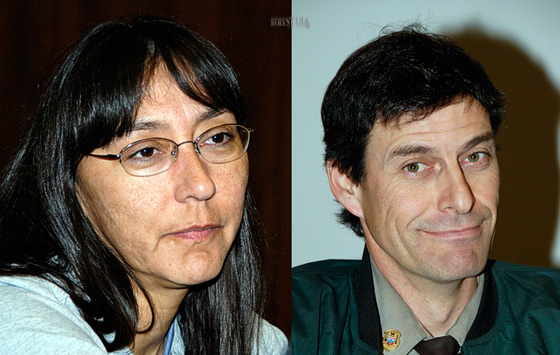
Yukon government biologist Dorothy Cooley, Dawson City conservation officer Torrie Hunter
Photo by Whitehorse Star
Yukon government biologist Dorothy Cooley, Dawson City conservation officer Torrie Hunter
Much of the troubled Porcupine caribou herd may not reach the Dempster Highway this fall.
Much of the troubled Porcupine caribou herd may not reach the Dempster Highway this fall.
Yukon government biologist Dorothy Cooley of Dawson City told a Whitehorse media briefing this morning that satellite tracking of 16 radio collars are showing the herd is currently moving westward, away from the highway toward Alaska.
The caribou did the same thing last year, and it's not unusual for them to overwinter next door, Cooley said.
"They do have a few weeks to change their mind."
Even if the herd continues its westward march, it's likely there will still be some hunting opportunities along the highway, just not as much as there would be if the bulk of the herd moves toward the artery.
But that may be a good thing, given current realities.
Cooley and Dawson City conservation officer Torrie Hunter are in Whitehorse as part of a team to help host tonight's public meeting on the draft harvest management plan for the Porcupine herd.
The plan was developed under the umbrella of the Porcupine Caribou Management Board by a working group comprised of wide-ranging representation from communities, first nations governments, the Yukon and N.W.T. governments, boards and so on. Tonight's meeting at the High Country Inn will begin at 7:00.
Based on computer modeling, the plan suggests the herd could plummet in 15 years from its current estimate of 100,000 animals to below 20,000 if the current annual harvest of 4,000 caribou continues.
Even if the annual harvest was cut in half today, the computer model suggests the Porcupine population would still fall to below 75,000 in two years.
The draft management plan lays out a number of proposals, including education to encourage different hunting practices aimed at more efficient harvests, resulting in fewer wounded caribou roaming off to die.
The importance of stocking and killing a wounded caribou instead of allowing it to wander away and die, would be emphasized.
The plan recommends a system of implementing different harvest scenarios, including an outright closure - except for ceremonial purposes - if the population fell below 50,000 animals.
If the herd was more than 125,000 members strong, on the other hand, there would be no limitations on the harvest, either the number or gender.
With a population of between 125,000 and 75,000 - where it sits today - hunters would be asked to voluntarily limit their harvest and shoot bulls only.
Between 75,000 and 50,000, hunters would be required to shoot bulls only.
Under all scenarios, aboriginal and non-aboriginal hunters would be encouraged to ensure accurate shooting and retrieval of wounded caribou, and asked to file a report of how many caribou they harvested.
Aboriginal hunters are not now required to report their harvests, though the Yukon's three first nations involved in forming the draft management plan - based in Dawson, Mayo and Old Crow - have been tracking harvest levels by their memberships in recent years.
The draft harvest plan notes hunters can make a big difference by not shooting cows, as one cow, with its offspring, and its offspring's offspring, can account for 23 caribou in 10 years.
If the current harvest was cut in half to 2,000, but only bulls were taken, the computer model indicates the population would stop its decline and stabilize, says the plan.
Historic survey information shows the Porcupine herd's most recent population peak was in 1989, at an estimated 178,000 animals. Its been on a steady decline since.
The last complete and accurate census in 2001 put the population at 123,000. Efforts to update the census each year since 2003 have been foiled by either weather, smoke from forest fires or the migration patterns of the caribou.
There have, however, been other scientific studies, such as research into the survival rates of cows and calves, that were built into the computer model, which is now is putting the population at 100,000, says the draft plan.
Dawson's regional biologist said it's difficult to say just how much of a factor the annual harvest is in the current decline.
There are issues of weather, predation and other factors affecting caribou mortality, Cooley noted.
One thing is certain, the biologist emphasized; the annual harvest is something concerned communities and wildlife managers can influence.
And the communities are indeed concerned, she said.
"People are really worried about this herd, and agree something has to be done."
Cooley said its the desire among all the participants who've put together the harvest management plan to see it implemented next year.
For this season along the Dempster, however, hunting practices will remain the same as they were last year, Hunter said.
He said there will be no enforcement of the 500-metre, no-hunting corridor along the Dempster Highway for hunters stalking Porcupine caribou.
The corridor will remain in effect for all other species, such as moose, as well as for the Hart River caribou.
There will not be a week-long hunting ban when the caribou start to show up, a practice first implemented in 1999 as a means of allowing the leaders of the herd to guide the way to the winter range.
The removal of both the 500-metre corridor and the week-long ban arose out of an aboriginal rights court case. The court ruled the Yukon government did not have the right to infringe on aboriginal hunting rights in such a fashion.
The Yukon government subsequently removed the restrictions for non-aboriginal hunters as well.
The decision was made in part for safety reasons, as having a no-hunting corridor for some hunters and not for others could have caused problems, Hunter explained.
In order to encourage thoughtful and responsible discussion, website comments will not be visible until a moderator approves them. Please add comments judiciously and refrain from maligning any individual or institution. Read about our user comment and privacy policies.
Your name and email address are required before your comment is posted. Otherwise, your comment will not be posted.
Be the first to comment