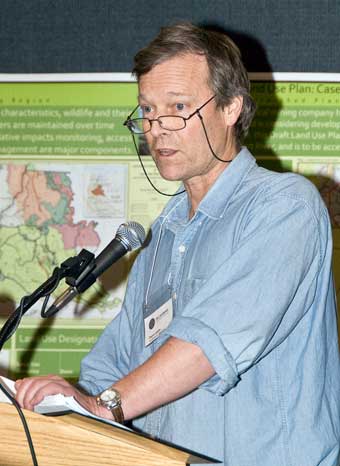
Photo by Whitehorse Star
Dave Loeks
Photo by Whitehorse Star
Dave Loeks
The Peel Watershed Planning Commission is reversing three key recommendations in its proposed land use plan released last month.
The Peel Watershed Planning Commission is reversing three key recommendations in its proposed land use plan released last month.
The plan recommended that further industrial activity be prohibited on several existing mineral claims and oil and gas leases inside the watershed.
It also recommends no further mineral staking nor release of oil and gas leases be allowed in almost all of the 68,042 square kilometres.
Most companies should be permitted to work existing claims but only access them by air, as the proposed plan recommends no roads be allowed in 97.2 per cent of the planning area.
In three specific areas – along the Snake River, the Blackstone River Uplands and the Turner Wetlands – the original recommendation was to prohibit all future industrial activity, even on existing claims.
One of the three areas includes the large Crest iron ore deposit owned by Chevron Canada.
In a statement released this morning, the commission says it did not mean to recommended no further activity on existing industrial interests in those three areas.
"The Peel Watershed Planning Commission regrets that these errors were published,” reads the press release.
Dave Loeks, one of the six commissioners, said this morning they realized their mistake before Christmas while reviewing the 200-plus-page document.
The commission, he said, wanted to clarify the error as soon as possible, particularly for the benefit of those companies with existing claims and oil and gas leases in the three areas.
The recommended plan has been condemned by the mining industry,which has said it would create massive uncertainty, causing investment in the territory by mining and exploration companies to dry up.
Acceptance of the plan in its current form would also lead to expensive legal challenges from companies seeking compensation for money already spent staking and working their claims, industry has warned.
Supporters of wilderness protection have applauded the recommendation as a reflection of what a large majority of Yukoners want to see for what is called some of the last pristine wilderness on Earth.
Yukoners, the pro-wilderness camp insists, have demonstrated their support for maximum conservation, and have indicated they're willing to take that desire into the next territorial election, due in 2011.
It will largely be up to the Yukon government to accept, reject or alter the recommended plan, as 97 per cent of the planning area is territorial Crown land.
The recommended plan was forwarded to the Yukon government and the four affected first nations for review in early December.
Any substantial changes to the plan would have to be negotiated by the affected governments, then sent back to the commission for another look.
Three of the four first nations have called for maximum wilderness protection.
A territory-wide land use planning process for the Yukon is provided for in the Umbrella Final Agreement, the template for negotiating aboriginal land claim settlements in the territory. The exercise for the North Yukon, the Peel is the second and the Dawson region is next.
At a press conference last month following the release of the recommended plan, commissioners were adamant that there was no middle ground to be found that would please both the mining and pro-wilderness sectors.
It was therefore decided to take a conservative approach and keep the maximum number of options open for the future, the commissioners explained.
Commissioners have also indicated they have no idea how long it will take the governments to complete their review; that it could take six months, a year, or longer.
As part of the recommendation, the commissioners called upon the Yukon government to impose a moratorium on further mineral staking until the plan is finalized
There's been no word from the government on the request for a moratorium.
Karen Baltgailis, executive director of the Yukon Conservation Society, said this morning she accepts the commission's explanation that it simply made an error.
Allowing further industrial activity on claims in the three areas is consistent with the rest of the recommended land use plan, she pointed out, emphasizing access is still by air only.
She said the conservation society would not like to see the plan become something of a moving target where changes are made prior to the government-to-government consultation work.
The society supports the implementation of a moratorium on further staking, she said.
"New claims staked at this point in the planning process should have no legitimacy in our view.”
In order to encourage thoughtful and responsible discussion, website comments will not be visible until a moderator approves them. Please add comments judiciously and refrain from maligning any individual or institution. Read about our user comment and privacy policies.
Your name and email address are required before your comment is posted. Otherwise, your comment will not be posted.
Comments (2)
Up 0 Down 0
G Hardy on Jan 5, 2010 at 9:12 am
MISTAKE ??? my *ss, this commission folded, sold us out to big money, how much pressure were they under ?
Thats quite obvious, to declare such a lame excuse as..."oh..hehehe we made a boo boo"..How incompetent can they be then? There should be a public inquiry into this travesty of the original recommendations.
Up 0 Down 0
Joe Yanisiw on Jan 5, 2010 at 8:52 am
So when did the Peel watershed Planning Commission actually wake up and take a look at a map and realize that Crest Exploration's Snake River, iron ore deposit was in the Peel Water Shed.
Is there anything else they may have slept thru, say for instance, the fact that they are recommending that only special interest groups from Europe will be the only ones allowed to use the watershed as their personal playground.