Patient rode chair from Granger to hospital
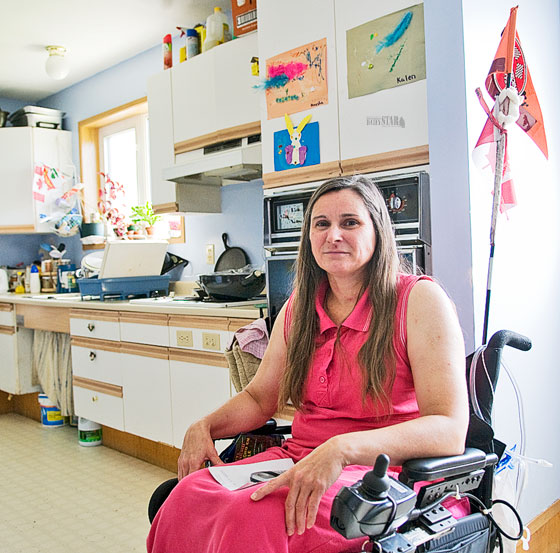
On June 9, the day Christiane Cramp was scheduled to have her cancerous ovaries removed, she rode her motorized wheelchair to Whitehorse General Hospital for her 7 a.m. appointment.
By Will Johnson on June 20, 2008
On June 9, the day Christiane Cramp was scheduled to have her cancerous ovaries removed, she rode her motorized wheelchair to Whitehorse General Hospital for her 7 a.m. appointment.
Starting at her small home in Granger, she guided the chair down Hamilton Boulevard, through downtown, and on to the hospital.
It was raining.
"I'm a little, little bit angry," the 49-year-old Cramp said sarcastically, in a recent interview.
According to Cramp, the Handy Bus she relies on to transport her had refused to pick her up early, and she was forced to take measures into her own hands.
Cramp lost the use of her legs in 2002, when she was a passenger in a head-on car collision.
"I guess there was just too much slush, too much snow, too much bright sun," she said quietly, with a shrug.
"I'm paralyzed from the waist down. I have trouble convincing people I'm not paralyzed from the waist up," Cramp said.
Since her accident, she has been working for the territorial government, attending classes at Yukon College, and helping take care of her granddaughter Kaelynn, four. The biggest obstacle, she said, is getting from place to place.
Cramp's wheelchair weighs approximately 150 pounds, and has a Canadian flag on the back. A second flag declares "I'm not speeding, I'm qualifying."
The problem, she said, is that it doesn't fit into vehicles.
"Very few people have wheelchair-accessible vehicles," Cramp said. She estimates she gets stranded about once every couple of months, and she has been scared for her safety several times.
"I call 9-1-1 and they tell me it's not an emergency. I'm stuck on a sidewalk. There's snow on the ground. I have no place to go. I can't just camp here.
"I'm telling you, there is a problem here. It's the middle of winter and I'm left," said Cramp, getting visibly upset.
Her sons, both of whom also rely on public transit, are angry about what they see to be deficiencies in the system.
"I mean, if the government's paying for it, they're paying for it. We deserve just as much service as people in Ottawa," said her son Matthew, noting that service in bigger cities far exceeds the local service.
"The system here is a joke," he said.
"In Vancouver, they would apologize if we had to wait half an hour," said Cramp, adding that his mother is regularly left waiting for hours at a time in Whitehorse.
She spoke highly of the system in Vancouver, where she had to use the service while going to the hospital.
"They don't load us on like so much baggage. You get the sense that they don't want us here, like we're a nuisance," she said.
Cramp was diagnosed with cancer last year, and when it suddenly got worse recently, the decision was made to surgically remove her ovaries.
"They told me it had to come out right away," she said. But once she booked her appointment, she said, the Handy Bus dispatchers told her they could not take her in time.
Instead of trying to re-schedule or find an alternate way to the hospital, Cramp decided to make her own way there.
"It was really, really cold and wet," she said.
Cramp was held in the hospital until the following Saturday, then transported home by the Handy Bus. Now she has now been instructed by doctors to stay at home and get some rest.
Though Cramp has spent the last few years fighting various institutions for her rights, she now seems tired and ready for some rest.
Along with her friend Judy Johnny, they've petitioned government officials, human rights tribunals and the City of Whitehorse.
Recently, Cramp said, they were informed by the city that no one was willing to talk to them or co-operate with them.
On May 22, Yukon Liberal Leader Arthur Mitchell wrote a letter to Mayor Bev Buckway. Listing a number of issues he discussed with Cramp and
Johnny during a May 21 meeting, he urged Buckway to help in addressing some of the downfalls of the current Handy Bus system.
"I recognize that the City must balance the needs of many users within the limited budget available for the Handy Bus," he wrote.
"However, because of their disabilities, Ms. Johnny and Ms. Cramp very much need to make use of this service...They are very concerned that any complaints about the service that they feel the need to bring forward may be used as a reason to deny them service or make it difficult to obtain service."
Dave Muir, the manager of Whitehorse Transit, declined to comment on Cramp's situation specifically this week due to confidentiality issues, but said the Handy Bus service does everything it can to accommodate users' needs.
"We really try to work with individuals," said Muir, who noted there are close to 300 users (approximately a third of them who use the service regularly) but only one Handy Bus in operation.
It currently works on a first-come, first-served basis. There is a one spare Handy Bus, in case the other one is unavailable.
Users of the Handy Bus go through a verification of eligibility, and need to meet certain criteria and get a recommendation from a medical professional to use the bus.
"It's simple, really," said Muir. "If you can't walk to your nearest stop, can't understand the schedule, can't climb steps...then you're welcome to our service. We have users all over the map."
He also noted Handy Bus users receive a significant discount compared to the regular public.
"We also use the conventional fleet to accommodate our users' needs," said Muir.
If the Handy Bus is unavailable, Whitehorse Transit attempts to utilize its other resources, he said. The regular bus fleet is equipped with services to aid in wheelchair accessibility and to cater to users' individual needs.
Val Pike, the hospital's spokeswoman, said the hospital is not responsible for patients' transportation, but said there are many options for working around their needs.
The hospital communicates with Handy Bus and Emergency Medical Services, and staff do everything they can to work around various schedules.
If a patient is unable to make an appointment on time, she said, medical staff would try to accommodate that.
Pike could not speak about Cramp's situation specifically, but said there were other alternatives available, including rescheduling an appointment or seeking other forms of transportation.
Many patients get rides from family members or friends, and Pike wondered why Cramp couldn't use a taxi.
Cramp told the Star she has two wheelchairs-one motorized and one standard chair she maintains herself.
According to her, the government only pays for one of the chairs, so she has chosen not to use her other one. Her second wheelchair can fold up, and could be put in the back of a cab or car.
Buckway said issues surrounding the Handy Bus are ongoing.
"We're always looking at these issues, and taking them very seriously. My staff work diligently to address any problems," she said.
She admitted there are some budget issues, and the Handy Bus is not always available when needed.
"We can't do all the things people want us to do, but we have many satisfied customers. The Handy Bus is a really good service, and we get a lot of very positive feedback. People are appreciative," she said.
As well, Buckway said, the regular bus fleet is becoming entirely wheelchair-accessible.
Using "kneeling" buses, the fleet will have ramps and fully-trained staff.
Buckway expressed hopes more citizens will be able to get where they need to go using these new buses.
"People will be able to take their wheelchair, their scooter, whatever they need, right on board," she said.
If it was determined that the Handy Bus was no longer effective because of too many riders, the mayor said, they would consider adding another bus to the fleet. But there are other factors involved, such as operating costs, that have to be considered.
In the mean time, Cramp feels she does not have any options other than the Handy Bus, and said she will continue to ride her wheelchair up and down Two Mile Hill when necessary.
She said sometimes people yell from their vehicles as they pass her.
"‘Get off the road!' they yell. If only they knew how hard I was trying," she said.
Be the first to comment