Parties pronounce promises on Peel, platforms
Party leaders used catch-phrases and lists of promises to win votes six days before Yukoners go to the polls at Wednesday evening's CBC leaders' debate.
By Nadine Sander-Green on October 6, 2011
Party leaders used catch-phrases and lists of promises to win votes six days before Yukoners go to the polls at Wednesday evening's CBC leaders' debate.
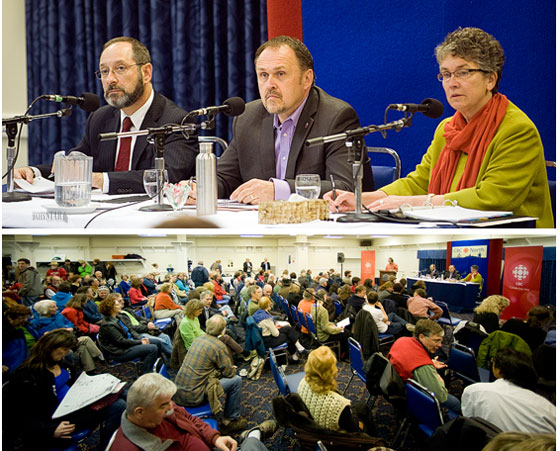
The Gold Rush's Town Hall saw a full house, with Yukon Party Leader Darrell Pasloski, NDP Leader Liz Hanson and Liberal Leader Arthur Mitchell dressed in their parties' colours (except for Pasloski, who wore a purple tie) and sitting under the bright lights at the front of the room.
Yukon Green Party Leader Kristina Calhoun and Yukon First Nations Party Leader Gerald Dickson were not invited by the CBC to participate in the event.
Pasloski used a Yukon Party newspaper ad several times to drive his points home.
"The facts are clear,” he said, holding up the sheet of paper which shows graphs of economic growth in the territory since the party took office in 2002.
"The previous Liberal and NDP governments resulted in seven years of economic recession, six years of population decline, double-digit unemployment and no mining industry.”
The premier repeated several times during the night that his party has three First Nations candidates, six women, five town councillors and eight cabinet ministers, something he also read from the piece of paper.
Forum host Dave White of CBC North told audience members to articulate their questions quickly and clearly and gave party leaders one minute to answer. He had hockey at 9 p.m. and didn't want to be late, he joked.
Yukoners were also invited to ask question though Twitter or by telephone.
The Peel watershed's future has emerged as one of the hottest election topics. It was no exception last night.
Eddie Taylor, Chief of the Tr'ondëk Hwëch'in First Nation, asked Pasloski if he was really calling his First Nation government "irresponsible” for coming up with a position on the Peel.
None of the party leaders answered Taylor's question, instead reiterating their stances on the Peel.
Pasloski said what he has been saying since, and even before, he called the election Sept. 9. The government is not done with its consultation process and therefore cannot say whether it supports the planning commission's recommendations.
"We have two parties on either side of me who are willing to do this, irregardless of the cost, and that's not responsible,” the premier said.
"It's really been pitting Yukoners and businesses against each other, and that's not responsible.”
Several times throughout the night, the premier used the phrase "We need to cool the rhetoric” and "Come together to find common ground.” This received laughter and groans from the audience.
"Does anyone here believe that based on protecting critical values in the Peel for future generations, that Alexco is going to close?” asked Mitchell, listing of all of the Yukon's mines.
"This is a false construct that mining is going to leave if we take one portion of Yukon and preserve it,” he said.
The leaders debated on what to do with the watershed's existing claims after an audience member asked Pasloski if he would only start to listen to Yukoners when they are saying what he wanted to hear.
Pasloski brought up, as he did in last week's environmental debate, the Windy-Craggy example from the early 1990s. Windy-Craggy was a large copper deposit in northwest B.C. The area eventually became Tatshenshini-Alsek Wilderness Park, a UNESCO world heritage site.
Pasloski said the B.C. government had to compensate mining companies more than $100 million in the making of the park.
But Hanson said Pasloski was wrong. It was only $29 million, she said.
Someone from the audience yelled that it was $180 million.
"There is legal precedence all over the world for compensation when you expropriate claims property from someone, directly or indirectly,” Pasloski responded. "To say you can have your claims, but no access to it, that is an indirect expropriation.”
Mitchell said someone wanting to lead the Yukon shouldn't go making those kinds of claims.
"Good luck if you do end up in court having put that on the record,” he said.
Hanson agreed.
"It is a strange negotiation position to say that the 8,000 claims that were staked have an equal value as an established mine or an advanced exploration property,” she said.
The NDP leader stressed that Yukoners have to "keep in mind” that staking a claim does not automatically vest interest in owning the land.
"Yukoners still own that land, Mr. Pasloski.”
Hanson believes a responsible government would create a set of principles in how to compensate interests, instead of one-off deals, as Pasloski has eluded to.
Although general questions on the economy, privatizing the public services and accountability were raised, there was one question which caught everyone by surprise.
The audience laughed and clapped when John Striecker, the former federal Green Party candidate and newly-appointed party president, asked each leader how they would work more co-operatively together.
Look to your neighbour and say something nice to them, he said.
Hanson said she wants to work with the premier
"Can we, Darrell?” she asked.
"Of course we can,” he said.
When working together, we have to focus on the issue, not the people involved, Pasloski said repeatedly.
On the issue of the economy and how to deal with the "bust” cycle, Pasloski told the audience that mines generally do well in the event of an economic downturn. It's the exploration industry that feels it the most, he said.
He thinks turning Yukon College into a university, though, could help diversify the economy.
Mitchell said his party would make housing affordable, health care accessible and maintain a strong mining economy.
Hanson's answer was to diversify. Her party wants to support small businesses and tourism, arts and culture.
"We cannot build an economy on only one pillar.”
The evening ended with Pasloski reiterating that the "facts are clear” and listing how many town councillors, First Nations and women he has on his team, Mitchell explaining his balanced approach
and Hanson claiming the Liberal party has no chance of winning the election.
"This election is a two-way race between the New Democrats and the Yukon Party.”
After the event, Calhoun, who was not invited to attend the event, told the Star she wished she could have been at the table debating.
"It's unfortunate that two were not invited to be up there,” she said. "A real strength that we have is directly answering questions, and directly offering pro-active solutions.
"What I feel was missing from the debate was actual tangible ideas.”
The three leaders the CBC invited were offering a lot of words, she said, but not actually directly responding to the questions.
Comments (3)
Up 0 Down 0
Any-Mous on Oct 7, 2011 at 7:00 am
i would say give out some of the staked lands but save most of the peel, cause its pretty ridiculous that we are tearing up all of our beauty here in the Yukon just for people to make some money.
I highly doubt it would bankrupt us too, just say no to the University as well cause there's really no need, its a convenience, but not not needed at all. Lots of the students like traveling south and making a University with no housing available in town sounds like a bad idea already.
Just Sayin.
Up 0 Down 0
YukonMax on Oct 7, 2011 at 5:32 am
Protect the region, 80% +
There are enough around in this Territory for everybody. If the mining industry is to seek compensation, lets cushion the blow with a raise in royalties, period. Everyone must pay to play, mining industry included.
Up 0 Down 0
bobby bitman on Oct 6, 2011 at 10:20 am
Too bad no one pointed out to Mr. Pasloski that approximately 3/4's of the claims were staked during the Watershed review. The Yukon Party ignored advice and normal procedures and refused to put a moratorium on staking during this review, and the miners rushed in immediately and staked the place up, perhaps even with an eye to receiving compensation in the future.
It would have been extremely difficult for the Yukon Party to explain why they failed to put a moratorium on staking; actually refused to do so. Why would they do that?
Regardless of their reasons, it is their fault that Yukoners now hold the bag on this whole compensation issue, and that should have been thrown in Mr. Pasloski's face. It is amazing that he has the gall to bring up 'well we can't protect because we'd have to pay off all these miners'. That makes my blood boil just a bit.