Parties practising polarizing politics: premier
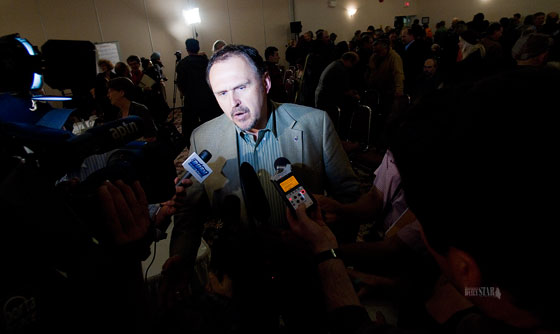
Premier Darrell Pasloski stayed silent on whether the Yukon Party would accept the final recommendations for the Peel watershed at last night's environmental forum.
By Nadine Sander-Green on September 28, 2011
Premier Darrell Pasloski stayed silent on whether the Yukon Party would accept the final recommendations for the Peel watershed at last night's environmental forum.
The premier said the Liberals and NDP are being irresponsible in supporting recommendations without knowing how much it would cost the government to compensate mining companies with existing claims in the watershed.
"They have no clue about the cost, but they're going to do it anyway,” said Pasloski.
"What will the cost to Yukoners be for almost 9,000 claims and world class iron ore deposits? How are they going to pay for this; what programs are they going to cut? Are they going to cut health care? Education? Child care? Seniors' programs?”
Pasloski said a climate of polarization has been created and an all-or-nothing attitude has set in with "two entrenched camps”.
His party's position, he said, is to "cool the rhetoric.” He believes stakeholders can reach common ground and the territory can have both pristine wilderness and a strong economy.
Pasloski said he wants "to bring everyone back to the table” so all parties are happy with the outcome.
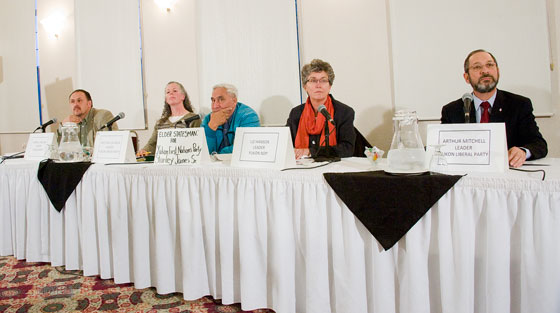
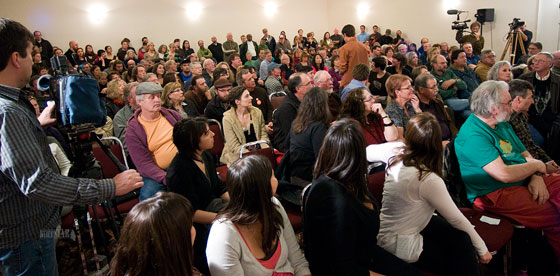
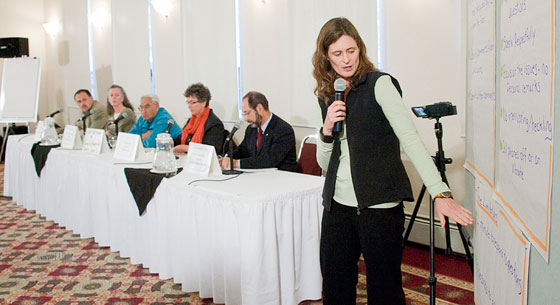
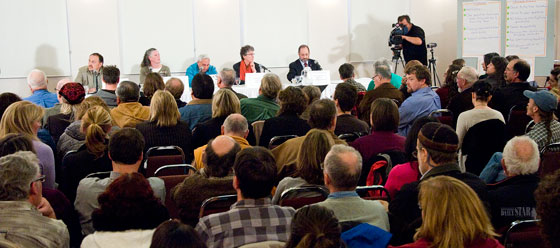
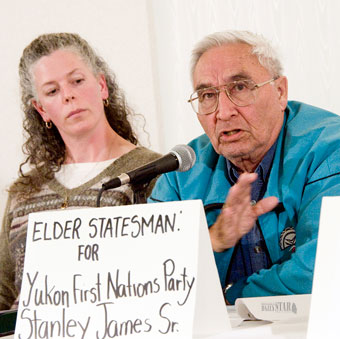
Four party leaders and Stanley James, representing the Yukon First Nations Party, participated in the environment forum. The event, held at the High Country Inn, drew a full house. It was organized by the Yukon Conservation Society (YCS), the Canadian Parks and Wilderness Society (CPAWS), Raven Recycling, Friends of McIntyre Creek and the Wilderness Tourism Association of the Yukon.
Each organization sent party representatives a question before the event and a handful of questions from the audience were heard.
Participants were given one minute to answer each question, which ranged from protection around McIntyre Creek to the territory's lack of any Species at Risk legislation.
Originally, Pasloski was not planning on attending the event because his party felt targeted by the organizers.
Jonas Smith, the media spokesperson for the Yukon Party, told the Star Monday that recent CPAWS and YCS anti-mining ads had already "set the tone” for the debate.
Talking to media after the event, the premier would not say what changed his mind. He only said he was supposed to be in one of the communities, but decided he "had to do this.”
Simon Mervyn, chief of the First Nation of Na-Cho Nyak Dun, was the first person from the audience to pipe in. Mervyn assured the crowd he is not opposed to mining.
"Protection for the Peel is not a choice between mining or environment,” he said. "It is a choice to have mining and environmental protection.”
Mervyn wanted to know how each party would work with the Na-Cho-Nyak Dun to ensure a balance between industry and environmental protection in the watershed.
NDP Leader Liz Hanson said her party would involve First Nations in consultation early in any planning stage so there are no "surprises”.
Liberal Leader Arthur Mitchell said he had a simple answer to the question.
"We would work with the First Nation of Na-Cho Nyak Dun as we would with all First Nations which is respectfully, in full consultation and with an eye towards sharing of opportunities, including employment and resource royalties.”
One Whitehorse resident echoed Pasloski's earlier comments, asking the parties how they could support a plan without knowing how much it would cost.
Kristina Calhoun, the leader of the Green Party, said the government has legal obligations to implement the plan under the Umbrella Final Agreement.
"I don't want anyone to be afraid that we're going to lose education, that we're going to lose this, that or the other thing, if we save the Peel,” she said, receiving loud applause.
James said he supports what the First Nations are saying, which is to support the planning commission's recommendations in the name of co-operation.
"We have to listen to what those people in that community are saying, instead of other people from other countries,” he said.
The only two issues all parties agreed on were selling water and implementing helmet legislation for ATV use.
Pasloski said he didn't need a minute to talk about bulk water exports.
"I'm not interested in selling water.”
Mitchell said he could be just as clear as Pasloski on the issue.
"I'm dead against it,” he said, explaining that he believes the territory's two most precious resources are its people and its water.
"I don't want to export either of them,” he joked.
A representative from the Trails Only Yukon Association (TOYA), which advocates for legislation to limit ATV users from straying from the Yukon's trails, asked each party where they stand on regulating ATV use.
A recent DataPath Systems poll, commissioned by TOYA, showed that 93 per cent of Yukoners support restricting ATV use in fragile, wilderness landscapes.
James told the audience he is an ATV user, but knows that people need to get together and figure out how ATV use should be regulated on First Nations land.
Mitchell said that although his party would implement a helmet law, he doesn't support legislation restricting ATVs to existing trails.
He said there are some trails where ATVs can do damage and there are other areas, like old mine sites, where ATVs can go anywhere without harming the environment.
"We need to have a more set, specific approach,” said Mitchell.
John Streicker, a Whitehorse-area resident and federal Green Party president, asked each party leader if they had specific greenhouse gas reduction targets and how they would achieve them.
Hanson said an NDP government would adopt emission targets consultation with Yukoners. As an example, she said, her party would use geothermal as a heating source for the new F.H. Collins Secondary School. The Yukon Party has been unclear on whether it would follow through on that.
Pasloski said the government is already doing a number of things to reduce emissions, including building SuperGreen housing and encouraging territorial employees to use bicycles.
In his closing comments, the premier said previous NDP and Liberal governments failed to reach a single land use plan in the last 18 years.
The Yukon Party, he said, completed the North Yukon Plan, is reaching the final stage on the Peel plan and has initiated the Klondike plan.
"The NDP and Liberals have deliberately contributed to polarization by engaging in the politics of division,” said Pasloski. "They have made this debate about picking winners and losers. This is not good government.”
As premier, he said, he is not willing to accept the suggestion that Yukoners cannot find common ground.
"No Yukoners need to lose as a result of this process.”
See statement, editorial,
Comments (3)
Up 0 Down 0
Francias Pillman on Sep 29, 2011 at 2:00 pm
Courage and strength? Give me a break. Now he is the hero of the Yukon because all he did was show up? Wow. I hope you were being sarcastic, because no one in their right mind would see a person who just showed up some type of person with super hero powers. I guess you do though.
Up 0 Down 0
Francias Pillman on Sep 28, 2011 at 4:17 pm
Nice threats Darryl. The whole sky will fall BS. You are no leader. Please Yukon, don't vote for the YP.
Up 0 Down 0
susan rogan on Sep 28, 2011 at 9:18 am
Thank you for showing up Mr. Pasloski. I found it very disturbing when you said you were not coming. Reminded me of our former premier just a little too much.
Being able to change your mind is a sign of strength, not of weakness, and I respect the fact that you did so.