Photo by Whitehorse Star
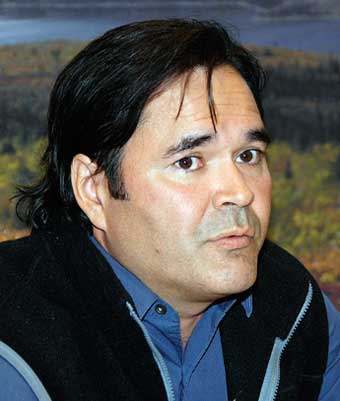
Stephen Mills
Photo by Whitehorse Star
Stephen Mills
Much of the city's waterfront could end up as a giant parking lot if council doesn't approve changes to the parking regulations for the properties, say two local developers.
Much of the city's waterfront could end up as a giant parking lot if council doesn't approve changes to the parking regulations for the properties, say two local developers.
Both Vuntut Limited Partnership president Stephen Mills and Tony Zedda of Kobayashi and Zedda Architects addressed a public hearing at Tuesday evening's regular council meeting.
They called on council to allow a relaxation of parking requirements and change the setback requirement in the zone.
"All other downtown zones have a relaxed parking requirement," Mills said in an interview Wednesday. "Our (potential) properties are exempted from the relaxation."
The Vuntut Gwitchin Limited Partnership was the highest bidder on the two territorial government properties on the waterfront, but the Ta'an Kwachan Council challenged the bid process in court.
Though the first nation lost the court case, the Vuntut Gwitchin have been waiting for the appeal period to pass while continuing to work on its development plans for the sites.
The city, meanwhile, has proposed changing the zoning bylaw to include principal uses on waterfront properties after no bids were received in its first release of lots on the former Motorways trucking properties downtown.
While the public hearing was set to look at the proposed changes, in his presentation to council Tuesday night, Mills proposed the changes to the parking and setback regulations.
Under the current commercial mix waterfront zone, developers would have to provide about 4 1/2 times more parking than other such sites downtown at three stalls for every 100 square metres of commercial, retail or office space and one stall for every residential unit.
"To us, that doesn't make any sense," Mills said in the interview.
In his presentation to council, he commented the regulation prevents the mixed-use development proposed in the master plan for the former Motorways yard where the waterfront properties are.
Meanwhile, other zones in the city - including some other waterfront zones - benefit from the relaxed regulations of one stall for every 150 square metres of commercial or office space and one stall for every two residential units.
With the waterfront lots sitting on a traditional flood plan, moving to underground parking to provide the stalls isn't practical and would be expensive, Mills argued in his presentation to council.
"It is our belief that sufficient surface parking exists in the area and could complement the mixed-use nature of development envisioned for the Motorways site," Mills noted.
The parking lot at Shipyards Park in the area, which often sits relatively vacant now, could be used for the new developments that will be built.
"The mixed-use nature of the area meshes well with parking needs over a 24-hour period," he said. "Parking stalls occupied during the day by those working in the area would be available in the evening and overnight for use by those living in the area."
If the parking requirements remain as they are, the Vuntut Gwitchin Limited Partnership would be forced to build smaller structures due to the amount of parking it would have to provide. That would also mean spreading the costs over a smaller building area.
"This results in a significant impact on the economics of these lots as well as other properties," it was pointed out in Mills' presentation.
It then goes on to note the design guidelines of the zone speak to developing a "thriving, pedestrian-oriented, mixed-use residential neighbourhood that provides a unique identity befitting an urban waterfront."
The parking relaxation clause in the other zones is there to acknowledge the dense, mixed-use nature of the downtown and waterfront as well as showing requirements in the downtown are different than those in more suburban areas where there is usually more access to vehicles and higher ownership.
Developers are also likely to have trouble meeting the parking requirements in the CMW zone under the regulation requiring a 20-metre setback from the Yukon River and neighbouring streets, council was told.
"According to our calculations, if the 20-metre setback is applied to the subject properties, these properties would be unable to accommodate the current parking requirements, let alone those of a relaxed parking arrangement that we propose," he said before proposing the 20-metre setback apply only to the Yukon River side.
"We feel that if the two proposed revisions are included in the proposed bylaw rewrite, it would provide both the desired mixed-use densities envisioned in the design guidelines for a more diverse range of development options," Mills said.
In an interview this morning, Zedda said he shares the same concerns and favours the city's proposal to provide principal uses - and therefore more flexibility to developers - for the site.
"My sentiments echoed his," Zedda said of Mills' arguments.
Clearly, a relaxation of the parking requirements would better reflect what the city has envisioned for the waterfront, he sad.
Kobayashi and Zedda didn't bid on any of the properties the city put out to tender earlier which face Second Avenue, but Zedda noted the company is more interested in the sites that will be along the Yukon River.
Mayor Bev Buckway said Wednesday that dealing with parking issues in the city always presents a challenge in finding the balance between providing enough spaces and encouraging appropriate development.
"I believe they brought up a valid issue," she said, adding it's a prime example of how the city's process can work in bringing up issues.
Buckway wouldn't say whether she'll support the proposal.
Rather, she'll wait to see what comes out of the public hearing report that will be prepared by city staff for next week's standing committee meeting before the vote comes forward at council's next regular meeting on Oct. 27.
In order to encourage thoughtful and responsible discussion, website comments will not be visible until a moderator approves them. Please add comments judiciously and refrain from maligning any individual or institution. Read about our user comment and privacy policies.
Your name and email address are required before your comment is posted. Otherwise, your comment will not be posted.
Comments (1)
Up 0 Down 0
Michel Dupont on Oct 17, 2008 at 1:45 am
Going back a few years when the big box stores started establishing themselves, we needed a visionary to come up with the idea of making main street a mall from 4th. to 2nd. ave. Multilevel parking lots near entrances, would have help the parking situation. Also, businesses in the mall would have enjoyed street side sales year round, cafes with street side tables, events of all kinds, exhibits and the comfort to shop indoors. No doubt a Sears, The Bay or similar big player would have wanted to participate in such project boosting traffic for all business in the mall. Think of early morning walk for the elderlies, a meeting place for the youth concentrated in a safe environment. Northern communities are familiar with these kind of premises.