Pact enhances self-determination, chiefs say
Four Yukon First Nations announced Tuesday what they described as another significant step on the road to self-determination.
By Chuck Tobin on February 14, 2013
Four Yukon First Nations announced Tuesday what they described as another significant step on the road to self-determination.
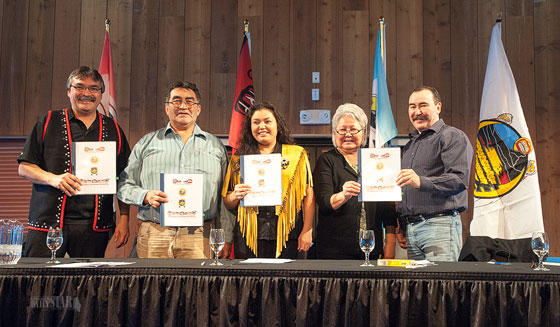
Agreements to jointly address outstanding issues related to overlapping traditional territories were signed by the Kwanlin Dun First Nation, the Ta'an Kwach'an Council, the Carcross-Tagish First Nations and the Champagne and Aishihik First Nations.
Kwanlin Dun Chief Rick O'Brien said the agreements build upon existing self-governing authority, and provide them with more control over land use planning and the use of natural resources.
For five years now, O'Brien pointed out, officials from the different First Nations have been working on the agreement to address matters in their overlapping traditional territories.
"This work has allowed us to move forward on a number of issues without compromising our traditional territories or the right of First Nations to manage,” O'Brien told a small gathering at the Kwanlin Dun Cultural Centre.
"Now that this is resolved, it is time to move forward, to roll up our sleeves and get ready for the next set of challenges.”
The chief said settling the overlap issues was among the last of the low-hanging fruit the First Nations had to deal with. It's time now, O'Brien insisted, to go after the high hanging fruit.
The overlap agreements were signed off Tuesday during a week of celebrations to commemorate today's official 40th anniversary of the aboriginal land claims movement in the Yukon.
The Council of Yukon First Nations has planned events marking the anniversary for today and Friday.
It was in 1973 that chiefs from across the Yukon travelled to Ottawa to present then-prime minister Pierre Trudeau with the document Together Today for Our Children Tomorrow.
Together Today for Our Children Tomorrow established the foundation for land claims in the Yukon, and set out the principles First Nations would stand by in negotiating their claims.
Trudeau accepted the document, and later announced he would begin a process of negotiating aboriginal claims in the territory.
In 1995, on Valentine's Day, the first four Yukon First Nation settlements became part of the Constitution of Canada, and seven more have been appended since then. Three First Nations have not settled.
Under the 1993 Umbrella Final Agreement, the blueprint for negotiating individual settlements, it was up to First Nations to work out amongst themselves any issues related to overlapping traditional territories.
Until the issues were addressed by the First Nations, their co-management rights recognized in their final agreements were suspended in the areas of overlap, with the Yukon government remaining as the sole management authority.
Lawrence Joe, the director of lands and resources for the Champagne and Aishihik First Nations, explained Tuesday the overlap agreements enable First Nations to assert their rights and displace the Yukon as the sole authority.
The overlap agreements, for instance, address the ownership of traplines.
With overlap agreements in place, the First Nations gain their management rights over timber management, fresh water fish resources, wildlife, heritage resources, and the management of special management areas.
All 14 of the Yukon's First Nations have overlapping claims. There is a huge amount of overlap in the traditional territories of Kwanlin Dun and the Ta'an Kwach'an Council of Lake Laberge, for example.
But Kwanlin Dun also has overlapping territory to the west with Champagne and Aishihik, to the south with Carcross, to the north with the Little-Salmon Carmacks First Nation and the east with the Teslin Tlingit Council.
Ta'an Chief Kristina Kane said the settlement of overlap among the four First Nations is a reflection of the unity and co-operation Yukon's aboriginal people have thrived under for thousands of years.
"Today is a day that affirms the wisdom of our past leaders, moving forward in unity, with respect and acknowledging the rights of future generations,” she told those gathered to witness the signing.
Carcross-Tagish Chief Dan Cresswell said he was honoured to be signing an agreement that sets out how they will manage the land and work together.
"Like Chief Kane said, we have had these relationships for thousands of years,” he said.
"This is what our elders did in the past. They knew that if you took care of your neighbour, your neighbour will take care of you, and if you took care of the land, the land will take care of you.
"That is what this is all about,” Cresswell said.
Be the first to comment