Ottawa unfurls anti-homelessness plan
Champagne-Aishihik Chief James Allen welcomed the influx of funding his community, among others,
By Christopher Reynolds on August 1, 2014
Champagne-Aishihik Chief James Allen welcomed the influx of funding his community, among others, has already begun to receive under a federally supported homelessness initiative unveiled this week.
“I’m happy the proper money and funding is being allocated to my people,” Allen told the Star. “It’s helping the community and it’s needed to lift those who are hurting the most up and into a better place.
“It’s about time,” he added.
Nearly $1.8 million in federal cash will be handed out over five years via the Council of Yukon First Nations (CYFN) to combat homelessness in Whitehorse and the communities, government officials announced Wednesday.
Four projects in Whitehorse, one in Haines Junction and one in Pelly Crossing are already underway.
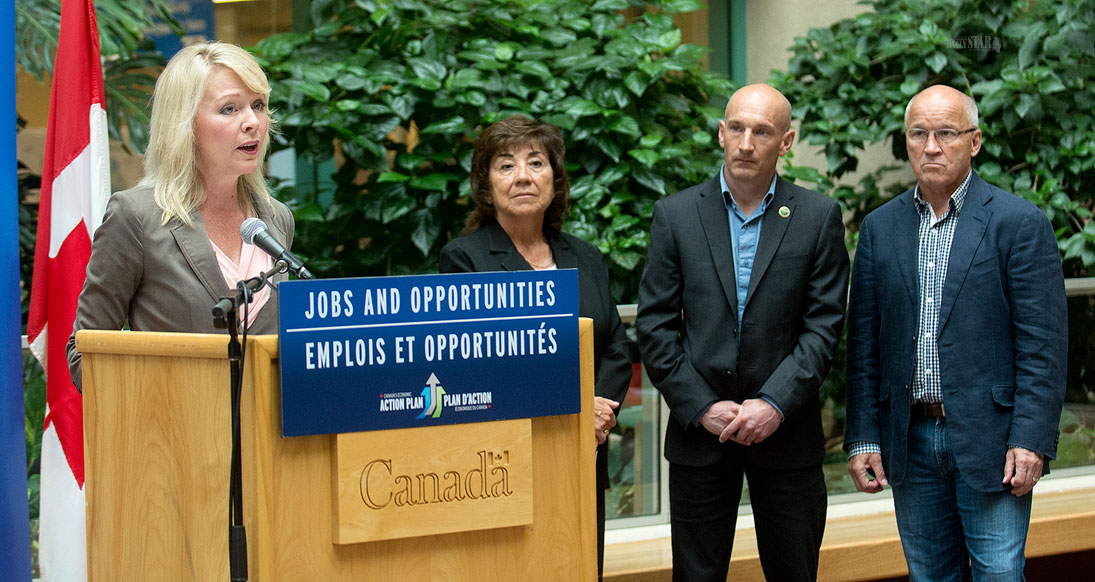
Allen stood alongside political representatives including Grand Chief Ruth Massie, MP Ryan Leef, Senator Dan Lang and Candice Bergen, the federal Minister of State for Social Development, for a signing ceremony at the Elijah Smith Building.
“We are grateful for the funding,” Massie said.
“It’s an important investment, and Champagne and Aishihik coming in as one of the community partners is great,” Leef added.
Bergen stressed the flexibility of the federal government’s homelessness partnering strategy, launched in 2007 and renewed in the Yukon this year. “We want you to decide where that funding should go, where it would best be allocated,” she said.
“Homelessness in the Yukon looks very different from homelessness in southern Manitoba (which includes Bergen’s riding), and that looks very different from homelessness in Vancouver or Toronto.”
The junior minister said Ottawa’s homelessness strategy aims first to move at-risk individuals into permanent housing and then to provide support for “underlying issues” like addiction and mental health problems.
That differs from what Bergen called a “crisis-based” model, which relies more on shelters and emergency interventions and offers housing only after individuals undergo treatment and demonstrate sobriety.
“(W)hen we give people a safe, secure house to live in with support, they then can, from out of that place of security and stability, go on and improve their lives,” she said.
“Whether it’s treatment, whether it’s skills development, whatever their need is, they can do it from that position of having a safe home.”
The ceremony Wednesday afternoon preceded a second announcement Thursday morning, when Bergen and Community Services Minister Brad Cathers signed a $16-million agreement between Ottawa and the territory that will help fund affordable housing in the Yukon over five years.
It’s part of the most recent federal “economic action plan,” which will see $1.25 billion spread across the country between 2014 and 2019.
Kate White, the Opposition critic for housing, questioned the impact on homelessness of a few hundred thousand dollars annually, “which is peanuts for dealing with the issue of supportive housing.”
She pointed out $11.5 million from the Northern Housing Trust remains unspent, though it has been available since 2006.
“The (Yukon Party) have turned up their noses at housing since forever,” White told the Star this week.
“But they’ve just been bypassed by the federal Conservatives when the money got given to the CYFN to deal with housing first, because the Yukon Party does not believe in a housing first model.”
White also highlighted June’s cancellation of a major affordable housing plan, nixed from above despite the Yukon Housing Corp.’s approval and Cathers’ assurance half a year earlier that the housing corporation had the final word.
The last-minute backtrack drew criticism for supposedly prioritizing realtors above renters, perceived cronyism and the hundreds of hours and tens of thousands of dollars invested — and lost — by local developers on proposals for the 75 prospective housing units.
“That is kind of like paying lip service to the idea of housing without actually backing it up,” White said.
“My hope is that it’s been acknowledged by at least one of the Conservative parties in Canada, and that maybe we can ... force their hand now that Ottawa has said this a direction we should go in.”
Under the renewed program, Blood Ties, a support centre for HIV/AIDS and Hepatitis C, received $26,000 after submitting a proposal to the CYFN.
The money pays for a caseworker to arrange three-way housing partnerships between the centre, landlords and formerly homeless clients in Whitehorse.
“We create an arrangement with a landlord who has a suitable housing unit who might be open to rent it to a higher-risk person as long as their risk is minimized,” Blood Ties executive director Patricia Bacon said in an interview today.
While the client — six “chronically homeless” individuals have found a permanent home through the program so far — pays for the unit out of their social assistance housing allowance, Blood Ties also provides a rent guarantee.
“We’re very grateful to be one of the recipients this year,” Bacon said. “Without it, we wouldn’t be able to do the work we’re doing. We believe it’s innovative.”
The Salvation Army received $117,000 to maintain its low-barrier shelter. The Fetal Alcohol Syndrome Society Yukon (FASSY) has two housing facilitation projects on the go thanks to a similar amount from Ottawa by way of the First Nations council.
FASSY executive director Michael McCann served as master of ceremonies at Wednesday’s event.
The Selkirk First Nation and Champagne-Aishihik First Nation received roughly $100,000 between them.
The former is using the cash to continue a homelessness study in Pelly Crossing from last year by moving forward with an action plan.
Champagne-Aishihik, new to the program, is launching a study to better understand homelessness in Haines Junction.
“Homelessness is often very misunderstood in the North as much of our homelessness is hidden,” said Pearl Callaghan, a spokesperson for Massie.
Unlike in Vancouver, where a temperate climate means more people sleep on park benches or in laneways, individuals without a fixed address in the Yukon often bounce from couch to couch and are not identified as homeless.
As a result, relevant data on the problem are not available either.
“CYFN aims to work with stakeholders from all sectors to raise awareness of this social issue,” Callaghan said.
The project in Haines Junction aims “to get a clearer picture of what we actually need to do.”
Under the federally guided process, a community planning board reviews proposals and recommends to the CYFN which groups should receive funding.
The homelessness partnering strategy is delivered through three funding streams: designated communities, totalling 61 across Canada, usually urban centres; aboriginal homelessness, which includes off-reserve First Nations, Inuit and Metis; and rural and remote homelessness, for particularly far-flung communities.
In 2008, a study by Canada’s Mental Health Commission came out in favour of a “housing first” approach to homelessness.
Participants in the group in the Housing First group spent about three-quarters of their time on average in stable housing over the course of the study, compared with less than one-third for the “usual care” group.
Every $10 invested led to an average savings to government of $22 for participants who used emergency and social services the most, according to Employment and Social Development Canada.
Since the launch of the homelessness partnering strategy in April 2007, about 32,000 at-risk or homeless individuals have received training, support and assistance finding work.
Roughly 5,600 new shelter beds have also been created.
Comments (5)
Up 8 Down 0
Gutted social services on Aug 5, 2014 at 12:57 pm
The Homelessness money had nothing to do with Social Services under its current leadership being gutted. Its being run by someone who scores points with Senior Management by cutting costs. They could care less about staff or the programs or the people they are being paid a lot of money to help. When was the last time (if ever) did the current director work the floor in an effort to know who the clients are or what the needs are of staff ... why does she sit in an office behind locked doors several blocks away? People are calling for a review but the Minister is ignoring all the warning signs. This is going to blow up eventually with staff walking off the job in protest.
Up 7 Down 0
The Gutting of Social Services on Aug 5, 2014 at 5:17 am
To Max Mack ... the gutting of "not-so-social" services has / had nothing to do with this but everything to do with the person in charge. They sit behind locked doors afraid that a client will wander in and they have to (wait for it) ... actually have to interact with them. But then you just have to follow the bread crumbs and see how they have got their various jobs in HSS and it all makes sense what is now happening.
Up 3 Down 2
Max Mack on Aug 3, 2014 at 1:04 am
So, does this explain the gutting (ahem . . . "restructuring") of YTG's Social Services and the abandonment of supported living and housing for its clients?
Oh, what a tangled web we weave . . .
Up 4 Down 7
Josey Wales on Aug 1, 2014 at 5:00 pm
I think that is a great idea to fund the issue. Funny thing though, why Ottawa and not the various F/N's themveryselves?
Seems to be no shortage of new gear in town, many, many, many, "new" businesses popping up everywhere complete with equity jobs.
Somehow despite all the SCADS-O-MILLIONS dumped into their laps, Ottawa needs to fund a program to take care of what seems to be "their" people? How is that sovereign if my nation funds it?
...suppose by default now for merely wondering aloud, I'm a somethingist now?
Up 7 Down 3
Northern Trust Other Investments by the Federal Govrnment on Aug 1, 2014 at 4:32 pm
The Northern trust was $50 million dollars and most of that has been spent. We need to rethink homeless and how we assist people to get into homes. Such as the affordable homes idea. What is the meaning of affordable housing program needs to be clarified. The NDP just stated there is 11 million dollars left from the northern trust but they do not bring forth any plan. To state that $1.25 billion across Canada and spending $100 thousand is nothing to help people to do better. I don't think the people being helped would appreciate that type of comment. NDP just wants to spend money with no direction or understanding of impact or real outcome. It is easy to make blank statements like the NDP. Show me a reasonable and effective the strategy for housing?