Photo by Vince Fedoroff
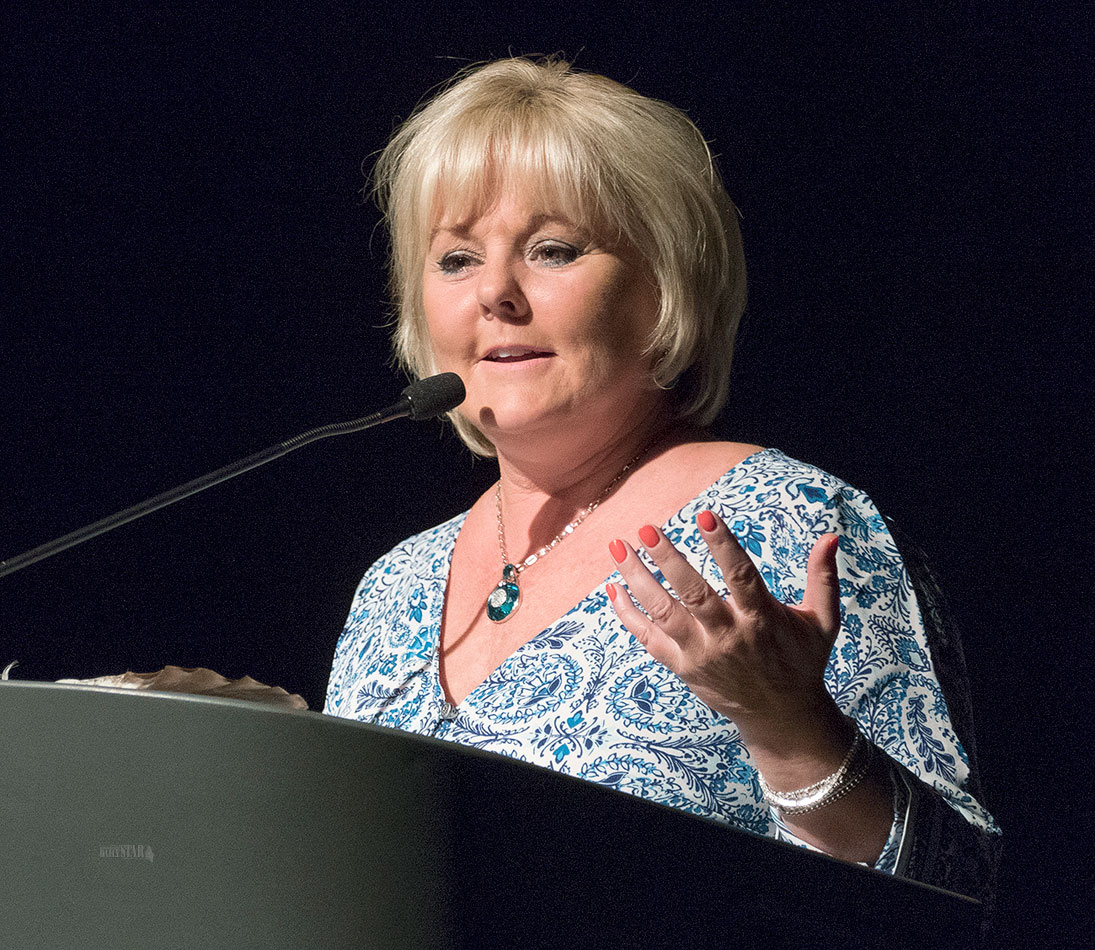
RECALLING TRIALS AND TRIBULATIONS – Elizabeth Manley, seen Friday during her talk in Whitehorse, hopes to educate the public on some of the false ideals surrounding mental health care.
Photo by Vince Fedoroff
RECALLING TRIALS AND TRIBULATIONS – Elizabeth Manley, seen Friday during her talk in Whitehorse, hopes to educate the public on some of the false ideals surrounding mental health care.
Athletes train to be tough. To be strong. Not to show emotion.
Athletes train to be tough. To be strong. Not to show emotion.
That’s a large part of the reason Elizabeth Manley found it so difficult to manage her mental health as a teen, when she was diagnosed with depression.
Now, the former Olympic figure skater is open about it.
Manley has written books about it. She’s a spokesperson for mental health.
She regularly gives talks like the one she gave Friday morning at the Kwanlin Dün Cultural Centre, which hosted a two-day summit on mental health in the Yukon.
The event was organized after the Yukon government released its 10-year mental wellness strategy in May. Attendees of the summit included mental health professionals and community partners.
Manley joked, as she looked around the room, that it was nice to be recognized here, unlike when she visits school classrooms these days.
“I think about 80 per cent of this room was alive when I skated,” she said. “And look! I’m wearing the blue eyeshadow again.”
That’s how most remember Manley – as Canada’s sweetheart.
A petite blonde powerhouse of a figure skater who, in blue eyeshadow and a fuschia costume, skated to silver at the 1988 Olympics in Calgary.
But a lot came before that, Manley told the crowd.
Her life on the ice began around the age of three. With three hockey-crazed brothers who regularly duct-taped her into a net to shoot pucks at her, Manley’s skating dreams weren’t originally of the Olympics. They were simply to be better than her brothers.
Her parents registered Manley in CanSkate classes, where she excelled. By the time she was 15, Manley was the national figure skating champion, and on track for the Olympics.
But her parents had separated. Manley rarely saw her father or brothers anymore.
Her long-time skating coach dropped her, saying he didn’t feel he had the skills to take her to the Olympics. (In reality, he had AIDS, and was trying to spare her the experience of watching him deal with that.)
On top of that, Manley’s mother could no longer afford the necessary skating lessons.
Manley was trying to accept a life of normalcy, of being a regular kid instead of an Olympic hopeful, when Skate Canada called and offered to pay for Manley’s training and billeting in Lake Placid, N.Y. It seemed like perfect timing.
But the reality of the experience was less than perfect.
Manley lived alone in the attic of an old house in New York State. Her billeter was rarely home.
She completed school by correspondence. She had no friends and no family nearby. At their first meeting, Manley’s new coach grabbed her from behind and told her she was fat.
Within a matter of weeks, Manley noticed that, though she wasn’t eating, and was training 10 hours a day, she was gaining weight at an alarming rate, and her hair was falling out in handfuls.
When her mother found this out, she drove from her home in Ottawa and pulled her daughter from the situation.
Manley recalled the ride home that night. She was dead silent throughout the trip.
When her mother asked her what was wrong, Manley told her nothing was wrong. She was fine.
“Fine means ‘I am coming apart at the seams but I don’t want to talk about it. Leave me alone,’” Manley told the crowd at the cultural centre.
It was part of her training, she said, not to show that emotion.
And that expectation was further reinforced after Manley was diagnosed with depression.
Manley recalled a night, shortly after, when Skate Canada called to find out whether she would be appearing at an upcoming competition in Montreal.
They’d heard what she looked like, they said – the weight gain and the hair loss that had progressed to complete baldness.
They’d heard what she was going through. They didn’t want her to embarrass them.
“There’s your stigma,” Manley said on stage. In the ’80s, she said, people thought of mental health in terms of straightjackets.
That perception was why Manley hesitated when a doctor called her after the Montreal competition (she did participate, and was stripped of her Skate Canada uniform), offering free therapy. Eventually though, she accepted.
“It was a floodgate,” she said of the experience. “All these emotions that I’d been holding in for so long.”
That’s where she realized that skating, which she’d thought was the problem, wasn’t the issue. The root was much deeper.
It had to do with Manley’s father being gone. With guilt. With being 16 and feeling immense pressure from all sides.
In time, she returned to skating, but when she did, she did it for fun.
Manley made rules for herself that it had to remain fun. That, if she felt like it, she would take days off to spend in her pyjamas with her pet dogs.
That she would continue therapy, and that no one would pressure her. In that way, she said, she was able to fall in love with the sport again.
And in talking about it, she hopes to break down some of the stigma surrounding mental health care.
In order to encourage thoughtful and responsible discussion, website comments will not be visible until a moderator approves them. Please add comments judiciously and refrain from maligning any individual or institution. Read about our user comment and privacy policies.
Your name and email address are required before your comment is posted. Otherwise, your comment will not be posted.
Comments (2)
Up 0 Down 0
Harry Fleich on Jun 28, 2016 at 9:46 pm
Thanks for coming Ms Manley and showing that great obstacles can be overcome and goals can be reached by anyone with enough patience and perseverance.
Up 8 Down 2
Mark Sanders on Jun 27, 2016 at 4:23 pm
Amazing and very candid account! Thank you for speaking about it and sharing your experience.