An Ontario-based Crown prosecutor says he hopes to see a greater recognition that the healing of offenders and victims has to play a more dominant role in the criminal justice system.
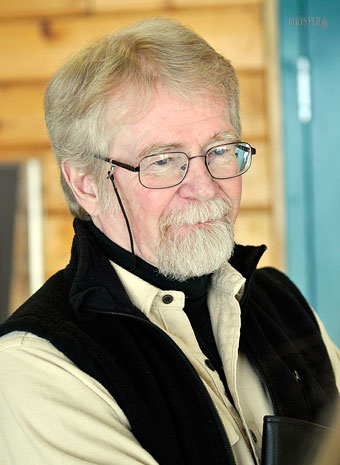
Rupert Ross was a keynote speaker at a Whitehorse conference called Moving Forward Together: Focus on Victims of Crime.
The two-day event, at the Mt. McIntyre Recreation Centre, includes attendees and representatives from governmental justice and social services departments, non-governmental organizations, and first nations groups.
Ross gave his opening keynote address, entitled Exploring Criminal Justice and the Aboriginal Healing Paradigm, on Tuesday evening.
"The conference is ultimately about healing," he said in an interview Wednesday.
Ross has been a Crown prosecutor in northwest Ontario for more than 20 years. He has been responsible for criminal prosecutions in more than 20 Cree and Ojibway first nations near Kenora, Ont.
"My primary push is that within the traditional (first nations) teachings is everything that communities need," Rupert said. "The challenge is to empower communities to increase their own healing power.
"Criminal activity has its roots in many decades of colonization. I'm very interested in any effort to help first nations deal with the impact of colonization," he added.
Rupert said he wishes traditional first nations healing practices were formally incorporated into more justice systems in Canada, but that the Yukon is "making a good start."
Conference attendees were provided with copies of two books Rupert has written about the relation between first nations' culture and the criminal justice system in Canada, entitled Dancing with a Ghost and Returning to the Teachings.
Rupert said that his approach to the justice system has been heavily influenced by an observation that Elmer McKay, the solicitor-general during Brian Mulroney's 1984-93 governments, once said in Parliament: "If putting people in jail made for a safer country, the U.S. would be the safest country in the world."
"I live by those words," said Rupert, who noted a recent study shows one out of every 100 people in the U.S. - several million people - are either incarcerated or awaiting trial.
"That's scary," he said.
Many other community leaders have attended the conference, including Justice Minister Marian Horne and Heino Lilles, a longtime territorial court judge who is semi-retired.
"We're acknowledging the relationship between victims and the justice system," Dennis Cooley, the deputy minister of Justice, said in his opening remarks on Wednesday.
Paraphrasing author Wilma Gallet, Cooley added that justice's purpose is not simply to compensate for a crime, but to restore trust, a sense of safety and the human spirit.
Sandra Bryce, manager of the territorial victim services unit, asked the audience members, who were seated around various tables in small groups, to write down their definitions of the term "victim".
"People who use our services do not like the term 'victim,'" Bryce said. "We use the word 'client' instead."
While examples varied, the audience members seemed to agree that a victim is someone who has suffered emotional or physical harm because of another person.
Following the open remarks, audience members circulated between several workshops offered by professionals who deal with victims every day.
Representatives from YTG victim services discussed the various avenues available to victims who are in need of assistance.
"We focus on crisis intervention and safety planning," said Lisa Ivens, who works in the child services unit.
Ivens added that 95 per cent of their clients are victims of domestic violence or sexual assault.
Judy Pakozdy of the Fetal Alcohol Spectrum Society Yukon (FASSY), hosted a workshop about the harm in drinking alcohol during pregnancy.
"People with FASDs (fetal alcohol spectrum disorders) need structure, support and supervision," reads a pamphlet made available to the audience members. "Without these three things, they become victims, criminals, homeless, isolated and suicidal."
Barbara Powick, executive director of the women's transition home Kaushee's Place, said staff at the home have "a real concern for victims of violence, especially with the low rates of vacancy right now (in Whitehorse)."
Powick said that last December, Kaushee's Place was running at a 98 per cent occupancy rate, when normally it only houses two or three women at that time of year.
Powick said she has no explanation for the change.
Be the first to comment