Numbing weather is expected to break Sunday
The coldest weather so far this winter settled over the territory this week,
By Max Leighton on January 18, 2012
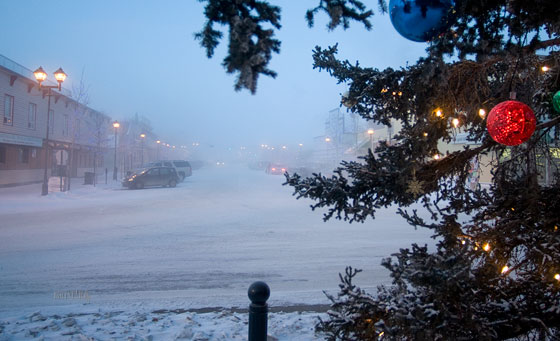
The coldest weather so far this winter settled over the territory this week, bringing record-high energy use and some seasonal challenges for local businesses and homeowners.
Late last week, an Arctic flow moved south over the territory, heading from the North Pole via the Beaufort Sea and blanketing the Yukon.
In Whitehorse, temperatures reached as low as -39 C Monday and were in the negative 30s again last night – and in the -40s on the city's outskirts. This morning's temperature was -32.
Temperatures of -44 were reported in Dawson City this week, with -48.2 reported in Watson Lake.
Part of the reason for the chill has been our otherwise clear weather.
"You need to have clear skies for -40, and cloud coverage tends to keep things a bit warmer,” said Doug Lundquist, a sector meteorologist with Environment Canada based in B.C.
"But it's certainly not record-breaking. In fact, we have really been spoiled-rotten scoundrels for having the January weather we have had so far.”
In other words, we may not be as tough as we think.
Despite not clearing our record lows for this time of year, we have consumed more power than ever before.
"We reached 82.30 megawatts of power usage around dinner time (Monday) night,” Janet Patterson, the spokesperson for Yukon Energy, said Tuesday.
"We think that's a record. If we had a -35 or -40 day eight years ago, we would have reached about 65 MW.”
Before Monday, the closest the Yukon had reached 80 MW was during the 1990s, when the Faro lead-zinc mine was in operation.
Increases in commercial developments and public facilities like the Canada Games Centre and government buildings, as well as developments in the mining industry, have been key growth factors, said Patterson.
"We are burning some diesel, about six to nine mw during peak periods,” said Patterson.
"But that's less than half what we'd be burning without the Aishihik and Mayo B plants, which are producing much more power for the system.”
High energy consumption, of course, often means swelling payments for homeowners.
"Whatever the temperature, be as careful with electricity as you can be,” Patterson advised.
"It's precious, and should be treated as a precious commodity. For instance, if you've got your vehicle plugged in from the time you get home from work to the time you leave in the morning, that's excessive. About two hours or so is plenty.”
For most Yukoners, times like this are just about trying to get though the cold without too much disruption to their routines.
Five buses at Standard Bus Lines, the company contracted to provide most school bus services to the territory, didn't run in Whitehorse on Monday morning and four others were stalled in the communities.
Since the setback, they have been working to keep business running smoothly.
"We are working 100 per cent, with all our drivers stepping up to the plate to pick up any slack for buses running late,” said Norma Lee Craig, with Standard Bus Lines.
"(Monday) we had a couple of delays, but we are doing the best we can. We have a great team of drivers, and a few of them have even been in early, helping our mechanic get things in order.”
Currently, all the company's 61 buses are up and running, except those going through regularly scheduled repairs.
Some service businesses actually do better during a prolonged cold snap, such as tow truck companies, vehicle repair shops and taxi firms.
"We have been getting quite a few more calls,” said Jesse Zelitt, a dispatcher with Quality Cabs.
"The majority are people who don't want to be standing around for a half-hour waiting for the bus, others have had their cars break down, or don't want their vehicles to die while they are at work.”
Local cab companies keep their cars running nearly 24 hours daily, so they don't experience the same setbacks that bus services can during the coldest parts of the year.
"The cold helps,” said Zelitt.
"After New Year's and Christmas, we see a bit of a decline in calls, but in the extreme weather, we are blessed with good business and we try to help people as much as possible.”
Today's afternoon temperatures look like they will settle in at around -27, with overnight temperatures of about -33 – colder in the city's peripheral areas.
The weather is likely to remain fairly consistent until Sunday, when a system may arrive from across the Alaska panhandle, bringing warmer weather and the possibility of more snow.
See related story below.
Be the first to comment