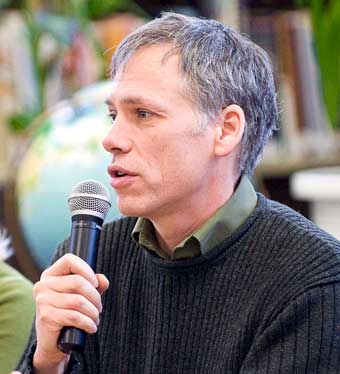
Photo by Whitehorse Star
John Streicker
Photo by Whitehorse Star
John Streicker
A report on adapting northern infrastructure to the effects of climate change highlights important issues,
A report on adapting northern infrastructure to the effects of climate change highlights important issues, but is more useful for policy makers in Ottawa than it is for people living and working in the Yukon, says the territory's most prominent environmentalist.
John Streicker, the Yukon's federal Green Party candidate, spoke to the Star about a report released last week by the National Roundtable on the Environment and the Economy (NRTEE) , titled True North: Adapting Infrastructure to Climate Change in Northern Canada.
As they write in the report, members of the federally funded advisory body chose the topic for their latest report because "climate change is a reality and the global front line runs directly through Canada's North .... The impacts of climate change pose risks to a range of economic sectors and systems that northerners value.
"Chief among them is the region's infrastructure, including its roads, buildings, communications towers, energy systems, and waste disposal sites for communities, and large-scale facilities and waste-containment sites that support the territories' energy and mining operations.”
Its conclusion: Infrastructure and and communities in Canada's North are unprepared to cope effectively with the looming threat that climate change poses to roads, buildings, industrial waste sites, energy and other critical infrastructure.
It says Canada needs to update national building codes and standards to address the fact of melting permafrost and fluctuating winter temperatures. The government should have funding available so communities can make the changes they need to vital roads and buildings as quickly as possible, the report suggests, and the insurance industry needs to be brought on board as well.
The report urges the Canadian government to gather and share the most current information available on infrastructure needs, climate change projections and current conditions, in co-operation with northern experts and other polar regions.
Streicker, one of the experts consulted by the roundtable, said that although the report sounds grim, it's nothing new for northerners.
"I would say that people should not be panicking when they see the report. These are all things that we have been talking about in the North for a long time,” he said.
"The real audience is the South and Ottawa.”
How far it will get in Ottawa is another question, Streicker said.
The roundtable used to report directly to the Prime Minister's Office, but has been demoted since its creation and now reports to Environment Minister Jim Prentice.
"The last couple of reports they have submitted, the minister has not accepted the conclusions,” Streicker said.
"So we'll have to wait and see how this one is received. What we really need is for the federal government to take its role and its responsibility seriously.”
Regardless of federal reaction to the recommendations, northern communities are already doing many of the things the report suggests.
The Northern Climate Exchange, a clearing house for climate change information which Streicker is a member of, is already doing adaptation planning in three northern communities, and creating climate projections which are publicly available.
There is a need for a national plan, however, Streicker said, because no matter how well adapted an individual community is, it will still rely on federally or territorially maintained and regulated infrastructure.
"If you just do community-based adaptation planning, then you miss things like roads that lead out of the community and mines with retaining walls that rely on permafrost,” he said.
While the report is a positive sign that the world outside appreciates the unique situation northerners are in, Streicker said, it misses one very important point: the interface between mitigation and adaptation.
Mitigation strategies, he explains, are aimed at reducing our negative impact on the planet; while adaptation strategies are aimed at preparing ourselves for the changes a warming climate will bring. The two strategies have to be undertaken together, he said.
"If you mitigate but don't adapt, you leave yourself in harm's way. If you adapt, but you don't mitigate, you lead yourself to harm.”
He gave the example of increased flooding in remote communities caused by heavier snowfalls in the winter and a rapid spring thaws.
One of the outcomes of flooding will be that some communities will be cut off from the supply routes, thereby threatening their food security.
Two solutions are put forward: One is to fly food into the affected communities, the other is to build greenhouses for local food production and warehouses for food storage.
Both solutions are ways of adapting to life without a road, Streicker said, but only the local growing and storage mitigates by reducing the distance the food has to travel and therefore reducing the greenhouse gases emitted.
"Most people (working in the climate change research field) ask why we continue to separate mitigation and adaptation, and the report didn't even mention that.”
The roundtable's report comes just in time for the United Nations Climate Change Conference in Copenhagen, where many hope the world's leaders will agree on international adaptation and mitigation strategies.
In order to encourage thoughtful and responsible discussion, website comments will not be visible until a moderator approves them. Please add comments judiciously and refrain from maligning any individual or institution. Read about our user comment and privacy policies.
Your name and email address are required before your comment is posted. Otherwise, your comment will not be posted.
Be the first to comment