Photo by Dan Davidson
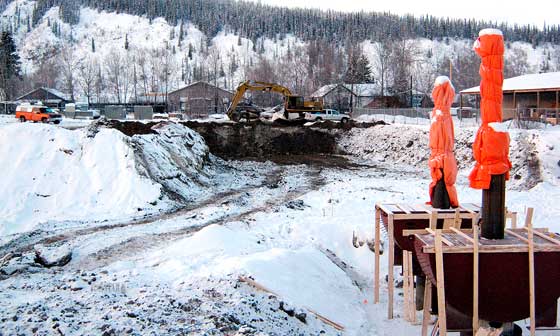
DIGGING DONE – The entire area where construction of Dawson City's sewage treatment plant is planned has now been excavated without any more coffins being unearthed. In the foreground are the shafts for the plant.
Photo by Dan Davidson
DIGGING DONE – The entire area where construction of Dawson City's sewage treatment plant is planned has now been excavated without any more coffins being unearthed. In the foreground are the shafts for the plant.
Digging has finished in the old territorial highways compound off Fifth Avenue without the discovery of any additional coffins or bodies of executed criminals.
DAWSON CITY – Digging has finished in the old territorial highways compound off Fifth Avenue without the discovery of any additional coffins or bodies of executed criminals.
The operation closed down Friday, 22 days after the first coffin was uncovered while crews were excavating a foundation for Dawson's new secondary sewage treatment plant.
Two more coffins were discovered in short order, and then a fourth on Nov. 15.
As a result of these discoveries, none of which had been hinted at during drilling and soil remediation digging the year before, it was decided that Corix Water Systems would extend its fall construction season and excavate its entire foundation now.
In addition, there are plans for the Yukon government to put a bio-fuel (wood chips) district heating plant in behind the treatment plant.
The government decided to dig out that foundation area and the space in between the two pits just to make sure there was nothing else there.
As it turns out, there wasn't anything else.
What did turn up were pieces of a fairly deeply buried wooden frame conduit which apparently was used as a drain into the slough that used to run diagonally through the compound, according to site plan drawings from the days of the Northwest Mounted Police. During that era, Fort Herchmer was larger and had more buildings than it does now.
During examination of the uncovered gravesites, it has been determined that the four of them were within four inches of each other in elevation (depth in the ground), suggesting a standard burial procedure.
So far, it has been determined that two of the bodies were of First Nations men, suggesting they belong to two of the four Nantuck brothers, who were hanged in May 1899.
There could be as many as seven more bodies somewhere in the former NWMP compound.
Parks Canada has looked for them without success in the past, but now that some bodies have been discovered, there may be some incentive to look again.
In order to encourage thoughtful and responsible discussion, website comments will not be visible until a moderator approves them. Please add comments judiciously and refrain from maligning any individual or institution. Read about our user comment and privacy policies.
Your name and email address are required before your comment is posted. Otherwise, your comment will not be posted.
Be the first to comment