New solar system already paying for itself, keeping the house warm
For the past 10 days, Malcolm and Renee Mills haven't burned a lick of fuel to heat their 60-year-old home in Takhini.
By Chuck Tobin on February 28, 2014
For the past 10 days, Malcolm and Renee Mills haven't burned a lick of fuel to heat their 60-year-old home in Takhini.
With the bright blue daytime skies of late, temperatures have still headed south of – 20 C at night.
Not a penny has gone into heating fuel.
The sun has done it all.
The couple's decision to reduce their reliance on fossil fuels with a significant investment into solar energy will eventually pay for itself.
They didn't do it for the savings. Though it doesn't hurt that they'll recover most of their cost in a little more than eight years.
They did it because they believe in minimizing their carbon footprint.
There was also their young son's asthma condition and his sensitivity to particulate matter released by burning fossil fuels.
When the Mills purchased their duplex in Takhini five years ago, it was meant to be a starter home until they could move into the new Whistle Bend subdivision. There was talk of a district heating system for Whistle Bend using renewable geothermal heat from the ground: right up their alley.
After it was decided the proposal for geothermal was not feasible, they lost interest in Whistle Bend.
"By that point we had already settled into this house, and we got to know our neighbours,” Mills says in a recent interview sitting at his kitchen table. "And for the first time – I have moved so many times in my life – for the first time, I felt this sense of community.
"The only thing that was not going to work for us was our house.”
The Mills began researching options to replace an old oil furnace.
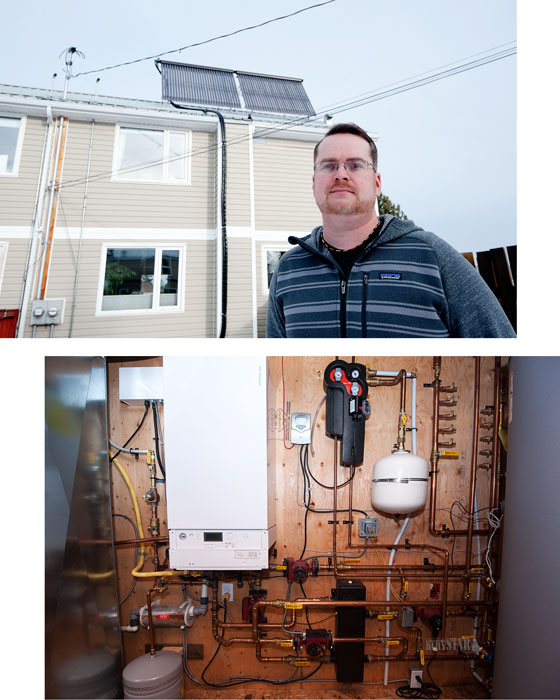
They settled on a new $42,000 hot water heating system, using a combination of solar energy and cleaner burning propane to heat their home and provide domestic hot water.
"We really, really looked at a healthy home, and what we could do to help our son, and what we could do to help our community, and work within our core values.”
Mills says they didn't want to just switch from oil to electricity, in part because Mills doesn't support the direction the Yukon government and Yukon Energy are going with the territory's energy future – particularly the move to liquefied natural gas.
Instead of a standard oil tank in their basement, the Mills now have a super-insulated, 450-litre hot water storage tank. In the last 10 days, the tank has been heated entirely with energy captured by 60 solar-thermal collectors on the roof – facing south. Large copper tubes filled with glycol transfer the heat from the roof to the new plumbing system which resembles something of a NASA space project.
Heat is pumped through the home through the existing duct work.
When there's not enough sunlight, the propane boiler kicks in.
Prior to the conversion last summer, the Mills were spending an average $250 a month or $3,000 a year for home heating fuel.
They've spent $600 on propane since September when the system became operational.
In addition to the new heating system, since moving into their home, the Mills spent approximately $10,000 replacing old appliances with energy-efficient models: washer, dryer, stove and fridge.
They're not the top of the line, but they're right up there, says Mills.
For the billing period from Jan. 6 to Feb. 3, the electrical bill for the family of four was $93.20, the largest amount since September.
A normal month in the past was in the neighbourhood of $130 to $140, and a big month was closer to $290.
Hot water for the home is a lot less expensive than it used to be.
Mills says by reducing the monthly electrical bill, combined with the savings in the cost of heating fuel, the family will earn back $27,000 in eight years and three months.
The remaining $15,000 is what the couple would have had to pay for a new oil furnace in any case, so Mills doesn't factor in that portion of the cost when calculating the return on their investment.
Of the $42,000 for the new system, $17,000 was for the solar equipment and installation, and $25,000 was for the high efficiency, condensing gas boiler.
During the longer days of spring and summer, says Mills, they'll have to start dumping excess heat.
Malcolm and Renee have a couple of options in mind. Perhaps a heated greenhouse, or a hot tub.
"It's one of those interesting byproducts of one of these systems,” says Mills. "You have to look at what you do if you have to much.”
Mills points out their monthly energy savings come before they've started their project to upgrade the original building envelope, the old 2 x 4 construction used back in the army days.
Once the exterior upgrades are complete, the savings will be even more dramatic, he expects.
There's no question in Mills' mind that if a new super-green home was fitted with the same type of system, heating costs would be vastly reduced, as would the CO2 emissions.
The co-founder of the anti-fracking group Yukoners Concerned about Oil and Gas Exploration and Development is critical about the non-existence of financial incentives available here to encourage energy conservation.
Other Canadian jurisdictions like Ontario offer incentives, he points out.
Mills says no matter what one might say about the United States, it's years ahead of Canada when it comes to promoting conversation among homeowners.
Had he and Renee completed their project in the U.S., they would have been entitled to a 30 per cent federal rebate, and maybe more, depending on what individual states were offering on top of the federal grant.
In Alaska, says Mills, they would have been eligible for another $10,000.
Mills says he knows attaining zero reliance on fossil fuels is not realistic in his family's everyday life.
He is, however, willing to do whatever he can to minimize the use of oil and gas products and their impact on the environment.
To go along with the next phase, upgrading the exterior envelope, will be a modest addition.
Mills says he and Renee won't add on if it means increasing their energy use. He's convinced they'll be fine. Along with the addition will be more solar panels to produce electricity, perhaps even a special vertical access wind generator.
In fact, says Mills, he expects they'll be selling electricity back to the grid before long.
Comments (11)
Up 1 Down 1
Atom on Mar 4, 2014 at 6:59 am
Must have gotten advice from the YG beancounters with the math on the refit.....
let's see now, let's not add the price of the new furnace because (err) it isn't really a cost, then we can use the 'ball' to calculate the return on your investment....(mhmm) oh it may never pay off but who cares, you likely won't want to continue paying the bill on the refit and the monthly heat and utility to operate it so you can just sell, the market in Yukon is certainly (hmm) strong. Then it will be someone else's problem when the power goes out at -40 and the whole thing freezes and busts...sort of like the mineral industry...but (ahhh) that's another story...
Up 0 Down 3
north_of_60 on Mar 4, 2014 at 6:46 am
@cab
Insults don't add to the discussion...pal.
Up 11 Down 77
CabComms on Mar 3, 2014 at 1:09 pm
North of 60,
While I agree that sealing cracks will lead to energy savings, your vitriol is misplaced. Hydronic heat is extremely comfortable, and can produce the same efficiency as a propane furnace if the system design allows for low return water temperatures. Electric furnaces, while 100 percent efficient, have their own issues, and will soon be more expensive per btu than diesel or propane. Furthermore, you must have missed the part where the son has asthma. Forced air furnaces, even with regular duct cleaning and filter changes, can lead to respiratory irritation for those already sensitive. Low temperature radiant heat is the way to go in these leaky PMQs, and I for one cannot wait to swap out my forced air system for a boiler.
Your ignorance is showing, pal. You may want to see to that.
Up 11 Down 7
north_of_60 on Mar 3, 2014 at 12:02 pm
If the goal is to use less petroleum and more renewable energy, then a wood pellet stove with electric back-up is far more economical.
Up 15 Down 7
north_of_60 on Mar 3, 2014 at 7:26 am
Propane is a by-product of natural gas processing and petroleum refining.
Implying that it only comes from fracking or oil sands is quite disingenuous.
Yes, a wood pellet stove would have been a much better choice if avoiding petroleum was the goal. One heck of a lot cheaper than LPG too.
Of course that wasn't the slick boiler salesman's objective. Future customers should be very wary of this common practice. Many have been 'burned' with expensive systems that didn't save them any money.
Whitehorse needs a Better Business Bureau where 'ripped off' customers can lodge complaints.
Up 12 Down 3
Pro-science Greenie on Mar 3, 2014 at 6:34 am
More solar is good but as a backup we should be looking at things like beetle killed wood and our local extensive coal deposits. Doing the 100 Mile energy diet means less hydrocarbons hauled up the Alaska Hwy which is a good thing.
Up 9 Down 5
Yukoner on Mar 3, 2014 at 6:00 am
I wonder if the guy got the right permits he needed.
Up 29 Down 17
hyprocite on Mar 2, 2014 at 10:56 am
So in order to get away from oil and gas dependence he switched to a propane-mix-solar heating system? I'm missing the logic. If you want to get off petroleum go to a wood stove. And for those who jump into the LNG conversation...propane is much more dangerous than natural gas in terms of explosion hazard. And it is created by refining of fracked oil reservoirs or upgrading of tar sands. Let's give our heads a shake. Why does the media give these guys credibility without fact checking?
Up 33 Down 20
north_of_60 on Mar 2, 2014 at 7:06 am
Somebody paid attention to a slick salesman and got fleeced. Much more energy and money would have been saved with air-sealing, an exterior insulation retrofit, a high efficiency propane or electric forced air furnace and a HRV ventilation system.
Don't listen to slick boiler salesmen without getting an energy audit first. You'll get much more 'bang for your buck' that way.
Caveat Emptor
Up 37 Down 22
north_of_60 on Mar 1, 2014 at 1:21 pm
The Yukon should be more energy independent with gas developed cleanly and safely in the Yukon. Those who don't like that should go live off-grid and be self sufficient on PVsolar and wood, instead of staying in town hypocritically sucking on the petro teat. The anti-everything crowd are huge on emotion, and deficient on knowledge. They all need an off-grid reality check.
Up 19 Down 32
Douglas Martens on Feb 28, 2014 at 10:25 pm
There is no better way to kick LNG where it hurts. However, there is already no justification for the 30 plus million upgrade other than to legitimize the introduction of fracking to the Yukon. Strongly suspected future official quote: "due to the high cost and danger to the children of transporting LNG from Calgary, it is now deemed necessary to produce our own here in Yukon to reduce our foreign dependance on Alberta gas. We apologize for any inconvenience resulting from drinking frackwater forever."