Photo by Vince Fedoroff
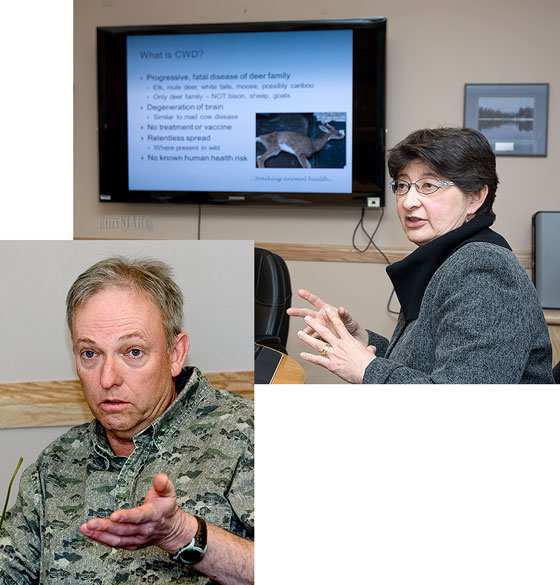
NO KNOWN CURE – CWD is a degenerative brain disease with no known cure nor vaccine, says Dr. Mary Vanderkop, Environment Yukon's chief veterinary officer, seen at Friday's media briefing. Kris Gustafson
Photo by Vince Fedoroff
NO KNOWN CURE – CWD is a degenerative brain disease with no known cure nor vaccine, says Dr. Mary Vanderkop, Environment Yukon's chief veterinary officer, seen at Friday's media briefing. Kris Gustafson
The Yukon government has implemented new rules to help protect the territory's deer populations from chronic wasting disease (CWD).
The Yukon government has implemented new rules to help protect the territory's deer populations from chronic wasting disease (CWD).
Members of the deer family or cervids, including deer, elk, caribou, and moose, killed outside the Yukon are now banned from entering the territory, with some exceptions.
Live cervids have been banned from entering the Yukon since 2011.
Meat, without bones, or portions of the carcass where the spinal column and head have been removed, are exempted.
So are finished taxidermy mounts, tanned hide, or raw hide in a protective container that will be tanned within five days of entering the territory.
Teeth are also exempt if they've been completely removed from the head, as well as antlers, with or without a skull cap, as long as there is no more hide or tissue.
Scent lures containing animal body fluids or tissue are also banned.
Cervids from the Northwest Territories or the two most northern hunting zones in British Columbia are also exempt from the new rules.
However, the Environment minister has the option to revoke this exemption immediately if the disease presents in either jurisdiction.
These new rules bring the Yukon's regulations in line with other jurisdictions, including Alaska, B.C. and Alberta.
Kris Gustafson, Environment Yukon's manager of enforcement and compliance, told a media briefing Friday the department's focus is on education at this point.
But eventually, a ticketing schedule will be developed for the new regulations.
CWD was first detected in Canada on an elk farm in Saskatchewan in 1996. And animals from Saskatchewan and Alberta are considered to present the highest risk of infection to Yukon species.
Similar to bovine spongiform encephalophathy, more commonly known as BSE or mad cow disease, CWD is a degenerative brain disease with no known cure nor vaccine, said Dr. Mary Vanderkop, Environment Yukon's chief veterinary officer.
Symptoms of the disease include weight loss, depression, difficulty swallowing and a change in behaviour.
It is spread by prions, abnormal proteins, spread through saliva, urine, or feces.
Prions can survive in the environment for extensive periods of time. They aren't destroyed by either sun or freezing temperatures, and become even more infectious when found in clay soils.
Once an environment is infected, it can't be disinfected.
Since 2005 in Alberta, there have been more than 100 wild deer detected positive for the disease.
They had a very aggressive culling program attempting to stamp out the disease, Vanderkop said.
The culling program led to more than 5,000 wild deer being killed. Eventually, the culling program was abandoned, but the disease occurrence did rise.
The disease is even more abundant in Saskatchewan, Vanderkop said.
While at this time, there is no evidence that the disease can spread to people or other deer predators, Health Canada recommends against eating meat from an infected animal.
Environment Yukon staff are encouraging voluntary submissions of animals for testing of the brain and lymph nodes.
"These new rules will help maintain Yukon's natural, healthy meat supply,” Environment Minister Currie Dixon said in a statement.
"It will also protect the economic interests of game farmers, outfitters and tourism operators.
"CWD has not yet been found in Yukon animals, and these rules will complement the current prohibition on importing live cervids to Yukon.”
The new rules will be set out in the 2013/14 Hunting Regulations Summary and can be viewed at www.env.gov.yk.ca.
In order to encourage thoughtful and responsible discussion, website comments will not be visible until a moderator approves them. Please add comments judiciously and refrain from maligning any individual or institution. Read about our user comment and privacy policies.
Your name and email address are required before your comment is posted. Otherwise, your comment will not be posted.
Be the first to comment