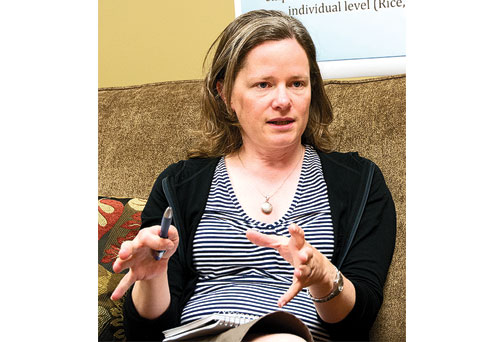
Photo by Whitehorse Star
Pictured Above: SHANNON RYAN
Photo by Whitehorse Star
Pictured Above: SHANNON RYAN
The Department of Health and Social Services has undertaken a new project to gather data on birth defects and provide better supports to families impacted by them.
The Department of Health and Social Services has undertaken a new project to gather data on birth defects and provide better supports to families impacted by them.
Across Canada, a need has been identified for better data on congenital anomalies, or birth defects, Shannon Ryan, a genetic counsellor with the department, said in an interview.
Data collection in the Yukon is currently inadequate, she said.
"Many of our births that go Outside tend to be high-risk births, so there's going to be a higher rate of birth defects in those births,” Ryan said.
"The data that's collected locally is collected at Whitehorse General Hospital, so we're not getting those outside births. We have an idea of those births here, but that isn't a complete picture,” she said.
"We just don't have a good handle on what is going on, because of the way the data is collected now, which isn't really adequate for a small population.”
The new program enables Health and Social Services to collect data on birth defects whether or not a child is born in the territory.
The project is based around referrals for public health appointments available to any woman or parents who have a child with a birth defect, or who may have miscarried or aborted due to a birth defect.
"We're offering to see those parents to discuss the birth defect, to talk about the birth defect itself, what it means, what they can expect,” Ryan said.
"Some birth defects, obviously, are more complicated than others, more complex, and might have more repercussions on the child's health or their development, so depending on what the defect is, we'll discuss it, discuss what they can expect, what services they should get hooked up to, what the recurrence risks are in a future pregnancy, and what you can do generally speaking to have a healthy pregnancy to reduce your risk of birth defects in general,” said Ryan.
Data on birth defects will be collected through the public health appointments with the consent of the parents.
But Ryan noted the appointment is still available, regardless of whether consent is given for data collection.
As of last week, Ryan hadn't had any referrals for a public health appointment, but she said they are only expecting 10 to 20 a year. The national rate of birth defects is about two or three per cent, she noted.
"We're hoping that we'll offer a more complete service to people locally, which they may have to go out for right now,” said Ryan.
"And down the line, once we've collected a fair bit of data and we can go back and look at rates and trends, one of the goals is to figure out what exactly the rates are up here.
"Are they higher, and is there anything in particular we need to put more focus on to try and lower that rate? We don't have a good handle on the specifics on birth defects that are happening right now.”
The department is also working with other jurisdictions and providing some information to the Canadian Congenital Anomalies Surveillance System helping to create a more comprehensive national picture.
In order to encourage thoughtful and responsible discussion, website comments will not be visible until a moderator approves them. Please add comments judiciously and refrain from maligning any individual or institution. Read about our user comment and privacy policies.
Your name and email address are required before your comment is posted. Otherwise, your comment will not be posted.
Be the first to comment