Photo by Vince Fedoroff
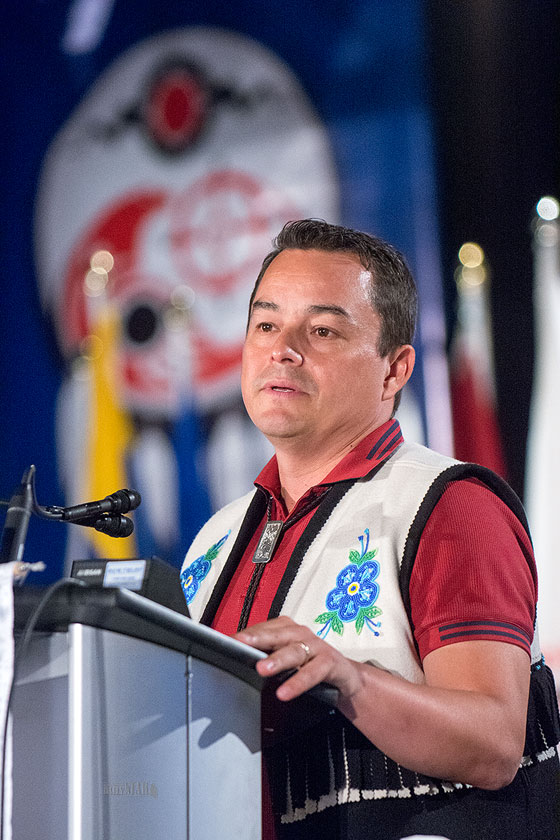
CLOSING REMARKS – AFN National Chief Shawn Atleo spoke of the need for unity during his closing speech at the Annual General Assembly yesterday.
Photo by Vince Fedoroff
CLOSING REMARKS – AFN National Chief Shawn Atleo spoke of the need for unity during his closing speech at the Annual General Assembly yesterday.
Shawn Atleo closed the Assembly of First Nations annual assembly the same way he opened it, with a call for unity.
Shawn Atleo closed the Assembly of First Nations annual assembly the same way he opened it, with a call for unity.
It's a message that has drawn national attention as a separate gathering of chiefs, calling for an alternative to AFN, took place in Saskatchewan concurrent to the meeting held this week in Whitehorse.
"Through all of our deliberations and discussions we're reminded that we're always stronger when we come together,” Atleo said during his closing speech yesterday afternoon at the Yukon Convention Centre.
"As I said at the outset, unity does not mean that we must walk the exact same path but that given our diversity we can find a way to move forward together towards a common destination, one where we all live and act on our rights, our title, and our treaties, where our children and families live in safe and secure communities.”
Atleo also envisions a destination where First Nations languages have been revitalized, where "songs are being composed and old ones being sung again and stories echo across our territories.”
Atleo's comments were followed by a personal message from a Vuntut Gwitchin elder.
Agnes Mills shared her experience of having to rebuild her sense of self as a First Nations woman after attending residential school.
She was seven when she was taken from her community.
"A lot of things happened to me and I was so ashamed of who I was I ran away after residential school for 50 years. That's how I ended up in Ontario,” she said.
But no matter how she tried, she couldn't escape her heritage. The First Nations people of Ontario made sure of it.
They helped her rebuild her self-esteem and helped her become proud once again to be Vuntut Gwitchin.
Along with her own story of healing, Mills had a few pieces of sage advice to share.
While the work is far from over, it's taken a lot to get First Nations and the AFN to where it is today, Mills noted. And she doesn't want to see the efforts of those who came before the current leaders forgotten.
"I'm here today to tell you that I have a lot of hope for our people,” she said.
"We need to deal with our people in jail and people at the hospital and the justice, we can't forget that. But above all you have to support the elders, we have to support the elders, we work hard and often times we're up against not just people in power but also our own people in our communities, don't forget your elders, don't forget all those people that got you here today,” she urged.
During his speech, Atleo also spoke to the value of elders, expressing in particular his admiration and respect for Alex Van Bibber, as he recognized Nelson Mandela's 95th birthday.
The national chief told the gathering how at 97 years old, Van Bibber is still out on the land teaching youth their traditional hunting and trapping ways.
Over the course of the four-day assembly 19 resolutions were passed, including an emergency resolution condemning the nutritional testing that was conducted on aboriginal children at residential schools.
The resolution was in direct response to a recently published research paper that revealed how aboriginal communities and children were used in nutritional experiments by leading researchers in cooperation with the government.
According to the research conducted by Ian Mosby, the experiments involved at least 1,300 children.
The resolution, which was passed both unanimously and passionately, condemned the experiments and confirmed that the revelation of the experiments demonstrate a pattern of genocide against aboriginal people at the hands of the crown.
It continues to say that the assembly will not accept the federal apology as a "catchall recognition” for all past and present federal policy that negatively impacts aboriginal people and calls on the federal government to provide full access to all records it holds regarding the experiments.
The resolutions asks Canada to develop a fair compensation system for survivors who suffered emotionally and physically from these experiments and to collaborate with provincial governments to develop curriculum to educate Canadians about the experiments.
Another resolution passed confirmed support for the Ross River Dena Council court case condemning free entry mining. It also directs the national chief and executive to support and advocate for a joint reform process of provincial and territorial mining legislation across the country.
Other resolutions ranged from support for advancing a national action plan to end violence against indigenous women and girls to the establishment of a First Nation leaders committee on investment.
In order to encourage thoughtful and responsible discussion, website comments will not be visible until a moderator approves them. Please add comments judiciously and refrain from maligning any individual or institution. Read about our user comment and privacy policies.
Your name and email address are required before your comment is posted. Otherwise, your comment will not be posted.
Comments (1)
Up 0 Down 0
joanna smith tait on Jun 24, 2017 at 6:25 pm
Hi, I'm trying to connect with Agnes Mills. Could you please ask her to contact me at the above email? Thanks so much, Joanna