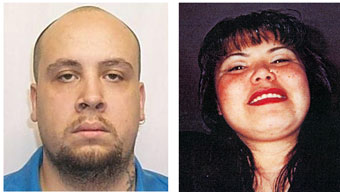
Photo by Whitehorse Star
Norman Larue and Christina Asp
Photo by Whitehorse Star
Norman Larue and Christina Asp
"When there's a problem that can't be solved, I'm the final solution.”
"When there's a problem that can't be solved, I'm the final solution.”
That's how the latest undercover police officer to testify at the Norman Larue murder trial described his role in the faux criminal organization police created to gather evidence.
The officer, who cannot be identified because of a Yukon Supreme Court order, began testifying Monday at the Yukon Supreme Court murder trial.
He was expected to continue testifying today.
The Crown is alleging Larue, 30, and his then-girlfriend Christina Asp, attacked 63-year-old Gordon Seybold in his Ibex Valley home in March 2008, before burning the cabin to the ground.
The fire destroyed much of the physical evidence, leading police to use an undercover technique known as a Mr. Big-style investigation.
Asp and Larue were led to believe the undercover officers were members of a powerful criminal gang with the ability to cover up crime.
The undercover operation, dubbed Project Monsoon, focused on Asp for months while Larue was in prison.
Officers convinced her she had been accepted into the gang and recorded many alleged confessions of what she told them happened on the night Seybold died.
By the end of July 2009, when Larue was released into a Calgary half-way house, he got a chance to meet with all of his girlfriend's new business associates.
This latest officer to give testimony first appeared as the bodyguard for the organization's powerful leader.
Later, he began giving her more information on his background, including that he was ex-military and now worked for the family.
This would be the officer with whom Larue would eventually seek a job, the court heard.
Through Asp, police insinuated that the bodyguard needed help with his computer which he used to keep in touch with clients, and possibly other work.
Most of Monday was spent hearing from another officer who portrayed the second-in-command of the organization.
The officer described sitting in a Calgary park with Larue discussing the possibility of filling that job.
On the recordings, Larue can be heard telling the officer he has other skills besides with computers.
He can be "muscle” he says.
"Can I be honest with you?” he asks in one clip. "I'm a lot better with muscle than computers.”
If the organization needs anything, Larue says he's willing to help, but asks that Asp be kept away from that work.
The officer assures him that Asp does not need to know.
He then proceeds to talk to Larue about his "Yukon problem.”
He tells Larue the family has already gone to the Yukon to look after things, and that he is "confident what Christina has told me is looked
after.”
Larue tells the officer about what he says happened to Seybold, but not before asking: "You're not law enforcement?”
The police officer assures him he is not.
The recording is often interrupted by outdoor noises, including planes,
Larue says Seybold disrespected his family and that his mother-in-law asked him "to take care of it.”
Jessie Asp has already testified she had no role in Seybold's death.
Larue tells the second-in-command he was just going to go to Seybold's by himself, but needed to take Asp for directions.
He tells the officer he beat Seybold "f-----g bad,” and "Christina hit him a couple times.”
After burning the place down, he tells the officer, they went to a rest stop and got rid of the bat, and guns from Seybold's house.
They drove back to Whitehorse, stripped off all their bloody clothes and later burned them.
During cross-examination of the officer who played second-in-command, Larue's lawyer, Ray Dieno, criticized the undercover technique.
He particularly focused on the demeanor of the officer playing the muscle, pointing out that early in the operation, he was just seen as a mysterious bodyguard.
"He just walked around looking like he could pop a cap in your ass if you hurt (the organization's leader).”
The officer agreed that the organization was portrayed to have a lot of power, but denied they ever said outright that they kill people.
The lawyer repeatedly suggested that's what officers were insinuating, even if they didn't use those exact words.
Asp has refused to testify in the case. She has already been convicted for her role in Seybold's death.
The officer who played the bodyguard was expected to continue his testimony today.
In order to encourage thoughtful and responsible discussion, website comments will not be visible until a moderator approves them. Please add comments judiciously and refrain from maligning any individual or institution. Read about our user comment and privacy policies.
Your name and email address are required before your comment is posted. Otherwise, your comment will not be posted.
Be the first to comment