Photo by Sabrina Ayotte
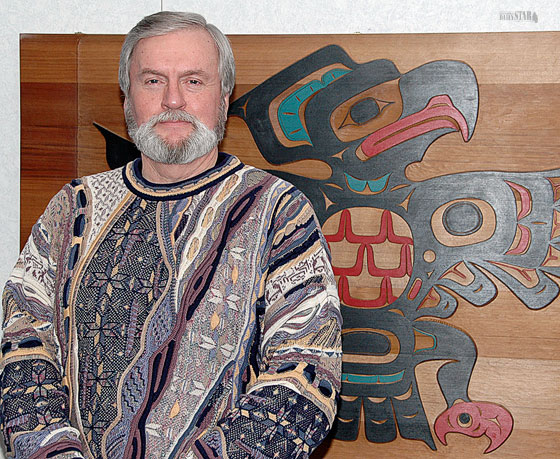
Brooke McNabb, vice-chair of the Commission for Public Complaints Against the RCMP, is seen at the Skookum Jim Friendship Centre in Whitehorse on Thursday.
Photo by Sabrina Ayotte
Brooke McNabb, vice-chair of the Commission for Public Complaints Against the RCMP, is seen at the Skookum Jim Friendship Centre in Whitehorse on Thursday.
The vice-chair of the Commission for Public Complaints Against the RCMP (CPC) was in Whitehorse Thursday as part of a cross-country tour designed to improve communications and build relationships with first nations communities.
The vice-chair of the Commission for Public Complaints Against the RCMP (CPC) was in Whitehorse Thursday as part of a cross-country tour designed to improve communications and build relationships with first nations communities.
Brooke McNabb, who's been vice-chair of the CPC since his appointment in October 2005, made an appearance at Skookum Jim's Friendship Centre Thursday morning. That was followed by meetings with local media and the RCMP Whitehorse detachment in the afternoon.
McNabb said his cross-country tour, which will take him to friendship centres in Yellowknife, Prince George, B.C., Cold Lake, Alta., Portage la Prairie, Man., and Happy Valley Goose Bay, NL, as well as Whitehorse, has several purposes, the primary one being outreach and awareness.
"Parts of Canada don't even know the CPC exists," the Ottawa-based McNabb said in an interview.
He explained that the National Association of Friendship Centres (NAFC) and the CPC collaborated to form an outreach pilot project which aims to improve public awareness of the CPC, particularly in first nations communities.
"They didn't feel they were part of the CPC process," said McNabb. "We want to make better connections in the communities.
"It's in everyone's interest to resolve (policing) issues, otherwise the issues undermine public confidence."
McNabb said 60 per cent of Canadians do not feel comfortable approaching their local RCMP detachment with policing
concerns, and he said that number is probably higher in first nations communities.
"(The tour) is a vehicle to explain the CPC to aboriginal communities, and other minorities," said McNabb.
Happy Valley Goose Bay, for example, has a large Inuit population, he noted.
McNabb said staff at the friendship centres will receive training about the CPC, enabling them to keep members of the first nations communities informed about the complaints process.
"In addition to concrete referral practices and contacts, staff members will be provided with written material, i.e. brochures to use and give to community members as needed," said a press release about the outreach pilot project.
If the pilot project is successful, said McNabb, the NAFC and CPC may collaborate again and pursue another outreach project aimed at more of the 120 friendship centres across Canada.
"We're not here because there are problems," said McNabb. "We just want to make improvements."
A complainant can either contact the local detachment or the CPC directly with their concerns.
McNabb said 95 per cent of complaints against the RCMP can be resolved informally.
Most complaints occur because of a misunderstanding, said McNabb. Once the RCMP and the complainant have a chance to communicate, an incident can usually be resolved, he said.
McNabb encouraged community members to come forward if they have any concerns about policing.
"If they let these things fester, they just get worse," said the lawyer and former Ottawa television news anchor.
If a complaint cannot be resolved informally, a formal process must be invoked, said McNabb.
This means that the CPC will compile a report from the complainant, which should include as many details about the incident as possible such as who was involved, when and where the incident happened, and what the circumstances were.
The CPC will forward the report to the local RCMP detachment, which will interview witnesses and consider evidence as part of its investigation.
If a complaint is serious enough, said McNabb, the RCMP may consult its Code of Conduct to determine an appropriate disciplinary action, or even lay criminal charges.
But enforcing disciplinary action is not within the CPC's jurisdiction, said McNabb.
"The CPC is remedial," he pointed out. "We try to prevent (harmful incidents) from happening again."
The CPC is a civilian organization, McNabb added, and not a branch of the RCMP.
The CPC receives about 2,000 complaints per year, said McNabb, and about 200 of those complaints are formally reviewed.
The nature of the complaints range from complaints about speeding tickets, to insufficient investigation into a dispute, to more serious complaints about denied Charter rights, excessive force or Taser use.
The "vast majority" of complaints are about less serious matters, said McNabb.
McNabb said that 80 per cent of complaints are resolved within 120 days, usually after a complaint is withdrawn or an informal agreement is reached.
There's been a 20 per cent increase in the number of complaints the CPC receives in the last two years, said McNabb.
He said it would be purely speculative to offer an explanation for the increase.
In the case of Robert Dziekanski's death at Vancouver International Airport in October 2007, McNabb said CPC staff were on the scene within 24 hours to provide an impartial observer to the investigation.
The Yukon is no stranger to serious complaints filed against RCMP officers. Charges of assault causing bodily harm laid against two Whitehorse RCMP officers were stayed in June 2005.
The factors surrounding the stayed charges were unknown because the proceedings took place in a closed courtroom.
Also in 2005, an RCMP officer in Dawson City served a three-month probational term after assaulting a woman while off-duty.
Another RCMP officer paid a $1,000 fine that year for careless driving.
In order to encourage thoughtful and responsible discussion, website comments will not be visible until a moderator approves them. Please add comments judiciously and refrain from maligning any individual or institution. Read about our user comment and privacy policies.
Your name and email address are required before your comment is posted. Otherwise, your comment will not be posted.
Be the first to comment