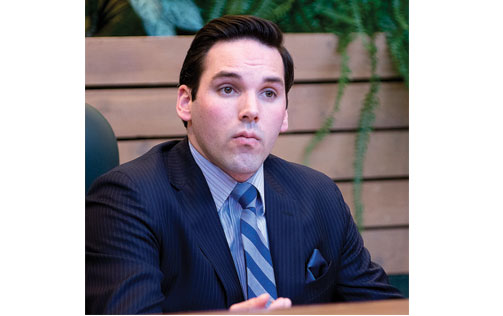
Photo by Whitehorse Star
Pictured ABove: CURRIE DIXON
Photo by Whitehorse Star
Pictured ABove: CURRIE DIXON
More people, economic activity cited in GHG rise
The Yukon's greenhouse gas (GHG) emissions increased by 10 per cent between 2010 and 2011, reaching 0.374 megatonnes, according to the 2014 Yukon State of the Environment Report.
That accounts for 0.05 per cent of Canada's total GHG emissions and represents a 30 per cent reduction from the territory's 1990 levels.
Yukoners account for approximately 0.001 per cent of Canada's population.
Environment Minister Currie Dixon said today the increase from 2010 is attributable to a growing population and more economic activity.
In 2013, the Yukon's average annual temperature was 1.6 degrees C higher than the average annual temperature from 1948 to 2013 – making last year the 10th warmest year the territory has seen since 1948.
The transportation sector continues to contribute the largest share of GHG emissions.
The report notes "it is challenging to reduce GHG emissions in Yukon because of the high energy input required to live long distances from production centres and to heat buildings during cold winters.”
Speaking in an interview this morning, Kate White, the NDP's Environment critic, said the report reaffirms what we already know, and reminds us that we need to be more proactive in our goals.
"This gives the government a good opportunity to say they're switching to LNG for backup, so that's better, but I disagree. I think we should be concentrating on renewables,” said White.
"The City of Whitehorse is doing a fantastic job (trying) to increase bus ridership, but what is the territorial government doing to minimize their own impact? What are we doing with fleet vehicles?
"If they're ones that are just travelling within certain jurisdictions, why aren't we looking at electrical cars?” she questioned.
Dixon said an important first step was to begin monitoring and reporting on transportation emissions.
"It's a difficult issue because we live in a northern remote area where we rely on so much of the goods coming up the highway and trucked into the Yukon or transported here by other means, and that means that we're dependent on transportation and it's a difficult issue to tackle,” he said.
"I can't tell you that I have a set of actions that's going to dramatically reduce transportation emissions but it is something we're trying to get our heads around and we're trying to find options for.”
The minister did say the government has taken some initiatives to green its fleet vehicles, and has some low-emission vehicles. He noted though that for highway crews, there aren't that many alternatives.
Some jurisdictions in the U.S. and Canada have transitioned to natural gas for larger vehicles as a way to reduce emissions compared to diesel, but that's not something the Yukon is considering at the moment.
On heating and electricity generation, Dixon said the government will always need a fossil fuel back-up.
"It's the only reliable, flip of the switch source of electricity that is out there,” he said.
"That being said, we are planning for additional energy...we've taken the early steps to develop a new hydro project in the territory to increase our supply of renewable energy in the territory.”
He noted the government has also released a micro-generation policy and is developing an independent power producer policy which will allow for smaller renewable projects.
More than 95 per cent of the Yukon's electricity is produced by hydro, so "we're in a strong position already,” he said.
White also raised other concerns regarding the lack of data available on the Yukon's groundwater – an issue she's spoken to in the house following expert presentations to the select committee on hyrdaulic fracturing.
"How is it possible that in a territory where water is so critical and we've got all this development looming behind us, how come we're not getting a better handle on ground water?” she asked.
The territory has eight groundwater monitoring sites, compared to 741 active surface monitoring sites and 698 discontinued surface monitoring sites.
Dixon said the upcoming water strategy will address that knowledge gap surrounding groundwater.
"We're looking to improve our understanding of the groundwater in the Yukon, so we're going to be doing increased levels of groundwater monitoring, although I can't speak on the details yet because (the strategy) hasn't been approved,” he said.
The minister also wished to highlight the increase in protected lands compared to last year's report. The Yukon now has just under 17 per cent of its land classified as protected.
"That puts us far and away the first in the country. We protect more of our land mass than any other province or territory in the country, and we're very proud of that,” he said.
In order to encourage thoughtful and responsible discussion, website comments will not be visible until a moderator approves them. Please add comments judiciously and refrain from maligning any individual or institution. Read about our user comment and privacy policies.
Your name and email address are required before your comment is posted. Otherwise, your comment will not be posted.
Comments (5)
Up 5 Down 1
DMZ on May 13, 2014 at 3:03 pm
What was happening in 1990?
Up 6 Down 0
Wundering on May 13, 2014 at 11:43 am
Environment Minister Currie Dixon said today the increase from 2010 is attributable to a growing population and more economic activity.
And what is Canada and every Nation in the world doing? Trying to increase economic activity and grow their population.
Good Luck!
Up 3 Down 9
NorthernMike on May 13, 2014 at 9:10 am
"That puts us far and away the first in the country. We protect more of our land mass than any other province or territory in the country, and we're very proud of that,” Dixon said…
Yeah, but density wise, at only representing 0.001 per cent of Canada's population, not like it's tough to achieve such a feat. Currie, don't be thinking you're some sort of saint or you had anything to do with protecting anything when it comes to the environment. We are selling this territory for peanuts.
Up 3 Down 25
June Jackson on May 13, 2014 at 7:52 am
GO! Kate!!! The groundwater tells the whole story. Stay the course Kate!
Up 24 Down 5
Francis Pillman on May 13, 2014 at 7:46 am
Show me the instrument you use to come up with these numbers. Oh wait, they are all made up. Please tax me more for your imaginary pollution.